Good Reason

It's okay to be wrong. It's not okay to stay wrong.

Category: religion (page 34 of 36)

Latest addition to the growing reading list

Funny how I hear a lot of people saying “I’m no fan of Hitchens, but…”

Yes, there’s a lot not to like about Christopher Hitchens. He was for the Iraq War, he acts boorish on chat shows, and one gets the impression that if he were to do the voicework on his own audiobooks, half of it would be incomprehensibly slurrred.

But the guy writes like a champ, and so I’m glad to see him add his weight to the recent wave of New Atheist books. Check the Slate excerpt from ‘God is Not Great: How Religion Poisons Everything’.

The mildest criticism of religion is also the most radical and the most devastating one. Religion is man-made. Even the men who made it cannot agree on what their prophets or redeemers or gurus actually said or did. Still less can they hope to tell us the “meaning” of later discoveries and developments which were, when they began, either obstructed by their religions or denounced by them. And yet—the believers still claim to know! Not just to know, but to know everything. Not just to know that god exists, and that he created and supervised the whole enterprise, but also to know what “he” demands of us—from our diet to our observances to our sexual morality. In other words, in a vast and complicated discussion where we know more and more about less and less, yet can still hope for some enlightenment as we proceed, one faction—itself composed of mutually warring factions—has the sheer arrogance to tell us that we already have all the essential information we need. Such stupidity, combined with such pride, should be enough on its own to exclude “belief” from the debate. The person who is certain, and who claims divine warrant for his certainty, belongs now to the infancy of our species. It may be a long farewell, but it has begun and, like all farewells, should not be protracted.

The other excepts, in which he deals with Islam and Mormonism summarily, are worth a read.

The week in Religion

The Catholic doctrine of limbo looks set to evaporate.

Pope Benedict XVI has reversed centuries of traditional Roman Catholic teaching on limbo, approving a Vatican report released Friday that says there were “serious” grounds to hope that children who die without being baptized can go to heaven.

This says volumes about science and religion, and the kind of evidence that people are trained to accept. When a scientist says there are ‘serious grounds’ to accept an idea, it means there’s some kind of evidence that other people can examine. When a religious leader says there are ‘serious grounds’ to accept an idea, it means ‘he thinks so’.

But here’s the problem: either people need to get baptised, or they don’t. If they do, then unbaptised babies and heathens are getting shut out of heaven. If these people can somehow get in without baptism, then there can be no entry requirements to get into heaven, not even being Catholic.

I just hope the parents of Edgar Mortara would be posthumously pleased that the doctrine that sanctioned their child’s kidnapping is now considered peripheral.

Veterans can now have a Wiccan symbol on their headstone.

Wicca is silly, but no more than other religions. I hate that it pretends to be older than it is, but at least it accidentally promotes a good idea once in a while. And that the US military wouldn’t (but now does) allow their silly symbol to be on headstones like all the other silly religious symbols was just… silly.

But is the Wiccan symbol the silliest? Of course not. That would be either the Atheist symbol or the Happy Humanist symbol. But you can see them all and decide for yourself.

Religion is good for kids, says Fox News

Unfortunately, Fox News is bad for kids. So are poorly-designed studies.

John Bartkowski, a Mississippi State University sociologist and his colleagues asked the parents and teachers of more than 16,000 kids, most of them first-graders, to rate how much self control they believed the kids had, how often they exhibited poor or unhappy behavior and how well they respected and worked with their peers.

Perhaps that should read: Religious parents underestimate the behavioural problems of their children.

In praise of Biblical ignorance

It’s been noted that many people who identify as Christian have an abysmal knowledge of what’s actually in the Bible. No surprises there; scriptures are rich texts with multiple interpretations, so church-goers are generally much more knowledgable about their church’s interpretation of scripture than of scripture itself. Take it, Dr Prothero.

In a religious literacy quiz I have administered to undergraduates for the last two years, students tell me that Moses was blinded on the road to Damascus and that Paul led the Israelites on their exodus out of Egypt. Surveys that are more scientific have found that only one out of three U.S. citizens is able to name the four Gospels, and one out of 10 think that Joan of Arc was Noah’s wife. No wonder pollster George Gallup has concluded that the United States is “a nation of biblical illiterates.”

For a particularly funny (or rank) example, check this clip of Georgia Congressman Lyn Westmoreland, who sponsored a bill to require a display of the Ten Commandments in federal buildings, and yet found himself unable to name more than three of them.

Okay, so people don’t know about the Bible. Whatever to do about it? Two ideas. a) Nothing, and b) Divert educational resources toward teaching the Bible in schools, for some reason. Let’s see what this author opts for.

One solution to this civic problem is to teach Bible classes in public schools.

Door number two. Surprise, surprise.

We already have huge buildings whose purpose is the teaching of the Bible. They’re called CHURCHES! Churches! You can go to a church and find out everything you’d like to know about the Bible. If even people who go to church aren’t getting it, this tells me that churches are falling down on the job. Perhaps they could work on that, instead of invading public schools to make them more Jesusy.

But here’s an argument:

Biblical illiteracy is not just a religious problem. It is a civic problem with political consequences. How can citizens participate in biblically inflected debates on abortion, capital punishment or the environment without knowing something about the Bible? Because they lack biblical literacy, Americans are easily swayed by demagogues on the left or the right who claim — often incorrectly — that the Bible says this about war or that about homosexuality.

Ooo, some tempting bait. Indeed, (you’re meant to think) perhaps if people were better informed about the Bible, they’d come around to a sensible way of thinking, instead of believing people who say that the Bible says things in favour of war, against homosexuality, and for the death penalty.

Except you know what? Last time I checked, the Bible actually did have verses that said all those things. And you know what else? It also had verses against all those things too. At least, according to someone’s interpretation. Well-educated scriptorians do not necessarily come to agreement on scripture. Like I say, scriptures are rich texts that can be enlisted to support just about any view. Vegetarianism? Slavery? Polygamy? Alcohol? No alcohol? It’s in there.

Oh, and of course, the Bible is the only book that deserves The Public School Treatment. Why?

[T]he Bible is of sufficient importance in Western civilization to merit its own course. Treating it no differently from, say, the Zend-Avesta of the Zoroastrians or Scientology’s Dianetics makes no educational sense.

Usually op-ed writers are better at concealing their biases. Not here. Eyeroll of the week.

No, the best way to avoid bad scriptural arguments is to avoid scriptural arguments altogether. They contribute nothing to a factual discussion. Instead, let’s try to settle public policy questions somewhat pragmatically. We need to focus on what outcomes we’d like to see, and then try to find out what will bring those about. And check out what’s happened elsewhere to see if it worked. Maybe it won’t much easier without the Bible than with it. Maybe we won’t even be able to agree on outcomes. But we may get a little farther then we’re getting now when we drag mythology into the discussion. The process won’t be helped with the inclusion of made-up opinions purportedly from a magical man.

There’s nothing wrong with ignorance of the Bible when the Bible lends itself to biased and ignorant interpretations.

UPDATE: Still don’t think you can find anything you want in the Bible? Here’s Michael Medved to tell you why the Bible says it’s wrong to give to the poor.

Leviticus 19:15 declares: “You shall not commit a perversion of justice: you shall not favor the poor and you shall not honor the great, with righteousness shall you judge your fellow.”

It should, indeed, come as a revelation and a rebuke to all liberals that Holy Scripture identifies “favoring the poor” as “a perversion of justice.”

As I argued in my recent townhall column about the essence of liberalism (posted on March 21st), the outlook of the left insists upon favoring the poor and the unfortunate—and thereby injecting unfairness and discrimination into the very core of politics and government.
Evidence for Exodus

Interesting article from the NYT on this Easter holiday:

Did the Red Sea Part? No Evidence, Archaeologists Say

It didn’t look like much — some ancient buried walls of a military fort and a few pieces of volcanic lava. The archaeologist, Dr. Zahi Hawass, often promotes mummies and tombs and pharaonic antiquities that command international attention and high ticket prices. But this bleak landscape, broken only by electric pylons, excited him because it provided physical evidence of stories told in hieroglyphics. It was proof of accounts from antiquity.

That prompted a reporter to ask about the Exodus, and if the new evidence was linked in any way to the story of Passover. The archaeological discoveries roughly coincided with the timing of the Israelites’ biblical flight from Egypt and the 40 years of wandering the desert in search of the Promised Land.

“Really, it’s a myth,” Dr. Hawass said of the story of the Exodus, as he stood at the foot of a wall built during what is called the New Kingdom.

It’s a bit difficult to imagine what evidence there could be for this kind of event. Wave fossils? Sedimentary chariots?

I’m a bit more interested in the idea that the Hebrews were never in Egypt at all. One linguistic argument is that if they had been, we should expect to see lots of Egyptian loan words in Hebrew, and we don’t. From the Catholic Encyclopedia:

[N]otwithstanding the long sojourn in Egypt, the number of Egyptian words that have found a place in the Hebrew vocabulary is exceedingly small.

This is probably something I’ll be posting on more as I learn more about it.

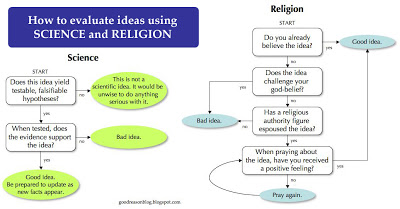
Science v religion

With apologies to Wellington Grey, here’s a comparison of how to evaluate ideas using science versus religion.

Click the image to enlarge in a new window.

Open Thread for family members re: Daniel’s atheism

Since I’ve already come out as an atheist to my family members, you wouldn’t think the contents of Good Reason would be much of a surprise to them. However, at least one has reacted with dismay as the extent of my rejection of theism has become apparent.

So this is an open thread where family members who have recently found the blog can chat, discuss, fulminate, or cajole. Other readers are also invited to share their experiences (from either side) of family and faith or non-faith.

I’ll start.

When people identify closely with a religion that emphasises family, the rejection of the shared values of the religion seems to entail a rejection of family. Allow me to assure you that this is not the case. I love you guys, and I’m grateful to have the family I do. My decision to follow the evidence instead of feelings has not been an easy one. However, as I’ve come to understand the frailty of human perception and the workings of reason, I’m convinced that the evidence as we have it points overwhelmingly to a lack of gods. I’m aware that this view has caused some pain to my Mormon family members, who view religion as the way to return to God and live together as a family forever. But I’m confident in saying that, on the pain scale, no one has been more affected than myself, as I have abandoned a belief system that I had faithfully followed and invested heavily in all my life. At the same time, being an ethical atheist is a noble thing, and part of a long and honourable tradition. I can explain things I couldn’t before. The candle of reason is small, but it shines brightly, and illuminates warmly.

Feel free to share your thoughts and feelings by clicking on the ‘number of comments’ link.

Swearing class observations

The swearing class has wrapped. I have to say, it was a lot of fun to teach. Part linguistic dissection, and part rowdy storytelling.

The students made a lot of interesting observations. One student, a mother, related her children’s reaction when she told a salacious joke over dinner. From anyone else, the kids would have enjoyed it, but from Mom it was an absolute clanger. It made me reflect on the social aspect of language. To other people, we seem to be these bundles of expectations. When we step outside the expectations of others, social incongruity is sure to follow.

Most of the words we consider ‘dirty’ were once matter-of-fact terms, with no inherently obscene connotations. These words wouldn’t become taboo until the Puritan crackdown of the 1600s. Insults are an exception. One gentleman researched the epithet ‘raghead’, and found that it dated from British involvement in India, recently dusted off and used for Muslims. In many ways, the class was a chance to see the sad history of how we torment each other with our words.

Even more sobering for me was a discussion of how blasphemy was punished in Colonial America.

2. If any pson wthin ye Province professing ye true God shall wittingly and willingly presume to blaspheme the wholly name of God, Father, Son or Holy Ghost, wth direct, express, presumptions or high-handed blasphemy, either by willful or obstinate denying ye true God or his creation or Governmt of ye world, or shall curse God, Father, Son, or Holy Ghost, such pson shall be put to death. Levit. 24: 15 and 16.

Now imagine that. A capital offense, and you didn’t even have to swear. All you had to do was, in essence, be an atheist.

I hope this is enough to disperse the lie that America was established as a land of religious liberty. America was established by Puritans, a bunch of religious froot-loopers so fanatical that no one else could stand them. They happily bored awls through people’s tongues, branded their foreheads with a B, and killed them for using certain God-words outside of a religious context. How many people were tortured and killed for their words and opinions in order to assuage the Biblical god?

America wouldn’t become a land of religious liberty until a bunch of free-thinkers, deists, agnostics, and atheists established the Constitution and dragged the nation out of the muck of Puritanism.

Finally, to my Christian readers: when you hear people arguing that America is a Christian nation (as they seem to), ask yourself if this is the kind of Christianity you want. There are many types, and you may not get to select your favourite flavour. In view of the punishments mentoned above, the wall of separation between church and state starts to look better and better.

People of faith

Part one:

A Pakistani minister and woman’s activist has been shot dead by an Islamic extremist for refusing to wear the veil.

Zilla Huma Usman, the minister for social welfare in Punjab province and an ally of President Pervez Musharraf, was killed as she was about to deliver a speech to dozens of party activists, by a “fanatic”, who believed that she was dressed inappropriately and that women should not be involved in politics, officials said.

The gunman, Mohammad Sarwar, was overpowered by the minister’s driver and arrested by police. A stone mason in his mid 40s, he is not thought to belong to any radical group but is known for his fanaticism. He was previously held in 2002 in connection with the killing and mutilation of four prostitutes, but was never convicted due to lack of evidence.

Mr Sarwar appeared relaxed and calm when he told a television channel that he had carried out God’s order to kill women who sinned. “I have no regrets. I just obeyed Allah’s commandment,” he said, adding that Islam did not allow women to hold positions of leadership. “I will kill all those women who do not follow the right path, if I am freed again,” he said.

Part two:

We need to have a person of faith lead the country.

Mitt Romney, 17 February 2007

Was there ever a man of more unshakable faith, of greater moral certainty than Mohammad Sarwar?

You think your job sucks.

Just be glad you’re not a Republican running for U.S. President.

First of all, you’re horrendously unpopular, with self-reported Republican identification the lowest in years. Then you have to Defend the Indefensible and argue for escalation of the war in Iraq/Iran/Syria. I mean, maybe you’re a sensible person and maybe you can even count, and you’d like to take some positions that Americans actually agree with, so already you’re a little edgy.

Then you have to take a position like this:

Republican presidential candidate John McCain, looking to improve his standing with the party’s conservative voters, said Sunday the court decision that legalized abortion should be overturned.

“I do not support Roe versus Wade. It should be overturned,” the Arizona senator told about 800 people in South Carolina, one of the early voting states.

Suicide! I seem to remember that Roe vs. Wade is immmensely popular, and has been for, oh, about 30 years.

CNN/Opinion Research Corporation Poll. Jan. 19-21, 2007. N=1,008 adults nationwide. MoE ± 3.

“Would you like to see the Supreme Court overturn its 1973 Roe versus Wade decision concerning abortion, or not?”

Would: 29
Would Not: 62
Unsure: 9

Yes, that’s about right. So why run against that? Oh.

McCain is trying to build support among conservatives after a recent rebuke from Christian leader James Dobson, who said he wouldn’t back McCain’s presidential bid.

Tsk.

So after kissing Dobson’s shiny white ass, followed by Robertson’s, Swaggart’s, and probably Haggard’s (but that one’s on your own time), you’re still not done. You have to cap off the evening by doing something really Christian, like attending a purity ball, or…

McCain later attended an evening rally promoting an abstinence program.

Yeah, something like that.

He told the crowd of more than 1,000 teens and parents that young people have pressures far different from the ones he faced while growing up. “Sometimes I’ve made the wrong choice,” McCain said.

So, that’s a ‘no’ on abstinence? I think I need a less ambiguous comment on that.

I wonder what it must be like for the Republican candidates. To ignore the vast majority of Americans so you can court the vote of the most freaked-out minority just seems nuts. It would drive me crazy. But then, I’m not masochistic enough to be a Republican.

And another thing: Whose (the fuck) business is it anyway that you took a tumble in the hay with Mary Lou in 1955? Imagine having to flagellate yourself publicly over it at an abstinence rally in 2007. Unbelievable!

Here’s me at the rally: Kids, we got it on! And it was great! I don’t regret it for a second! We were young and gorgeous, and our skin was soft yet firm. I’ll never boink an eighteen-year-old woman again, and it’s one of my choicest memories.

No wonder they don’t vote for atheists. Mom and Dad and Grandma wouldn’t have liked that part of my speech.

The false gatekeeper

There’s this argument out there that atheists aren’t moral. Maybe you’re one of those rare atheists who can manage to restrain yourself from looting and pillaging despite your lack of belief in divine retribution. Maybe you’re even kind and good, and return library books on time. Are you then a moral person?

Not according to the author of this essay: ‘The Lie of Moral Atheism’. See, you’ve rejected God, the source of all goodness and morality. How could anything you do be ethical? What you’re doing must be something else besides ethics.

When secular humanists, agnostics, nontheists, and atheists reject God and yet claim to be moral and ethical, they are first lying to themselves. If they reject the origin of truth, morality and ethics, their version of truth and morality can only be a subjective counterfeit. Trouble is, this brand of moral relativism is being taught wholesale throughout the country. And the atheists are organizing to get more of it. Proverbs 22:6 says, “Train up a child in the way he should go: and when he is old, he will not depart from it.” All the more reason the Bible should be used as a textbook in every school.

Buh. Duh. Guh. Must… fight… non sequitur

I’m fine now. They tried to hit me with a Confusion Attack. Good thing I had 20 health and rolled a six, or that could have been serious.


Dear God, please let them not see through the faulty reasoning, at least not until the checks are cashed.

I’ve noticed a strategy that religious belief systems use to survive. They piggyback onto life milestones, and act like they own them. These are:

  • birth, which religions co-opt with ceremonies like baptism or blessing
  • adulthood (or young adulthood), commemorated in bar mitzvahs and first communions. In LDS culture, this finds expression in priesthood (for boys) and missions (a later adulthood ritual)
  • marriage, which serves as a symbol for the beginning of long-term relationships
  • death, with its funerals and last rites

And then basic moral goodness, as in our example above.

The ceremonies are usually nice, and people like them. But because religions have set up shop around these basic parts of human life, it becomes difficult for believers to imagine the event occurring (or being done properly) in the absence of the ceremony. Yet parts of the life cycle, like birth, death, mating and the like have been around for as long as there have been organisms. It’s unnecessary for religions to come and claim them with ceremonies. It’s like if I tried to set up a booth at the public library and charge admission.

Seen this way, religious belief systems act as parasites on life’s great moments. Allowing religion to claim them gives it strength that it hasn’t earned. And the parasite will always want more. Let ’em have marriage, and they’ll be claiming honesty and decency, and probably punctuality besides. Let ’em have those, and they’ll be coming for gravity.

Older posts Newer posts

© 2026 Good Reason

Theme by Anders NorenUp ↑