Good Reason

It's okay to be wrong. It's not okay to stay wrong.

Category: religion (page 33 of 36)

Hey, guys, don’t fight! You’re both insane.

Brownback and Huckabee trading barbs over whose religion is better is like watching clowns whacking each other with big fish, but slightly less entertaining.

[A] pitched battle has broken out involving two lesser-known candidates who are trading accusations of religious bigotry and hypocrisy. The battle has become the most heated and personal rivalry in the Republican field.

The current tensions stem from an e-mail message sent to two Brownback supporters by Rev. Tim Rude, the pastor of an evangelical church in Walnut Creek, Iowa. In the message, Mr. Rude, a Huckabee volunteer, compared the religious backgrounds of Mr. Huckabee, a Baptist pastor, and Mr. Brownback, who is Roman Catholic.

“I know Senator Brownback converted to Roman Catholicism in 2002,” Mr. Rude wrote. “Frankly, as a recovering Catholic myself, that is all I need to know about his discernment when compared to the Governor’s.”

While it’s refreshing to see the term ‘recovering Catholic’ in print, I’ll just put something out there that I’ve been thinking for a while: Insane people hate competing insanities. I mean, both Huckabee and Brownback put their hands up as evolution deniers in a debate. They’re both religious nutters. Why can’t they get along?

Bibles in newspapers

I noticed this:

Everything from detergent to computer discs is packaged with the Sunday newspaper. So why not Bibles?

International Bible Society-Send the Light is planning on spending hundreds of thousands of dollars to distribute Bibles with 11 newspapers during 2007 and 2008. New Testaments would be packaged in pouches on the outside of newspapers, much like soap or other sample products.

But not everyone is happy with the move:

“Do you have any idea how blatantly offensive this boneheaded move is to the thinking public?” a Fort Worth reader wrote in one of several letters to the editor on the topic.

Oh, come now. They’re just trying to share their beliefs. And grow their market share. Any business would do the same.

The project leader can’t imagine what the fuss is about.

“It’s disappointing that anyone would object to getting a Bible, which is the best read book in the whole world and has been for hundreds of years. They have the right to do with it what they want to,” he said. “Do they object to getting a bag of Quaker oatmeal or Tide detergent or an AOL disc?”

Except that those other things are demonstrably useful. Well, not the AOL disc.

But this advertising gimmick rests on a couple of bad assumptions.

Assumption 1: There just aren’t enough Bibles around.

In reality, almost everyone either has a Bible or could easily get one if they wanted one. There’s no shortage, and there’s certainly no reason to go packaging them in the morning paper.

Assumption 2: A good way to get someone to become a Christian is to have them read the Bible.

In my experience as a missionary, almost no one joins a church because they read the book and think it’s true. Not all by itself. How many people already had a copy of the Book of Mormon? Tons. Our work would have been much easier if that were all it took. Instead, we had to arrange hours of teaching appointments, get them to meet people in the church, have them make commitments to start doing churchy things, and generally massage them into being Mormons. It was exhausting. You couldn’t just fling scriptures around and expect to have people walk in the door. Not surprisingly, people were most receptive when they had a family member or close friend that was already in the church. That was a shortcut because then it wasn’t just about the book, it was about the relationship. Communal reinforcement and personal investment did the rest.

So I don’t expect Bibles in newspapers to lead to conversions. But I’m not offended by the campaign. In fact, I find it rather appropriate that religion is being flogged like soap or oatmeal. It’s a commodity, after all, and one that relies on need creation and brand loyalty, just like anything else.

Hindu fundamentalists and Sanskrit supremecists

Once I was at the UWA Open Day, answering questions at the Linguistics table. We get a few — what’s the deal with Yiddish? Is the Tower of Babel story plausible? What was the original language? and so forth.

But a gentleman came up to the display, and after seeing the language genealogy chart, said to me, “Are you saying that Sanskrit is not the oldest language?”

“That’s correct,” said I. “Sanskrit itself came from an earlier language, which we call Proto-Indo-European.”

“This is not possible,” he said. “Sanskrit is the earliest language.”

“Well, not really,” I explained. “Proto-Indo-European is the parent language for a lot of other languages, including English, Latin, Greek, and Farsi. And Sanskrit,” I added, as he began to look steamed. “Of course, Proto-Indo-European is so old that we’ve had to reconstruct it. All we know about it has been hypothesised from looking at later languages.”

He thought about that, decided that he had no significant objections, and went away.

“What in the world was that all about?” I asked. Had I met a Sanskrit supremacist? Would there be more?

Well, I have just run across this page full of fun facts about fundamentalist Hinduism.

Indian Civilization has unceasingly existed for 1,972 million years ago as the fully developed Ganges civilization

Yep, nearly 2 billion years old and counting. So Indian civilisation existed in its present form sometime during the early Proterozoic period.

Sanskrit has been in its perfect state since its origin millions of years ago.

So while humans have existed only about 100,000 years, Sanskrit is millions of years older. One wonders who might have spoken it. Perhaps trilobites.

I suppose the Fundamentalist Hindu gentleman decided not to press the question because Proto-Indo-European was hypothesised by scientists, and could therefore be ignored.

Are there fundamentalist Buddhists? Do I need to prepare? Only one thing is for sure. When you see someone making no sense, religious doctrine can’t be far behind.

Teaching children about religion

Only a couple of years ago, I would have been horrified if my kids hadn’t wanted to be active in the Church. Now, after my deconversion, I’ll be horrified if they do. I realise it’s a major flip, and it must be confusing for the little dears. Their mother is still taking them to church, and as I watch them go every Sunday, I feel a sense of dread. I think it’s the same feeling as the mom from that scene in Erin Brockovich. You know the one:

INT. IRVING HOUSE, LIVING ROOM – DAY

Another copy of those DOCUMENTS, now in Donna’s hands. She’s
on her couch with Erin, reading them. Outside, Donna’s two
daughters are playing in the pool. She reads the last page
and looks up at Erin, bewildered.

DONNA
An on-site monitoring well? That means —

ERIN
It was right up on the PG&E property over
there.

DONNA
And you say this stuff, this hexavalent
chromium — it’s poisonous?

ERIN
Yeah.

DONNA
Well — then it’s gotta be a different than
what’s in our water, cause ours is okay.
The guys from PG&E told me. They sat right
in the kitchen and said it was fine.

ERIN
I know. But the toxicologist I been talking
to? He gave me a list of problems that can
come from hexavalent chromium exposure. And
everything you all have is on that list.

Donna resists this idea hard.

DONNA
No. Hunh-uh, see, that’s not what the
doctor said. He said one’s got absolutely
nothing to do with the other.

ERIN
Right, but — didn’t you say he was paid by
PG&E?

Donna sits quietly, trying to make sense of this. The only
sound is the LAUGHING and SPLASHING from the pool out back.
Then, gradually, Donna realizes what it is she’s hearing —
her kids playing in toxic water. She jumps up …

DONNA
ASHLEY! SHANNA!

… and runs out to the pool. Erin follows her.

EXT. DONNA’S HOUSE – DAY

From the door, Erin watches Donna run to the edge of the pool
in a frantic response to this news.

DONNA
OUT OF THE POOL! BOTH OF YOU, OUT OF THE
POOL, RIGHT NOW!

SHANNA
How come?

DONNA
CAUSE I SAID SO, THAT’S WHY, NOW GET OUT!
OUT! NOW!!!

Erin watches compassionately as Donna flails to get her kids
out of the contaminated water.

Now surely that’s too dramatic, isn’t it? Swimming in a toxic pool isn’t the same as going to church. What harm is religion going to do them? The harm is this: religion kills critical thinking skills in people who are most devoted to it.

Religion offers a substitute for reason. It offers faith instead of evidence. Instead of teaching that something’s true because it’s well-supported, it teaches that something’s true because

a) the holy book said,
b) the man at the pulpit said, or
c) it ‘feels right’.

Psychological traps such as wishful thinking, anecdotal evidence, communal reinforcement, selective sampling, and confirmation bias are part and parcel of the religious experience. Their use is encouraged and rewarded by the group. With all these fallacies in play, religious devotion is going to hamper good reasoning and encourage fallacious thinking. And this will cause bad decisions along the way. What parent wants to see their children make bad decisions? Or what parent wants to hinder their child’s thinking skills? Yet this is what religion does.

So even though all the ‘golden rule’ talk is pretty innocuous, I sometimes want to grab my boys out of Sunday School, tuck one of them under each arm, and run out of the building to make the brain damage stop.

What can the deconverted parent do to help children reason despite the influence of religion? While it’s difficult for me not to be negative about religion (as you’ve noticed), on better days I use a more positive approach:

Teach reason. Learning how to examine ideas is a skill children will use throughout their lives. And it’s less controversial to believing family members than bagging religion to the kids. When Youngest Boy asks, “Do you think the Golden Plates are real?”, I like to ask “How could we find out?” I get them to think about what sort of evidence would be adequate, and what sources would be reliable. Sometimes I show them optical illusions, and I tell them about crop circles and Bigfoot, and how easy it is for people to be fooled.

It’s usually in the car that we talk about logic and fallacies. Yesterday in the car, the boys were arguing about something, and Oldest Boy said, “You made the claim, so it’s up to you to provide the evidence!” Once I blew on the lights to ‘change’ them, and when I said, “Look, it worked,” Youngest Boy said, “That’s post hoc, Dad.” And I thought, I must be doing something right.

I suppose I should add that I like teaching reasoning skills rather than teaching that Religion Is Bad because, you know, I could be wrong. They’ll need to work that one out themselves.

Teach religion. Under most circumstances, I’d fight hard to keep religion out of schools. But my kids’ school teaches a lot of religion, and I couldn’t be happier. Why? Because they teach everything from Norse myths to Hinduism. They go through Greek and Roman mythology, the lives of Catholic saints, and Australian Aboriginal creation legends. By presenting Christian fables as one set of stories among many, it naturally raises the question: what claim does this religion have as the ‘true one’ when so many other people have believed so many things? Why does Mom believe in Jesus and not Zeus?

There’s an added benefit to telling my kids religious stories: it inoculates them. Parents who raise their children without religious instruction run the risk of them contracting it in a world of infected people. I’ve seen a number of cases where parents do a great job of raising kids secular, but then later in life someone gives them a copy of ‘Mere Christianity’ and they think it’s the greatest thing they’ve ever seen. If they’d been taught about Christian mythology (and Greek, and Norse, etc), they’d realise they’d heard it before, and we wouldn’t get them in church saying “My family doesn’t know about the Gospel.”

So I don’t mind so much when the boys go off to church with their mother. I just wave and say “Bye kids! Remember to ask for evidence!”

I don’t envy their Sunday School teacher.

I thought they were in favour of mixing religion in government.

Today in the Senate.

WASHINGTON: Christian activists briefly disrupted a Hindu invocation in the US Senate on Thursday, marring a historic first for the chamber and showing that fundamentalism is present and shouting in the US too.

Invited by the Senate to offer Hindu prayers in place of the usual Christian invocation, Rajan Zed, a Hindu priest from Reno, Nevada, had just stepped up to the podium for the landmark occasion when three protesters, said to belong to the Christian Right anti-abortion group Operation Save America, interrupted by loudly asking for God’s forgiveness for allowing the ”false prayer” of a Hindu in the Senate chamber.

“Lord Jesus, forgive us father for allowing a prayer of the wicked, which is an abomination in your sight,” the first protester shouted. “This is an abomination. We shall have no other gods before you.”

Democratic Senator Bob Casey, who was serving as the presiding officer for the morning, immediately asked the sergeant-at-arms to restore order. But they continued to protest as they were headed out the door by the marshals, shouting, “No Lord but Jesus Christ!” and “There’s only one true God!”

This is what they say about school prayer. Oh, it doesn’t have to be explicitly Christian. But would they be happy with a Wiccan prayer? A prayer to Allah? A Hindu prayer? Evidently not; America’s a Christian nation.

The organisation Operation Save America later issued a press release confirming that Ante Pavkovic, Kathy Pavkovic, and Kristen Sugar were all arrested in the chambers of the United States Senate “as that chamber was violated by a false Hindu god.”

“The Senate was opened with a Hindu prayer placing the false god of Hinduism on a level playing field with the One True God, Jesus Christ,” the statement said, adding, “This would never have been allowed by our Founding Fathers.”

Well, at least one. Thomas Jefferson was the author of the Statute of Virginia for Religious Freedom.

It was adopted in 1779 with the valuable assistance of james Madison but not until a proposed amendment attempting to insert the words “Jesus Christ . . . the holy author of our religion” was rejected. In his autobiography, Jefferson notes the defeat of this proposed amendment “by a great majority, is proof that they meant to comprehend within the mantle of its protection, the Jew and the Gentile, the Christian and the Mohammedan, the Hindu and the Infidel of every denomination.

Let’s all remember that pandering to these people just feeds their hunger for domination. They won’t be happy until other views are eliminated but their own. It’s never Jesusy enough for them. Abomination, indeed.

I could never be president of the USA.

Atheists don’t get elected to public office in America (very often). And so we see all the major players paying lip service to Gawd, or a higher power, or ‘spirituality’ or some other such claptrap.

But if I’m annoyed by political goddiness, colour me supremely irked by this:

Sen. Barack Obama drew his heartiest welcome of a two-day swing through Iowa in the state’s capital of inner peace.

To the frustration of the cameramen in the Fairfield town square, Obama delivered his remarks facing east, with the setting sun behind him blotting out their shots.

But here, there’s a power even higher than the television networks: Obama had positioned himself in alignment with the rotation of the earth, in accordance with the teachings of the Maharishi Mahesh Yogi, whose followers moved en masse to this small Iowa city more than 30 years ago.

You need votes, and you’ve got to pander to respect people’s beliefs. That’s the part I’d be rotten at. I’d probably tell them that the Maharishi was a fraud, that spirituality is just made up, and then I’d challenge them to show me some yogic flying. In short, I’d get nowhere at all with the nutball New Agers.

Obama needs to pander to faith, I suppose, but does he have to wallow in it? Surely part of the job of President must be calling out bullshit of one type or another, and Obama looks incapable of it.

And how does the Democratic Party hold together when it contains the secular Left and the New Age spiritual left at the same time?

Church activity and evolution

Let’s dip our canteens in the stream of public opinion.

The majority of Republicans in the United States do not believe the theory of evolution is true and do not believe that humans evolved over millions of years from less advanced forms of life.

And the more often you go to church, the less likely you are to understand facts.

The data from several recent Gallup studies suggest that Americans’ religious behavior is highly correlated with beliefs about evolution. Those who attend church frequently are much less likely to believe in evolution than are those who seldom or never attend.

You see what’s happening here: evolution is being used as an indicator for other kinds of scientific understanding. Good choice, too. It’s as well-supported a theory as we get, so if someone refuses to accept it, it probably means they lack understanding on other scientific topics, as well as skill at knowing how to tell if an idea is good or not.

These results follow some patterns that I think are pretty consistent in religions I know of. As a Mormon, I happily believed unsupported or even counterfactual ideas, as long as I liked them or already believed them. I was sometimes encouraged to superficially examine the basis for my faith, but only if I eventually arrived at the conclusion that the Church was true. And I was given terrible mechanisms for evaluating ideas; basically, if I felt ‘good about it’, it was true. I was also surrounded by parents, friends, and authority figures who constantly worked to build my (and their) faith in false beliefs. And so the religion forms a bubble that keeps you ‘feeling good’ about your beliefs by constantly reaffirming them. It’s very difficult for facts to penetrate the bubble.

Religions are support groups for reality deniers. And so, it seems, are political parties.

Hitchens on Falwell

Falwell’s death has made the world a better place, and in this clip Hitch gives an anti-eulogy.

Lots of intriguing thoughts here:

  • Do religious conmen really believe their schtick?
  • If you think religion is false but ‘teaches good moral values’ (as I have been guilty of thinking from time to time), then how moral is it to teach lies to children?
  • Why do religious beliefs so often get a pass when it comes to critical evaluation?

But the interesting thing for me: Did anyone notice Anderson Cooper’s use of ‘yeah, no’ at 3:33? This is typically regarded as Australian, but it could be spreading.

Why do people say ‘yeah, no’? Is the ‘yeah’ an agreement, and the ‘no’ a discourse particle? If so, what’s the ‘no’ doing? Is it to backtrack to an earlier part of the discourse? Does it start a new branch off the dialogue? At this point, I tend to think it’s there to anticipate disagreement, or to set up an imaginary opponent, and disagree with them to show that you’re following your listener.

More research needs to be done et cetera.

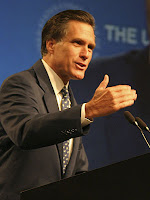
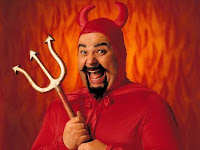
Romney v Satan: How do they stack up?

Did you know that a vote for Mitt Romney is a vote for Satan? So says prominent Christian pastor Bill Keller.

“If you vote for Mitt Romney, you are voting for Satan!” he writes in his daily devotional to be sent out to 2.4 million e-mail subscribers tomorrow.
….
“This message today is not about Mitt Romney,” he writes. “Romney is an unashamed and proud member of the Mormon cult founded by a murdering polygamist pedophile named Joseph Smith nearly 200 years ago. The teachings of the Mormon cult are doctrinally and theologically in complete opposition to the Absolute Truth of God’s Word. There is no common ground. If Mormonism is true, then the Christian faith is a complete lie. There has never been any question from the moment Smith’s cult began that it was a work of Satan and those who follow their false teachings will die and spend eternity in hell.”

Who could remain unconvinced by the waves of certainty coming off this man like so many flecks of spittle? And here’s his conclusion.

“Romney getting elected president will ultimately lead millions of souls to the eternal flames of hell!”

Eh. Cheney tried that one against Kerry in ’04.

I’m shocked to see this level of religious bigotry in this day and age. Why anyone would be so prejudiced against Satan is beyond me. Especially after all he’s done for the Republican Party.

It’s not true that a vote for Romney is a vote for Satan. Satan’s a Libertarian, for one thing. To help you compare, I present a handy info chart: Romney v. Satan.

  Romney
Satan
Experience Governor of Massachusetts Prince of Darkness
Accomplishments Responsible for rescuing Salt Lake Olympics Responsible for existence of evil, human suffering, temptation, and international banking conspiracies
Ambitions Become US President Enslave the children of men, and lead the world into hell.
Same diff.
Physical description Nice hair. Nice horns.
Favourite book Battlefield Earth, by L. Ron Hubbard Battlefield Earth, by L. Ron Hubbard
Tough on terror? Maybe Yes; extensive experience in punishment and torture; perfect as a Republican nominee
Man of faith? Yes Yes

Who comes out ahead? I think it’s up in the air for now. In fact, I think the Republicans might be missing out on an opportunity for a great ticket:


They’d pick up some center-left votes, and they wouldn’t lose any of the evangelical conservatives, who’d vote for Satan over a Democrat anyway.

Deconversion stories: The way forward

I had occasion to chat with a student recently. He was raised in a religious family, but has realised that he doesn’t believe in any gods. The realisation has not been particularly easy. I got the feeling that, while he hadn’t believed for a long time, he was only just beginning to admit this to himself, and to solidify his identity as a non-believer. He seemed poised on the verge of some kind of decision about what to do next, and he was concerned about the effect that his deconversion would have on his family.

The first thing I did was to congratulate him on his sound reasoning and judgement! I also noted that we might have had some experiences in common. I had a deconversion ‘click moment’ about a year or so ago, but it was a long time in coming. While I identified very closely as a Mormon, I was also learning concepts about evidence, and how to evaluate ideas. As a result, I found that my religious knowledge was becoming less and less relevant. Rather than working my secular knowledge into my spirituality, I now found myself trying to defend my religious faith from the onslaught of remorseless reason, and these attempts seemed increasingly dishonest. At last I was able to consider the idea of the non-existence of gods, devils, spirits, and demons without panicking, and then to realise that the doctrine of theism was not well-supported, and very likely untrue.

There are some differences in our stories. For instance, the people in my life have taken my deconversion very well. I’m aware they don’t like the approach I’m taking to life, but they’re still my friends and family. I think it might be somewhat easier for them because I haven’t changed my behaviours — I still don’t smoke or drink, and the only commandments I disobey concern spending hours at church and giving the Church forkloads of money. For this student, it’s a different story. His religion ostracises its ex-believers, and it’s going to have an impact on the people closest to him. He’ll have to take a peripheral role in his social group, and perhaps in his family. They may cut him off. He may not see them again. And what a shame that would be. They’d be missing the chance to associate with a smart, great young person.

Why do we atheists put ourselves through it? Why not just go with the flow, keep our doubts to ourselves, and stay in the organisation? It’s not a bad life. They teach about being nice. Well, nice to other believers, at least. Maybe we’d eventually be able to deal with being slightly out of step with our peers — hey, some of us actually enjoy it. Why not just stay undercover and enjoy the benefits?

The first reason I’d suggest taking the road to deconversion is that when one sees the religion for what it is — a system that people have made up — association with believers becomes less tolerable. This was particularly true for me in a ‘Bible literalist’ church (which Mormons are, though not everyone sees it that way). People would swallow amazing amounts of nonsense if spoken from the pulpit. I remember going to a Sunday School lesson about Noah and the Flood (post-deconversion), and realising that I was surrounded by people who actually believed that Noah literally got all those animals on a literal ark. (I marvelled that once I’d literally believed it too.) At that point, the people of my former faith seemed like aliens to me. I wondered how it was that they could believe these fantastic things in the absense of any physical evidence at all. Perhaps it was that they believed in God, and if one can believe in a god that can do anything, all the rest could follow. But my standard of evidence was higher.

Could I have saved myself some trouble by taking the Flood as figurative, in a church of literalists? Only if I wanted to have a lifetime of arguments in Sunday School. Or shut up completely — but I’m not good at shutting up. Too frustrating. And if the Flood is figurative, what about the Creation? What about the Tower of Babel? The parting of the Red Sea? The miracles of Jesus? What about the Resurrection? Why couldn’t they be figurative too? And if they were figurative, then there might be no literal resurrection, and no life after death — just like atheism. So without literalism, the much-touted ‘comfort’ offered by religion evaporates. And literalism doesn’t last long when sound evidence is required. Nope — might as well save a step and not believe. It’s certainly cheaper and less time-consuming.

Another reason I chose to ‘go public’ with my lack of faith is that I’m trying to be a more honest person, and I thought that pretending to believe would be inauthentic. I view atheism as honest in the same way as science is honest: you observe facts as best you can, and try not to say more than the facts will tell you. And if the facts tell you something new, you have to stay open to it. I sometimes tell people that if some solid reproducible evidence of a god’s existence came to light, I’d happily become a believer again. I’m not holding my breath though.

The road for my student — and for any recovering believer — will not be easy, whichever way he may take. There are costs for not believing. For me, coming out as an atheist meant not participating in church ordinances. Baptism and priesthood ordinations are, to me, symbols with no eternal significance, but they can acquire significant social meanings. My dad performed both of those ordinances for me; if I don’t, am I abnegating my fatherly duties? And so a good friend baptised and ordained my sons this year, while I watched and realised that it had to be that way. It was what I chose when I decided to accept an evidence-based worldview.

While deconversion isn’t easy, it is possible, and it is worthwhile. You can think more clearly. You can make decisions based on how they’ll affect people without worrying about offending some shadowy being. You can teach your children how to evaluate ideas, which will serve them for the rest of their lives. You can overcome a lifetime of religious training, centuries of philosophies and social patterns, and millions of years of human evolutionary perceptual weirdness, using only your mind. I view my deconversion as my greatest intellectual acheivement to date (although it’s a small list).

Leaving the religion of my youth behind was challenging, but I’ve come through the other side of it okay. And I’m finding that being an atheist can be a noble and good thing to be.

Older posts Newer posts

© 2026 Good Reason

Theme by Anders NorenUp ↑