Good Reason

It's okay to be wrong. It's not okay to stay wrong.

Category: post (page 33 of 125)

University retirement crisis somewhat overstated

Haven’t we heard this story before?

Ageing academics set university timebomb

UNIVERSITIES face a new crisis: up to 40 per cent of academics and lecturers are expected to retire over the next decade, with no one to replace them.

I remember reading stories like this ten years ago. You’d have thought everyone was going to retire by now, leaving lots of lovely jobs for all the up-and-coming grad students like me. Then, mysteriously, the old guard failed to retire, or if they did retire, the university decided not to keep their position going. Or they came back to teach part-time because they liked it so much. Apparently only 41 percent of American academics plan to retire at 65. (No stats for Australia, sorry.)

And no one to replace them? I wouldn’t worry. Even if everyone retired tomorrow, there’d still be a huge backlog of postdocs and postgrads to do the teaching, since many departments haven’t been good at discouraging students from doing PhDs. Ironically, the less discriminating and the less responsible they are about this, the more postgrads they have to do the teaching. Postgrads are cheaper, too, so it’s a win for everyone except for PhDs who are trying to get on permanently. (I say this as one of the lucky postgrads, getting to teach like I have.)

Let’s do the math. Say every professor supervises — what — 30 PhD students over their career? How many will get that professor’s job when he or she retires? One. Or maybe none, if universities keep downsizing. Which means that more and more qualified academics are chasing fewer and fewer jobs. There’s your real timebomb. The collapse of the academic talent pool when everyone realises that going for a PhD won’t lead to an university job.

Mormon young adult fiction: Preserving Racial Purity edition!

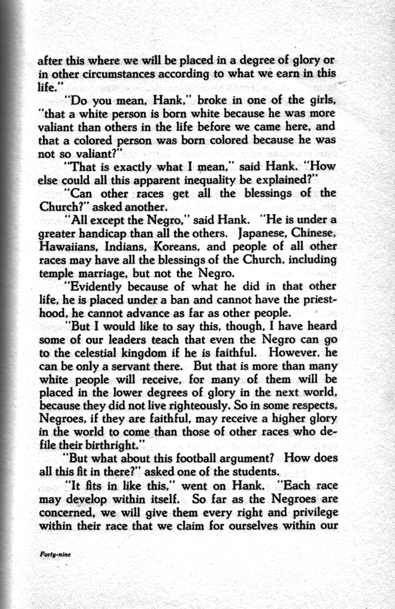
Today’s inspirational reading for youth is from the 1956 classic, “Choose Ye This Day” by Emma Marr Petersen. Yes, that’s the wife of Mark E. Peterson, an apostle during the swinging 70s. While it’s not quite as authoritative as if Elder Petersen had written it himself — although he might have, who knows, plausible deniability being what it is — I doubt Sister Petersen would have strayed too far from his ideas. (She was known to share the stage with Elder Petersen on one occasion.) At the very least, the book is an interesting indicator as to the kinds of thoughts that were welcome in the Petersen household.

In this chapter, trouble is brewing at a small college when Milo Patterson, a black student, takes a spot on the football team over the protests of students. Some students decide to ask Hank, an older, respected member of their community and a Latter-day Saint, what position he takes on the matter. Hank, who serves as the voice of the author, launches into a frighteningly candid defense of institutionalised racism in the LDS Church and society in general, using the tried-and-true ‘blacks were less valiant in the pre-mortal life’ argument that I heard many times during my Mormon days. At least Hank/Emma doesn’t advocate total banishment of the seed of Cain. He/she only asks that blacks endure partial social acceptance throughout their lives, and then eternal servitude in the highest Mormon heaven — but only if they’re righteous.

This extract serves as evidence that, yes, the idea that Africans were less valiant in the pre-mortal life was well-known and taught at one point in LDS history (note that Hank has been taught these things ‘all [his] life’). But it also shows that Mormon doctrine can change when members draw upon their capacity for fairness and justice, and ignore dogma coming from the many apologists in their midst.

Might a knowledge of evolution have helped Emma Petersen? When you understand that some people have dark skin because of evolutionary adaptation (instead of picking some self-serving supernatural reason, like “they’re evil”), it reduces your need to take scraps of mythology and weave them into a complicated justification of whatever social prejudices are prevalent in the religious community. But then, neither of the Petersens went in much for evolution. Sister Petersen’s book shows a creationist professor giving an evolutionist professor a good thrashing in a debate, while Elder Petersen once opined that evolution was Satan’s way of destroying America via atheism.

Happy reading! Scans at the bottom.

CHAPTER EIGHT
HANK’S POINT OF VIEW

THAT night when they went to Hank’s for a snack, a large group of students were watching TV. Hank himself waited on the two boys.

When he brought the order, Kent said in a voice loud enough to be heard by the other students, “Hank, what do you think about this Patterson rebellion over at school?”

Many wished to know what Hank thought about it.

“My attitude on this subject is pretty well guided by my religious views,” he said, “so I hope you won’t mind if I mix a little religion with what I say.”

The other students held Hank in such high regard that they listened respectfully.

“My religion teaches that our existence did not begin when we were born into mortality. We lived before we came to this earth. We were persons then as we are now.”

“Are you talking about reincarnation?” one student asked.

“No, not at all,” said Hank. “I certainly do not believe in reincarnation. We have one existence in mortality, and that is all. I mean that before this earth was made, we lived and worked and played together in another estate.

“We could do as we pleased there, too, just as we can here. Some were not as obedient as others, and naturally they didn’t get along as well.

“We are the children of God, as you know. We were with him. We were his family.

“It is my understanding that at one time our Heavenly Father called us all together and announced that he was planning to send us to this earth where we could be tested and tried under mortal conditions, to see if we would be worthy of further advancement in his kingdom.

“The Lord explained his plan to us at that time, but some of his children did not accept it, and rebelled. This rebellion was led by one of the brightest, but also the most ambitious and selfish of all God’s children. His name was Lucifer. About a third of all the spirits in heaven joined him in this rebellion. They were all driven out, and they became Satan and his followers.

“This fight up in heaven was very much like wars in this life. Some of God’s defenders were more valiant than others. Some were disloyal, but not so bad that they had to be driven out with Lucifer.

“When the time arrived for us to come to this earth, it appears to have been the plan of the Lord to reward us according to our loyalty.

“How could he do that? It seems quite easy, as I look at it, for he permitted those who were most obedient to be born into this life with white skins, and to have opportunities such as are to be had in our country.

“Others were born with dark skins in the jungles of Africa or in the valleys of the Amazon. Still others were born in China or Korea, or India, where opportunities are not as great as here.

“It was a case of reaping what we sowed. I have this same understanding regarding rewards in the life after this where we will be placed in a degree of glory or in other circumstances according to what we earn in this life.”

“Do you mean, Hank,” broke in one of the girls, “that a white person is born white because he was more valiant than others in the life before we came here, and that a colored person was born colored because he was not so valiant?”

“That is exactly what I mean,” said Hank. “How else could all this apparent inequality be explained?”

“Can other races get all the blessings of the Church?” asked another.

“All except the Negro,” said Hank. “He is under a greater handicap than all the others. Japanese, Chinese, Hawaiians, Indians, Koreans, and people of all other races may have all the blessings of the Church, including temple marriage, but not the Negro.

“Evidently because of what he did in that other life, he is placed under a ban and cannot have the priesthood, he cannot advance as far as other people.

“But I would like to say this, though. I have heard some of our leaders teach that even the Negro can go to the celestial kingdom if he is faithful. However, he can be only a servant there. But that is more than many white people will receive, for many of them will be placed in the lower degrees of glory in the next world, because they did not live righteously. So in some respects, Negroes, if they are faithful, may receive a higher glory in the world to come than those of other races who defile their birthright.”

“But what about this football argument? How does all this fit in there?” asked one of the students.

“It fits in like this,” went on Hank. “Each race may develop within itself. So far as the Negroes are concerned, we will give them every right and privilege within their race that we claim for ourselves within our own race, but we will not become intimate with them in any way, and we will not intermarry with them. That is my own personal feeling on this question, and it is what I have been taught all my life. I believe that is a fair position to take, and I believe it squares with the word of God.

“Too close association with them might lead to intermarriage and that would bring the curse of Cain upon children born to such a marriage.

“I must admit that one great danger in being as tolerant as we would wish to be is that some of our people lose their balance and forget that there is after all a barrier between white people and Negroes which should never be crossed. It was the Lord and not man who established that barrier. When man tries to break down a wall set up by the Lord himself, he is asking for trouble, and only trouble can come from intermarriage between white people and Negroes.

“You may not know it, but the Lord anciently commanded that His people should not marry the descendants of Cain, just as he commanded that His people should not marry unbelievers and idolators. If we were not faced with the danger of intermarriage with the Negro, we could be much more tolerant than we are. But there are some leading Negroes who advocate complete absorption of their race with the white race by intermarriage and that is something which I for one can never accept.

“Marriage between white and black people, as I see it, is a violation of God’s commands. So we must avoid steps which would lead to such a thing.”

“I take it, then,” said one of the students, “that you would be in favor of allowing a Negro to play on our football team, as long as we did not take him so far into our social life that some white girl might become infatuated with him.”

“That is just what I believe. I support the school president and the governor in what they have done, and I think you students should do the same.”

“Well, if that’s what you believe, I guess we’ll give the idea another whirl,” Steve said. “Pat’s a good fellow and a swell football player. How about it?”

“Whew, quite a speech,” said Kent, “but I’m game.”

    

Prayer is a strange concept anyway, but this…

Australia 2011 Census: Mark “No Religion”

A follow-up to the UK census post: the Atheist Foundation of Australia has launched the “Mark ‘No Religion’” campaign.

The AFA will be unveiling billboards across the nation in major cities stating “Census 2011: Not religious now? Mark ‘No religion’ and take religion out of politics.”

“It is time the Australian community questioned whether they hold religious beliefs or not. How they answer this question in the Census will influence decisions by Australian governments. Often the transfer of taxpayer money to religious organisations is justified on the basis of the Census results, as are special concessions and exemptions including the right to discriminate against some groups.

Of course, the ‘No Religion’ box is for the people who haven’t quite made it all the way to ‘Atheist’ yet. If you do identify as ‘Atheist’ or even ‘Agnostic’, feel free to write that in. Both categories are recognised on the census, so commentators can include them in with the non-religious vote.

One thing isn’t clear: what happens to joke answers like ‘Jedi’ et al. I can’t tell if they get dumped into the ‘did not answer’ bin, so don’t write them and risk not being counted. Let’s make the number of non-religious Australians zoom up this year.

Dear America: The gun thing

Hi, America. Just wondering how you’re doing. I know things have been a bit crazy lately — well, just like always, eh? Or maybe a little crazier.

Look, I noticed that you haven’t really changed your mind about guns, even with all the recent unpleasantness.

Americans’ overall attitudes toward gun laws have not budged an inch in the wake of the shootings in Arizona, according to a new national poll.

“Those numbers are identical to the results of a poll taken in the summer of 2009, indicating that the tragic events in Tucson have not changed how the public feels about gun laws,” says CNN Polling Director Keating Holland. “This is a familiar pattern in polling – surveys taken after previous incidents like the Columbine shooting have shown little or no change in Americans’ attitudes toward guns.”

I guess it was inevitable that nothing would change after the shootings — if Columbine didn’t do it, or Fort Hood, or Virginia Tech, — or the 80-something Americans that get killed every day — then I don’t suppose anything will. Just the cost of doing business.

But I also noticed that you think some restrictions are good.

The poll indicates that the two sides of the gun debate are evenly balanced, with one in seven Americans opposing any restrictions on guns at all and one in seven saying that all guns should be illegal except for police and other authorized personnel. Roughly a third support minor restrictions and roughly a third support major restrictions.

Wow, two-thirds of you want restrictions on guns. And yet there’s no plans to make it happen. It’s a dead issue. That must be frustrating. Is the gun lobby thwarting it? Would a bill ever get off the ground?

I’ll level with you, America. This issue makes you look… well, let’s just say other countries are starting to talk. That you can’t seem to get a hold on this issue even though it kills a lot of you seems suicidally masochistic. And it does kill a lot of you. Right now, gun deaths account for 78 percent of all your homicides — that’s the highest in the world except for Colombia.

Yeah, I know you like your guns. At least, those of you who are still alive. Let’s ask the rest of you how they feel. Oh, wait, we can’t. (Maybe that’s part of the problem — the dead can’t vote.) But some of you who are still alive say that you can’t take guns away because then only outlaws would have guns, or something like that. I guess that’s true; I wouldn’t like to be gun-less in a country already awash in guns. You can’t put the genie back in Pandora’s box, if you will.

Maybe gun control can’t work in America anymore, and if you want less gun violence, you just have to go somewhere else. I did go somewhere else, but even so, I still find this profoundly depressing. I like you a lot, America, and I hate thinking that this drama is going to play out again and again, and everyone will act just as shocked and outraged as ever, but it’ll never get better.

Machine translation could save minority languages

We’ve seen Word Lens, which translates signs automatically. Now this:

Google Translate App works as you speak

In an attempt to break down language barriers the world over, Google have developed an App which allows you to translate your words into another language as you speak.

Users simply speak into the device and the Google Translate app translates your speech and then reads the translation out loud, all in real time.

The person you are conversing with can then respond in their own language and their translated words will be spoken back to you.

But language teachers and linguists can rest easy that they’re not about to be put out of a job just yet: currently the app only supports English and Spanish.

I’d love to play with a copy. At the moment, I suspect it’d be pretty rudimentary and error-prone, but there would be updates. The task of machine translation is as yet unsolved — or should I say the set of problems that converge on MT — but we keep seeing innovations that get us closer and closer to that goal, inch by inch.

If we ever do realise the goal of instantaneous, unconstrained automatic translation, communication would of course be the most obvious beneficiary, but the other would be minority languages. It could potentially save them.

I see it as similar to the OS wars of the 90’s, which, like language, was a conflict over standards. Computer operating systems, like languages, require a population of users who can exchange information (in this case, files) with each other. But cross-platform file compatibility issues made this difficult. Operating systems also run applications that won’t run on other systems, so there’s a disincentive to adopt an OS that doesn’t have the software you need. At the time, the Mac was on the bad end of that struggle — there were fewer installed users, and some programs weren’t available for the Mac. I remember feeling very concerned that the Mac OS would die out.

Then the Mac adopted standards that were in common use anyway — text was text no matter what computer you were on, jpegs were jpegs, and Word files didn’t need to be converted. (Perhaps Mac users should be grateful for Word after all.) You couldn’t run the exact same programs, but every computer became able to do mostly the same things: Java, Perl, Flash, and so on. And if you got really desperate, there were Windows emulators. So the cost of settling on a minority OS went way down.

What automatic machine translation does is lower the cost of maintaining a minority language. Languages like English or Mandarin have an irresistible attraction for speakers of other languages because they have a huge install base. They represent economic and social opportunity. If translation between them is easy, then using the other language isn’t an irretrievable commitment.

You could argue that the ease of translation would doom minority languages because the translation might only flow one way: toward the big language. That’s not what happened in the OS wars. People liked their Macs, and the ease of conversion helped them hang on to them. People like their languages, too. They’re important markers of their identity. But not if the cost is too high. MT would bring the cost down.

One space or two after a full stop?

Forget left and right wing, forget coriander lovers v haters. The real divide in our society is between the one spacers and the two spacers. And Slate’s restarted the war with this article: Space Invaders: Why you should never, ever use two spaces after a period

Two-spacers are everywhere, their ugly error crossing every social boundary of class, education, and taste. You’d expect, for instance, that anyone savvy enough to read Slate would know the proper rules of typing, but you’d be wrong; every third e-mail I get from readers includes the two-space error.

I’m a one spacer, and I’ll tell you why: Go to your bookshelf, open up any book, and look after any full stop. You’ll find one space. That’s how the pros do it.

Back in the days of typewriters, all the characters were monospaced, so an ‘m’ took up the same space as an ‘i’. A monospaced font will look like crap if there’s only one space after a full stop, so people were taught to use two. Nowadays, we have computers with well-designed typefaces, so you only need one space, as nature intended.

I can only see two reasons to use two spaces. Either you’re on a clanky old IBM Selectric, or you were taught to type by sadistic nuns who beat you if you forgot the extra space. The former can be cured with a computer, the latter with therapy.

Rhetoric, Palin, and the Arizona shooting

A friend asked me what I thought about Sarah Palin’s responsibility with regard to the Arizona shooting. Here’s what I wrote back.

People have seized upon Palin as a very visible example of unacceptably over-heated rhetoric. This is not entirely unfair — Palin has done much to poison the dialogue, and there are many examples that people have unearthed. But the problem is much bigger than Palin. Advocacy of violence has been SOP for the GOP for a long time now, and there are many who have done it much more consistently than Palin. I’m thinking of Anne Coulter, Rush Limbaugh, and Michael Savage — at times, the most popular commentators on the Right. Check this link for many more examples of violent eliminationist rhetoric.

Does this send some people over the edge? Well, direct causation is hard to determine. I tend to view this a bit probabilistically. Let me use the example of health. In any population, there will be robust, healthy individuals, and some people on the margins. And there are always some nasty germs around in the population, and there’s a chance you might get sick from them, but you might not if you’re otherwise healthy. But if we now inject other factors into the population, it changes the odds. Say there’s an earthquake where services get knocked out. Now we’ll see the entire population moving toward poor health. Many people will remain healthy, but the probability of getting sick rises, and it’s going to send a certain percentage of least healthy individuals over the edge.

Similarly, if you have a population of individuals ranging from nice to crazy, and you change the environment so that formerly unacceptable kinds of discourse become commonplace, and in fact so common as to be barely noticeable, you are raising the chances that someone on the edge will take action (though they may not). This time someone did.

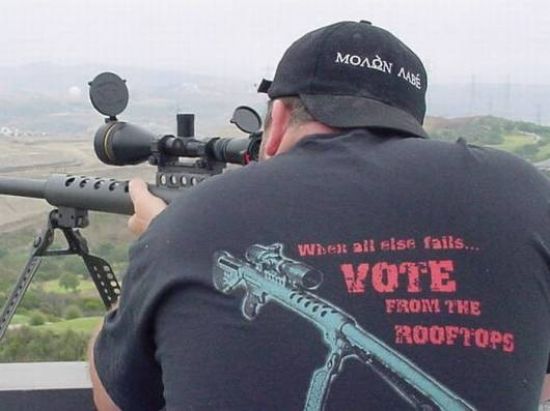
I also think our toxic discourse has the effect of hiding people with real problems: “I didn’t think anything when he said that; people on the radio say things like that all the time.” How do we know that someone wearing this shirt isn’t a potential shooter?

How about this guy?

They’re just normal guys, right? Or they could be crazies. They seem crazy to me. But if these people aren’t crazy, they’re making the real crazies that much harder to spot.

I don’t want to put limits on what people can say just because a mentally ill person might take them seriously, but I think it’s time for people to draw the line and vote with their feet and their money when media personalities engage in this kind of talk.

Finally, what I find most objectionable is the attempt of right-wing apologists to disclaim any responsibility by saying the shooter was a crazy guy. Well, yes, he was a crazy guy. Who else would do that if they weren’t? But he was also someone who used a gun for its intended purpose, acting on cues from the most significant and well-paid voices on the right. The GOP claims to stand for personal responsibility, but this incident has shown me that, once again, they don’t believe their own story. Everyone is responsible but them.

Census: ‘Atheism’ or ‘No Religion’?

Now here’s an effort I can get behind. Atheist Ireland requests that if you’re not religious, don’t automatically tick the box for a religion in the upcoming census.

Be Honest to Godless in the Irish Census on Sunday 10 April. Think before you tick. And if you’re not religious, please tick the no religion box.

It’s now three months to the next Irish Census on 10 April, and Atheist Ireland wants to see an accurate answer to the question on religion. You won’t write in your childhood home address unless you still live there. So don’t write in your childhood religion unless you still really practice it.

Sounds reasonable. And the British Humanist Organisation is saying the same thing.

If you say you’re religious on the census and don’t really mean it, then you are treated by some sections of the media, churches, and even government policymakers as if you are a fully-fledged believer.

This is significant for Australians because we’re having a census of our own in August this year. We have a census every five years instead of ten. (Takes less time to count us.) The 2006 census was the first time I’d identified as “No Religion” (but I didn’t identify as an atheist). I have to say, it was a somewhat exhilarating experience, one that you can enjoy for yourself. I’m really looking forward to see how the unchurched categories jump, as they have consistently done.

But somewhat strangely, the Irish Atheists are requesting that atheists not say they’re atheists.

Please don’t write in ‘Atheist’, or anything else that is not a religion, in box number 6, which says ‘write in your RELIGION’. That makes some people mistakenly think that atheism is a religion, and creates the impression that there are far fewer atheists than is actually the case.

Okay, so atheism is not a religion. But if someone asked me, “What religion are you?” I’d say, “None; I’m an atheist.” So I can see “No religion” or “Atheism” as appropriate answers. The confusion about atheism-as-religion is annoying, but people won’t suddenly straighten themselves out from the census alone. It’s the kind of thing you have to explain to people over and over, one person at a time. Which we will continue to do after the census is over.

And if you think about it, it doesn’t make sense to say “Don’t write in ‘Atheism’ because not enough people will write in ‘Atheism'”. Let’s turn that argument on its head — do write ‘Atheism’ so that more people will be writing ‘Atheism’!

How does the religion question work for Australia? The Australian Bureau of Statistics has a space for the categories “No Religion”, “Atheism”, and “Agnosticism”. (Download an Excel spreadsheet of all the religious data on this page.) I plan on writing in ‘Atheism’ because observers and journalists will group atheists in with the ‘No Religion’ category anyway, and why not be as specific as possible? And, of course, if atheists write “Atheism”, then more atheists will be identifying explicitly as atheists, which is a good thing.

That’s my argument, anyway. But what is everyone else doing?

As a final note, the LDS Church claims that there were 108,851 Mormons in Australia in 2006. In the same year, only 52,141 people self-identified as LDS. You’d think saying “I’m LDS” would be some kind of minimal requirement to be considered a member. Do you think the LDS Church is not doing their best to keep a really accurate count?

Brodies for 2010

It would appear that a few Good Reason posts have been nominated for the 2010 Brodie Awards. Many thanks to the nominators!

Even if you don’t vote, that link is worth checking out just because of all the great, funny, irreverent posts from other ex/post-Mo’s. I think it’s kind of cool that we have such a large, vibrant community these days.

Older posts Newer posts

© 2026 Good Reason

Theme by Anders NorenUp ↑