Good Reason

It's okay to be wrong. It's not okay to stay wrong.

Category: post (page 32 of 125)

Google and Bing

When I heard that Google had accused Microsoft of copying Google’s results for their search engine Bing, it was like 1995 all over again. Great snakes, I thought, can’t Microsoft develop anything on its own? Yes, I still hold a grudge over Microsoft’s plagiarism of the MacOS. But it appears there’s a bit more to this story.

The way Google unearthed the alleged copying was reminiscent of ‘copyright traps‘ that map-makers set. You don’t want someone copying your map, so you insert fictional towns into it. If anyone else shows the same town on their maps, you know they must have copied you.

In Google’s case, they took the unusual move of hard-coding strings of nonsense letters (e.g. “mbzrxpgjys”) so that it would find a certain web page (say, a theatre in Los Angeles.) The page wouldn’t even have the search term in it — it was totally arbitrary.

Within a few weeks, sure enough, Bing’s results started to show a few of Google’s hard-coded results. Caught red-handed!

But Microsoft, it appears, wasn’t copying; at least, not directly. Bing uses crowd-sourcing, a legitimate and very smart kind of information. If you’re using the Bing toolbar or Internet Explorer (with ‘Suggested Sites’ on), it’s watching what you do and reporting it to Microsoft. So if you search for something (on Bing or Google), it watches which suggested page you go for, and it upweights that link. So that would explain why Google engineers, after trying the links a few times, would trip Bing’s sensor, and their nonsense link would get into Bing’s results.

I’m a Microsoft hater — I won’t have MS software on my computer, and I use iWork rather than Office — but I don’t think Microsoft is doing the outright plagiarism that Google is accusing them of. They’re not copying, they’re imitating. It is creepy to have your computer watching you, though, so if you don’t like it, then don’t use the Bing toolbar, and don’t use Internet Explorer. Good advice anyway.

What atheism means to me

Reverberations are still being felt from PZ’s blog post last week. He complained about “dictionary atheists” who were overly specific about the definition of atheism. Singled out for his annoyance was something I’ve said many times:

Atheism is not a belief. It is a lack of belief.

Or when I’m feeling like breaking out the first order predicate calculus:

Atheism is not a “belief” in “no gods”. It’s “no belief” in “gods”. As such, atheism doesn’t make any claims. It’s a reaction to the claims of theists.

And so on.

As if in response, PZ says:

Dictionary Atheists. Boy, I really do hate these guys. You’ve got a discussion going, talking about why you’re an atheist, or what atheism should mean to the community, or some such topic that is dealing with our ideas and society, and some smug wanker comes along and announces that “Atheism means you lack a belief in gods. Nothing more. Quit trying to add meaning to the term.” As if atheism can only be some platonic ideal floating in virtual space with no connections to anything else; as if atheists are people who have attained a zen-like ideal, their minds a void, containing nothing but atheism, which itself is nothing. Dumbasses.

But but but!

I worried that PZ was getting away from good reasoning. The dictionary definition of atheism is very useful, if only for rhetorical purposes. Not advancing a claim means you don’t have to provide evidence, which is very handy for me. And in the case of gods, the burden of evidence really does belong to their claimants. Which puts the atheist on safe ground.

True, sometimes I do find myself speaking of “atheism qua movement” as being more than just lack of belief. For me, becoming an atheist and rejecting gods and supernaturalism — provisionally, of course — has been the gateway to a new way of thinking that has made my life better.

But how did a non-position do that? Since atheism is not of itself a philosophy or set of principles or anything like that, what kind of positive value does it impart? How can it help humanity or advance human knowledge, or really, do anything if it doesn’t of itself put forth any claims or do any of the things a philosophy usually does?

Let me use my subjective experience to untangle this.

My deconversion only became possible because I decided that I cared what was true more than I cared for my religion of origin. In the years leading to my deconversion, I learned more about how to think critically, and how to be skeptical about claims. Though my religion taught that I was to discount reason — sorry, “man’s reason” — I decided that it was better than the selective and convenient reasoning that people at church engaged in. And I learned more about the scientific method. Once those were in place, it was just a matter of time before I saw the claims of religion for what they were.

What I’m saying is that atheism didn’t get me to atheism — these other things did. Atheism was the result.

Which puts me where PZ already is: Atheism is not a philosophy — it’s a conclusion.

In that Montreal talk, I explained that there is more to my atheism than simple denial of one claim; it’s actually based on a scientific attitude that values evidence and reason, that rejects claims resting solely on authority, and that encourages deeper exploration of the world. My atheism is not solely a negative claim about gods, but is based on a whole set of positive values that I will emphasize when talking about atheism. That denial of god thing? It’s a consequence, not a cause.

What got me to that consequence — and what I’ve worked into my life since — are a number of positive -isms.

  • Secularism — I think people shouldn’t be allowed to use their god-belief as a way of controlling the behaviour of others, particularly children and those who don’t believe in the religion. A secular society means that everyone’s religion gets treated the same. That’s fair.
  • Rationalism — Having a commitment to using reason as a guide.
  • Skepticism — Being critical of claims. Asking for evidence. Asking “How do you know?”
  • Humanism — I’ve held off on calling myself a humanist so far, but if someone mistook me for one, I wouldn’t mind. I think it has much to recommend itself. The humanist slogan “Good Without God” is one that stirs this godless heart.
  • And of course, the scientific method — using publicly available observation and evidence confirmed by multiple sources to separate fact from fantasy.

These positive values are bound up in my atheism, and that of others whose stories I’ve read. So is it right to say that atheism is separate from these values? Well, they’re not all the same thing. Not every skeptic is an atheist. And atheists are not necessarily rationalists. So while these -isms are not synonymous with atheism (unfortunately), they do tend to cluster around atheism, to the extent that they get associated with atheism, even though they are not atheism themselves.

I think people use “atheism” as a kind of shorthand for these other positive values. Our minds work like that. We make little logical leaps all the time without noticing. So if I speak of atheism as a positive value, I hope you’ll understand what I’m doing. I’m leaving behind a strict dictionary defition of atheism, and using it as a way of talking about all the positive things.

So I get what PZ is on about. Hang the dictionary definition of atheism! Enough of arguing with the careful tweezers! These tools are our spaceship, and atheism is the rocket fuel!

Well, it’s not really rocket fuel, but I hope you know what I mean.
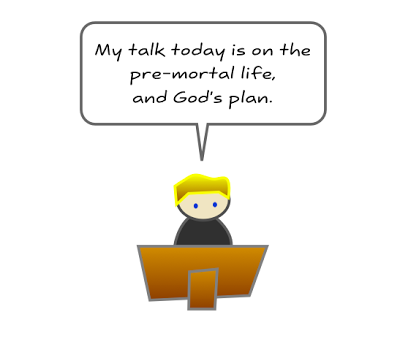
The church talk Rex would like to give

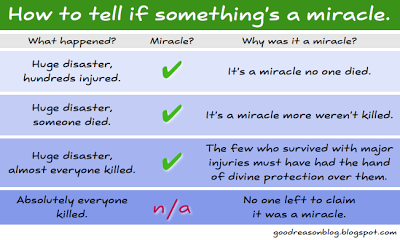
It’s a miracle! Always.

I thought I’d post this handy guide before the inevitable miraculous claims that seem to follow every horrendous tragedy.

Either they deserved it, or they’re in heaven now. Isn’t the divine plan amazing?

Talk the Talk: Chaser the Border Collie

This week’s ‘Talk the Talk’ podcast is about a very clever border collie named Chaser. Chaser can recognise words that pertain to objects, which is sort of languagey, but I don’t think she’s broken the syntax barrier yet.

Go have a listen at the RTRFM website, or hit us on the Facebook.

Can you prove that a god doesn’t exist?

Hellmut’s recent comment on ontology was so good that I think it deserved a new post. We have a distinct lack of evidence that dogs can’t fly. But can we prove it? Hellmut explains:

Actually, you can’t prove that dogs can’t fly. Somewhere in the space-time continuum, there might be a dog that can fly.

The precedence for that insight was Francis Bacon’s famous statement about white swans. Since every swan anyone had ever seen had been white, Bacon concluded that all swans are white.

Then we discovered black swans in Australia.

Logically, we cannot prove universal statements, i.e. claims about anything that is supposed to always be true.

Likewise, we cannot disprove existential statements because somewhere, sometime beyond the current reach of our senses, there might be a purple cat with five eyes and seven legs.

It’s the old adage: You can’t prove a negative. And in fact, I wouldn’t try. I’m an atheist because I find the claims of theism lacking in evidence, not because I’ve proven the non-existence of a god.

But this is only partly true. Some negatives can be proven. I can say for certain that there are no square circles. I can also say that there are no married bachelors. (Not unless we redefine those words beyond conventional recognition.) The existence of these things would entail a contradiction in terms, and that’s not allowed.

What about a god? Well, the concept of god is defined so poorly that I can’t be sure that there isn’t one lurking around in this big universe of ours. But I can be quite sure that the Christian god does not exist. According to the claims of its believers, such a being would entail some logical contradictions:

  • He would be all-loving, yet condemn people to suffer eternal punishment.
  • He would know the future before we do it, yet allow free will.
  • He would be able to do anything, and yet not. (Ever hear the one about god making a stone so big that he can’t lift it? Oh, you have.)
  • He’d be all-good, yet allow unspeakable evil to occur.
  • Wouldn’t being all-good and all-powerful make him powerless to do evil things?
  • I suppose that’s not a problem for the biblical god, who does evil things all the time, but then that raises omnibenevolence issues.
  • And he would be perfect, yet somehow need to be worshipped.

There’s nothing new about these contradictions, and people have tried to resolve them with varying degrees of success for a long time. Yet they persist.

It’s all very easy for me as a ‘weak atheist‘ to sit back and demand evidence, especially when believers refuse to provide it. Having done that for a while, I’m now feeling an urge to assail the problem on its own turf and make some claims of my own. Consider this, then, a tentative exploration of the boundary between weak and strong atheism, and a possible avenue for the disproof of a particular deity, even if it’s not a blanket denial of all possible gods in the universe.

Required viewing:

End tax-exempt status for churches

Life was good for the priest, back in the old days. He would grant legitimacy to the throne, put the crown on the royal head, say a few things about the divine right of kings, blah blah blah, and in return the king protected the papacy and provided access to power.

Those days are gone, but churches still get a sweet deal. They’re exempt from taxes, which means that all of us, even non-believers, are stuck with the tax bill for their water rates, property taxes, roads, car registration tax, and more — to the tune of at least half a billion dollars a year in Australia alone.

But this might be changing in the USA, as cities start to tax churches for their fair share.

When a community needs to rebuild crumbling roads, should houses of worship pay fees for the number of times their congregants drive on them?

That’s the question behind a recent suit filed by churches in the small city of Mission, Kan., who argue the city’s new “transportation utility fee” is a tax they should not have to pay.

With cash-strapped states and cities facing a slew of tough choices, there’s a growing debate nationwide about whether religious congregations should help foot the bill.

I don’t know how successful this will be, but I find it incredibly encouraging that people are starting to have this discussion.

“It makes no sense to tax churches and to limit their ability to provide their services, and it does damage to the constitutional separation between church and state,” argues Erik Stanley, senior legal counsel for the Alliance Defense Fund, which is representing Catholic and Baptist churches in the city of 10,000.

Ohh, now they care about separation of church and state.

Seems one American senator is highlighting the problem at the federal level.

“THE constitution does not require the government to exempt churches from federal income taxation or from filing tax and information returns.” The potential implications of this comment, in a report earlier this month by Senator Chuck Grassley of Iowa, are starting to dawn on a large chunk of America’s charitable sector, which has until now taken for granted that it is exempt from tax.

Currently, an estimated 1.8m “churches” are exempted from income tax—as they have been since America created its modern income tax system in 1894—and indeed from the many other reporting requirements imposed by the Inland Revenue Service on secular charities, which have to file IRS form 990 each year detailing their finances. The influential Mr Grassley, who has long championed greater transparency and accountability in the charitable sector, has become increasingly convinced that this privilege is being abused to the tune of many millions of dollars.

I look forward to a lot of squealing from the ecclesiastical sector. So churches do charity work? Fine. Have them disclose what percentage of their work is for charity, and treat that part of the business like any other charity. The rest of the business can pay taxes. Churches are money-making businesses, and they ought to be treated as such.

Everyone worships the same god — ours.

Shorter Dan Peterson:

Atheists wonder why we Mormons think our god is the right god, while everyone else’s god is the wrong god. But in fact everyone really worships our god, which is the right god. When people find out they’ve been worshipping the wrong god (which is actually the right god), I have it on good authority that the right god will give them a pass.

How terribly condescending. I wonder if he’d be just as happy to admit that he worships Allah.

And what about polytheism?

English-only in Indiana

The English-only movement is essentially an anti-immigrant movement, but they don’t always make it as obvious as this.

An Arizona-like Immigration bill is looming in the Indiana legislature, as one state senator is looking at cracking down on illegal immigrants in Indiana. But the bill goes a little further, making English the only language used by state and local government.

“It’s going to put everyone under the same rule of law, there isn’t going to be a question anymore that people in the state of Indiana are legally able to be here and legally able to work here as well,” State Senator Mike Delph, (R) Carmel, said.

Senator Delph, is the author of Senate Bill 0590. A bill that will require police to as people to verify their legality, for example, during a traffic stop if police suspect they could be illegal.

The bill also mandates all local and state government to only use the English language.

“Any government entity at the state or local level would be required to perform all of their operations and interactions in English, including public meetings, voice activated systems with the telephone or electronic communication,” Delph said.

An English-only provision tacked onto a bill designed to stick it to immigrants. Bit of a giveaway, isn’t it.

Meanwhile, another English-only bill has passed the Indiana House, and is on its way to the Senate. What’s up with Hoosiers these days?

‘Moroni’s promise’ still not evidence

I can’t do much better than profxm’s takedown of this drivel from the Mormon Times. A guy named Lane Williams bemoans the fact that some journalists have decided that atheism is interesting and worth writing about.

As disappointing as it is to say this, reporters may not be able to do much better than provide a balanced conduit for atheists in the modern world we live in.

Dontcha hate when that happens? I mean, balance? But have no fear — since journalists are providing a ‘balanced conduit’, he’s going to use his journalistic influence to unbalance the balance, or something like that.

So my point today, really, isn’t so much about reporters; my point is to use the opinion format of this blog to take a public stand because so few news reporters can or do so.

Way to go, Lane. That’s what journalists should do — argue their side, regardless of how true or well-supported it is. And here’s where things go awry.

Mormonism’s last evidence sits in the power of the Holy Ghost that comes to the hearts and minds of those who seek God through earnest, submissive prayer and faithful action. It is an “experiment” successfully repeated millions of times around the world.

Prayer is not any kind of experiment. As I’ve pointed out, it relies on bad sampling, since everyone who doesn’t get a revelation is either struck from the sample, or told to repeat the experiment until they get the “right” answer. Test subjects are told what emotions to expect, so bias enters the picture. And so on.

You can’t use a ‘holy ghost’ to confirm the existence of a god. They’re part of the same story! That’s what you’re trying to ascertain. It’s like saying “I know Santa Claus exists because I prayed to him, and one of his reindeer told me.”

Millions of Mormons, including me, would say that God answers prayers because of their own experiences with the Holy Ghost and prayer. Therein lies our evidence that God lives. I assume other religious believers feel much the same way.

That’s part of the problem. Many other religious believers feel the same way… about their mutually incompatible, multiply conflicting religious claims! Anyone who knows about science has heard that anecdotal evidence is not data. And notice the bandwagon fallacy. If this is the best Mormonism can do, they’d better give up their scientific pretensions.

Then he says, in a hushed voice, deep with portent, “I know.”

I study Shakespeare and have many books that have inspired me for years, but when I read the Book of Mormon for the 30th time or so and experience a deep, almost mysterious reassurance no other book has come close to giving me amid trial, I know.

I have experienced many joys of human interaction at holidays and in evening activities, but when I experience the quiet, soul power of priesthood blessing called down on a dark night, I know.

I am only one flawed journalist, but in the midst of the atheism debate that Gervais and others continue in our public space, I must say something. I know.

No, you do not know. You’re just certain. There is a difference. Even if your claims were coincidentally 100% right, you still would not know that they were true. Knowledge does not come from intuition or feelings. Knowledge comes from observation of real-world phenomena. And this kind of evidence is nowhere to be found.

This is my beef with religion and supernaturalism. It is such a lazy way of thinking (or not thinking). You take your own beliefs and preconceptions, and just assert them over and over again without trying to back them up with any real evidence. You get to feel all spiritual and believing. But it stops you from learning anything.

Older posts Newer posts

© 2026 Good Reason

Theme by Anders NorenUp ↑