Good Reason

It's okay to be wrong. It's not okay to stay wrong.

Category: post (page 31 of 125)

O-Day Hijinx: Part 1

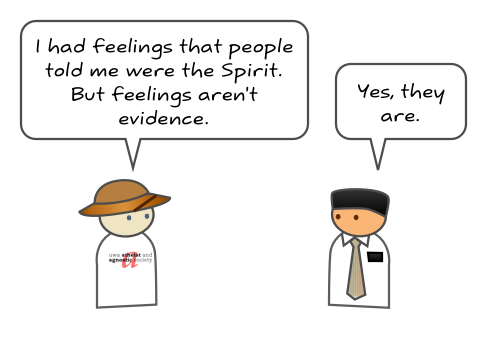
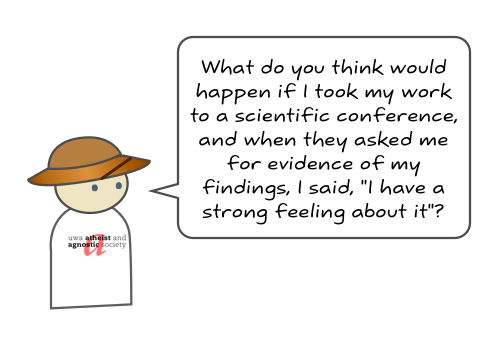
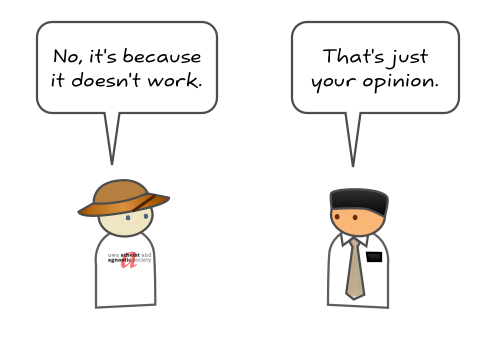
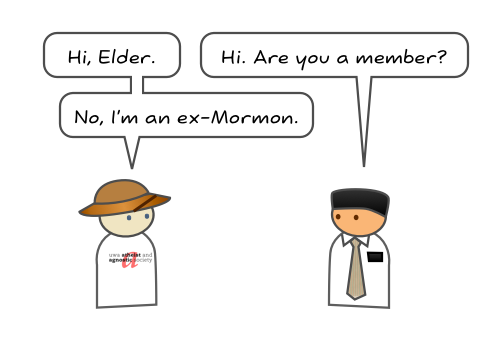
I talked to a lot of interesting people at UWA’s Orientation Day. It’s a day when university clubs have their big membership drives. Religions, eager to counter the effects of learning, have their booths as well, and — oh joy — one was a contingent of Mormon missionaries. So I took some time off helping the UWA Atheist and Agnostic Society to have a chat.

They’re fun to talk to, but I can never get used to how uniform their thinking is. You could get the same line of patter from any of them. I suppose atheists say the same things, too.

Here’s the first in a multi-part series: Trolling teh Mormons.

Creative campaigning

I know dog whistles aren’t meant to be heard by outsiders, but for this one, I can hear the whistle — I just can’t figure out who the dog is.

It seems that former Senator Rick Santorum (he of the ‘Google problem‘) is trying to polish up the image of the Crusades.

“The idea that the Crusades and the fight of Christendom against Islam is somehow an aggression on our part is absolutely anti-historical,” former Sen. Rick Santorum (R-PA) told a South Carolina audience yesterday. “And that is what the perception is by the American left who hates Christendom.”

Referring to the “American left,” Santorum observed: “They hate Western civilization at the core. That’s the problem.” Sanoturm also suggested that American involvement in the Middle East is part of our “core American values.”

“What I’m talking about is onward American soldiers,” Santorum continued.

Just to remind us, the Crusades were a series of religiously-motivated military campaigns in which Roman Catholic soldiers tried to retake the Holy Land, and ended up killing tens of thousands of Jews and Muslims along the way.

Santorum is Catholic, so I can see why he’d want to whitewash his church’s involvement, even though it’s a few centuries late. But I don’t think that’s the whole story. Since he’s reportedly mulling a presidential run, he’s probably just chumming the waters for more US military entanglement with the Middle East. (Because that’s gone so well.) You have to admire his vision though. I mean, he’s taking ‘culture war’ to a whole new level.

Next, we can expect to hear him explain that people who don’t like the Inquisition are just a bunch of lefty America-haters, and that Galileo got what was coming to him, the intellectual elitist bastard.

UWA O-Day hijinx with the AAS

UWA O(rientation)-Day is tomorrow, and I’ll be out there handing out info for the UWA Atheist and Agnostic Society. Come along if you want to meet up with me, have a chat, and perhaps join up, if you’re a university-type person.

Last year, we enjoyed the inexplicable presence of Mormon missionaries. They would try unconvincingly to plug their faith, and I’d point out their logical flaws and utter lack of evidence. Then they’d go away, a new batch would come, and the festivities would start again!

If you’re not sure where to find us, just position yourself somewhere near the coast and then follow the booming music.

Oh, and here’s something that happened last year, when I ran into a old friend from church. Maybe I should have broken it to her more gently.

Talk the Talk: Okay

This week’s Talk the Talk podcast features Allan Metcalf, author of “OK: The Improbable Story of America’s Greatest Word”.

We use ‘okay’ all the time, but its origins have not always been clear. Which means there are like a million fake etymologies for it! So we talk about that for a while.

Have a listen here.

One of these things

The Ottawa Citizen asks some religious folk: What should we tell our children about people who don’t believe in God?

Most of the responses are okay.

A Rabbi:

They can, and should be strong in their faith, strong in welcoming diverse faith affirmations, and welcoming to all people. That is a great message to tell.

Much the same from a Catholic priest:

Of course, tolerance, respectful investigation and openness to dialogue applies to peoples of all faiths and those who have no faith. True toleration means holding our own beliefs with conviction while acknowledging different beliefs with respect.

What is it that’s bugging me about the word ‘tolerance’ here? Wait, it’s a Buddhist to explain:

We should here contrast an appreciation of diversity and mere tolerance. Tolerance is usually a bland and biased acknowledgment extended from a presumed position of superiority and truth.

Nice.

Hinduism: What’s the problem?

Hinduism has never been uncomfortable with atheism and one may be a declared atheist, like the late prime minister Pandit Jawaharlal Nehru, and yet remain Hindu.

There’s even a humanist:

Despite the differences of what we think is above and beyond, the human web is sewn with the same thread — the needs of love, compassion, security and respect. Regardless of what some people are told to believe, atheists are an important part of this social fabric. We challenge others, and ourselves, to look outside the box. We empower people to self-reason, making choices based on their own path of truth and understanding.

Very nice. Wait, he’s still going.

As darkness casts its shadow across our life journey, we remain connected — trapped within the human condition, embracing what we love and have loved, appreciating with some regrets our life well lived, alone with our fears of the eternal abyss, facing them with the finite knowledge we possess.

Geez, that was kind of bleak. Couldn’t you have been a bit more upbeat? Or get an editor?

But at least it was better than the Muslim response, which I found extremely odd:

The best way to talk to our children on this subject is not just by words but, more important, through our own behaviour. I would rather talk “about God” and His benevolence and His many gifts rather than about people who do not believe in Him.

In other words, we affirm our own belief in God through positive activity. This would obviate the need to talk in negative terms “about people who don’t believe God.”

In other words, don’t talk about atheists at all. Just talk more about Allah so the atheism doesn’t distract them.

The cost of religious faith: Relationships

This rant from Matt Dillahunty is getting a lot of exposure this week, and justly so. He hits on a lot of great points, and I only wish I could say so much in one coherent stream. I had to hit ‘pause’ several times and let things sink in. It’s that good.

It’s all worth watching, but I’ve highlighted this part near the end. Jeff and Matt talk about the cost that Christianity (in particular) imposes on non-believers and ex-believers in the form of broken relationships.

Jeff: But there is, this is my personal hobby horse today; there is a cost in deciding that you’re going to take (in particular) Christianity on faith and that is that when you run into folks like us who don’t believe it, you are compelled because you’ve decided to believe in Christianity; you are compelled to think all kinds of horrific things about us. And tell us, or come at us with these threats of eternal torment which just draws an insurmountable line between us. And we cannot be friends because of what you have decided to take on faith. That’s the cost.

Matt: Yeah and I’ll tell you, that divisive cost plays out not only in the previous caller who had to give up his job because of “good intentioned Christians”, but I have a fiancée sitting in the room who is essentially estranged from a good portion of her family who consider me to be the devil. Now, I may not be a perfect person, far from it, but I’m generally a good person and a caring person, and I do the best I can to live the best life I can.

I certainly am not – well, I guess if I was the devil, this is exactly what he would say, so who knows? – but the absurdity of the divisive nature of Christianity in particular (and by the way, I am an atheist in regard to all gods, but since you’re kind of representing Christianity), it breaks my heart. People who actually understand what love is; people who actually understand what morality is; people who actually understand reality; it is almost unbearable to watch the people that you love be so absolutely duped into a divisive, hateful religion that they think is not divisive; they think it’s inclusive, and they think it’s positive.

It kills me, and it’s one of the reasons that I do this. Because I, for 25+ years, believed this stuff. I am so happy – so happy – that I no longer think that my former roommate is destined for hell. I am so happy that despite the fact that my relationship with my parents, the nature of it is changed, I don’t have to worry about them. The division is entirely one-sided. I didn’t end relationships when I became an atheist. Christians ended those relationships, and it was because their particular religion cannot tolerate – I have letters from people who said ‘We can no longer associate with you. You are of the devil.’

This is true for me, too, and I think it’s true for anyone who’s deconverted. The ostracism, the disownings, the mysterious unfriendings — we’ve all paid a cost in the form of broken relationships, and it’s not us that is doing the breaking. It’s not us that can’t tolerate other points of view. It’s the folks in the fragile bubble. Bubbles don’t last long without complete and unconditional unanimity, and we just don’t offer it, nor should we.

I’m still on good terms with many of my family, but certain other members have told me that by (for example) having this blog and writing against religion and Mormonism as I do, there would be “consequences” to our relationships. And I don’t hear from them now. Other ‘best friends’ from my younger and more churchy years have disappeared or rejected me entirely.

It’s a cost I’m prepared to pay, by the way. The loss of friends and family members is insignificant when compared to what I gain — the ability to tell the truth. (I realise that makes me sound like them, but I’m not the one making it an either/or issue.)

I don’t always say everything I think; I’m pretty good about choosing when and where to put my opinion in, and it’s just about always right here or elsewhere on the net. But even that’s apparently too much for them — I shouldn’t be saying or writing anything. The way they phrase it, I’m attacking them. I’m not; I’m attacking a religion, and if they think I’m attacking them, then that tells me that they’ve mistaken their own identity and their own goals for those of the religion. (A distinction that the religion is not keen to draw, for obvious reasons.)

I’m putting this out there because I seem to be running into a lot of people lately who think that religion is somehow this benign thing that doesn’t harm anyone. “What’s wrong with people having faith in their religion?” they say. “It gives people hope and a sense of community.” Blah blah blah. It’s not benign. It’s poisonous, and it ruins relationships. Ask any deconvert about the treatment they’ve had at the hands of believers who couldn’t let the presence of an unbelieving friend or family member sully their fantasy world.

Killing abortion doctors in SD, or: How to tame a religion

Every once in a while, someone will ask me if I think Islam is worse than Christianity. And I say, well, no, not intrinsically. Islam is worse at the moment — I don’t know of any Christians that want to kill ex-Christians — but any religion is capable of becoming just as bad. Some Muslims become extremist killers because of their religious beliefs, but extremist Christians are equally happy to kill people in ways that are allowed by law.

As evidence: South Dakota Moves To Legalize Killing Abortion Providers

A law under consideration in South Dakota would expand the definition of “justifiable homicide” to include killings that are intended to prevent harm to a fetus—a move that could make it legal to kill doctors who perform abortions. The Republican-backed legislation, House Bill 1171, has passed out of committee on a nine-to-three party-line vote, and is expected to face a floor vote in the state’s GOP-dominated House of Representatives soon.

“The bill in South Dakota is an invitation to murder abortion providers.”
The bill, sponsored by state Rep. Phil Jensen, a committed foe of abortion rights, alters the state’s legal definition of justifiable homicide by adding language stating that a homicide is permissible if committed by a person “while resisting an attempt to harm” that person’s unborn child or the unborn child of that person’s spouse, partner, parent, or child. If the bill passes, it could in theory allow a woman’s father, mother, son, daughter, or husband to kill anyone who tried to provide that woman an abortion—even if she wanted one.

A parade of right-wing groups—the Family Heritage Alliance, Concerned Women for America, the South Dakota branch of Phyllis Schlafly’s Eagle Forum, and a political action committee called Family Matters in South Dakota—all testified in favor of the amended version of the law.

So what’s the difference between ‘nice’ religions (say, Weak-Tea Anglicans) and ‘nasty’ religions (insert your fave here)? It’s nothing intrinsic to the religion — Christians have been awful when the law allowed it, and still are. I take the view that secularism imposed constraints on what religions could get away with. The ‘nice’ religions have been defanged by secularism. In places where secularism hasn’t taken hold, religions are still awful.

Congratulations, Fox News.

Two stories caught my attention this week, and reminded me that US Republicans are not making any more sense than they did two years ago. They’re actually getting worse.

One was that Iowa Republicans still think Obama is a secret Muslim.

Frank Luntz was back on Hannity last night (2/7/11) with another suspect focus group. This time, Luntz made no pretense of balance. He told us up front that the sea of white faces was a group of Republican Iowa caucus voters. But even he seemed taken aback when a majority of the group agreed that President Obama is a Muslim.

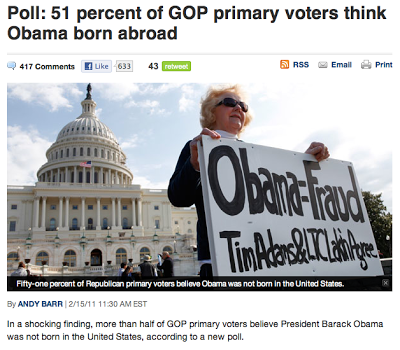
The other was that 51% of Republicans are birthers.

In a shocking finding, more than half of GOP primary voters believe President Barack Obama was not born in the United States, according to a new poll.

Fifty-one percent of 400 Republican primary voters surveyed nationwide by Public Policy Polling said they ascribe to the controversial birther conspiracy theory — despite the fact that the state of Hawaii has posted Obama’s certificate of live birth.

Here are two things that are manifestly not so, and which are heartily believed in alternative right-wing reality.

But I wouldn’t call this ‘shocking’. Why should it be, when an entire news network is entirely given to spreading misinformation and deceiving its viewers? I think Fox News should be running this graphic:

Talk the Talk Twofer: Google and Bing + Shit happens

Two Talk the Talk episodes have come down the pike today.

One is the “Google and Bing” story about dueling search engines and why being clever sometimes looks the same as being very stupid.

The other is about the phrase “shit happens“, which can get you into a lot of trouble if not handled correctly.

You can find older episodes on our Facebook page. Be sure to like us!

Faith as a cudgel

I am sometimes amazed by the simple hell Mormons give each other.

In recent years, a number of Mormon intellectuals have been spreading the meme that what matters in the church is not correct belief (orthodoxy) but correct practice (orthopraxy). In other words… they believe that it doesn’t really matter if you believe in the principles and doctrines that the leaders of the church teach. So long as you conform to the practices that the church can easily measure, such as paying tithes, obeying the dietary restrictions of the Word of Wisdom, attending church meetings, and holding regular family night, then you are a good, faithful Mormon and beyond reproach, even if you spend your time on the internet, and elsewhere, trying to convince others to adopt unorthodox beliefs that are clearly contrary to church teachings and leaders.

Let’s call this “Orthopraxy” meme what it is: Pharisaism. Those who practice Mormonism after this fashion are modern Mormon Pharisees.

Ah, the anti-intellectualism. I remember it well.

Mormons set a high bar for themselves. It takes a lot of constant effort over your whole life just to be considered basically ‘active’. Except that for this guy, it’s not only enough to identify with the Church, or just to do Mormon things. You also have to believe the right things. In Orwellian terms, you have to be “goodthinkful”. And to do otherwise is to open yourself up to criticism from the über-righteous.

I don’t identify with New Order Mormons, either. [Carson N corrects me on what NOMS are about — see below.] Okay, so you’ve noticed that there’s a lot of shift in “when a prophet is being a prophet”, or that the Book of Mormon has major factual issues. Maybe you want to believe that the Church is true, but you’ve noticed that it teaches wrong things. The right answer is not to erect complicated apologetic structures just so you can hang on to your precious belief by your fingernails. (Especially when people take it upon themselves to come and stomp on your fingers.) So-called ‘liberal Mormons’ may be engaging in convenient rationalisations to support their belief (and what Mormon doesn’t?), but at least they’ve noticed that Mormon doctrine has holes in it, and they’re trying to figure out an nuanced explanation around the conflict. This guy seems to think that Mormon doctrine is straight-forward, which suggests that he’s not really paying attention.

I do agree with him on one score: don’t be a hypocrite. If you know your belief system doesn’t make any sense and doesn’t jibe with reality, get out of it quick. If you’re in it, be in it! But then, it is a bit tricky to believe in Mormon orthodoxy when no one is able to tell you exactly what Mormon orthodoxy really is from year to year. Doctrines are subject to ad hoc modification or disavowal (define ‘Lamanite’ anyone?), and only later will someone say, “That? Oh, we quietly stopped talking about that decades ago!”

So how about this, orthodox Mormons — define orthodox Mormon belief, and then get back to us. Until then, stop giving other people a hard time over beliefs you haven’t got evidence for. Imaginary conflicts like this one remind me why I’m glad I left.

Bonus thought: If you want everyone in your church to be super-believing, then make it possible for less-believing people to leave without all the social consequences, like divorce and character assassination. You can’t have it both ways.

UPDATE: It seems I’m not talking about NOMs, though the linked author sure sounds like it. I’m probably describing ‘liberal Mormons’. Carson N points out that NOMs are not by and large apologists. Which was confirmed to me by reading the NOM Forum. They’re just as cynical and disbelieving as any RfM poster, except that they’re Trapped by the Mormons. Which I find unbelievably depressing. I hope Carson’s right that many NOMs use The Third Way as a transitional state, and that as soon as possible.

However, my eye-opening NOM experience makes me want to reiterate my Bonus Thought above: Let my people go. It should be okay to leave a religion without professional or social repercussions. It would only make the members who are left more committed, which ‘Brother Tiny Stones’ would no doubt like. Sorry to any NOMs who felt maligned.

One more thing: I don’t think the word ‘cult’ is a useful label, but if I had to describe the essence of cultiness, I’d say two things:

1. People in a cult aren’t forthcoming about their doctrines to those that aren’t initiated.
2. A cult won’t let you leave.

By these two guidelines, the Mormon Church starts looking a lot cultier the more NOM stories I hear.
Older posts Newer posts

© 2026 Good Reason

Theme by Anders NorenUp ↑