Good Reason

It's okay to be wrong. It's not okay to stay wrong.

Category: post (page 34 of 125)

Ronald Reagan was a bad president.

Ronald Reagan’s 100th birthday is coming up, says Gawker. I grew up in the Reagan 80s, so I knew Reagan sucked. Every punk song said so. Oh, sure, he did preside over economic good times and suffuse America with a breezy optimism that was sorely lacking under Carter. He was even fortunate enough to preside over the fall of the Soviet Union (by outspending them). But there were a lot of negatives.

  • His union busting made things hard for working people.
  • He dawdled on AIDS, and his flunkeys treated it like some kind of joke.
  • His checkbook diplomacy made life into a hell for South Americans, and ended up funding dictators that we’d end up fighting later.
  • His ramped-up militarism turned America into Sparta II, and not having that money for schools impoverished America’s education.
  • His public piety paved the way for the religious right.
  • He refined image manipulation to an art. Prior presidents were thinkers and decision-makers — Reagan was just some kind of totem that we held aloft to show ourselves our national identity. There wasn’t the same kind of identity politics before Reagan.

And that’s just the things I can think of off the top of my head.

But there’s one thing that he’s responsible for that towers over all those other things for me.

He championed a reflexively anti-government philosophy that has pervaded American thought to an extent that we’re not even aware of. In saying

government is not the solution to our problem; government is the problem

he harnessed a counter-productive cynicism about government disguised as liberty. With this view came privatisation and free-market cultism. Lack of regulation over the financial sector has caused untold economic hardship. And now we have a new generation of poorly-educated citizens who don’t know that they are the least taxed of any developed nation, and complain loudly about having to pay their share.

For someone in government to undermine the very fabric of government was unconscionable. Other presidents did it worse, but Reagan started it rolling. And that’s why he was a bad president.

On faith and gratitude

I was quite moved by the story of Ted Williams, the homeless man with the golden voice.

It seems that he’s getting a second chance, and people are clamoring to have him do voice work. Now his biggest problem will be managing his success. I sure hope he makes it.

I have to say, it’s made me think about my attitudes about homeless people. Instead of averting my eyes from someone’s cardboard sign, might I not look closer and find a special talent? How many people passed right on by him?

Here’s a more recent interview.

Mr Williams is a religious man, mentioning his god a lot, giving his god credit for his good fortune. I don’t mean to take away from his story, but it seems to me that people, not gods, are responsible for his turnaround. The Columbia Dispatch reporter who discovered him, the Redditors who worked to find him and get him some things he needed, the employers who are seeking him out and lining up work. When he had his god without the people, he wasn’t doing too well.

It reminds me of the joke: Someone said to a farmer, “God certainly has been good to you with your beautiful farm.” And the farmer said, “God? You should have seen the state he had the place in before I came along!”

When someone has little control over their life, it’s a normal human tendency to be superstitious. And sometimes when I look at my life, I feel an overwhelming sense of gratitude. Even I feel like directing that gratitude toward the entire universe! But then I think how much better it is to direct it back to the people who make my life worthwhile.

It’s important to correctly identify the source of the good things that come to us. We humans can do a lot for each other, and we do, even when gods do nothing.

Opt-out for phone books

Like everyone else in Australia, every year I get phone directories plopped onto my porch (sorry, veranda), even though I don’t want them. (Between Google and the White Pages website, phone books seem like such a leftover artifact.) And every year, I dutifully carry the dratted things off to the Post Office because they want them, and they’re happy to hold extra copies for people who want extras. Apparently there are such people.

Sensis is the company that makes the books in Australia.

Sensis admits that producing the 22.5 million White Pages and Yellow Pages directories in 2009-10 created the largest part of the company’s carbon footprint. More than 52,000 tonnes of paper are used to make the directories each year and they account for 175,000 tonnes of emissions annually, while Sensis’s business operations (fleet, electricity and air travel) total 30,000 tonnes of emissions.

If everyone’s getting the books I’m getting, 22.5 million phone books would cover the state of WA nearly twice.

Well, I’ve just discovered that you can halt the tide by opting out through Sensis’ Directory Select website. By telling them your address, you can cancel delivery and stay off the list for three years.

It’s not the best solution — the process should be ‘opt-in’, rather than ‘opt-out’. Why don’t they do it that way? Oh, someone’s already asked.

Why not offer an opt-in system rather than an opt-out system?

With such widespread use of Yellow Pages® and White Pages® books and only a small proportion of people requesting not to receive a book, we believe an opt-out such as www.directoryselect.com.au is an appropriate way to support consumer choice.

Hey, how about we make that proportion a whole lot bigger? Head over to Directory Select now while you’re thinking about it.

Why get married? A straight guy reflects…

I have an announcement: Ms Perfect and I are engaged! I proposed on Christmas Eve, and amazingly she said yes, despite knowing me for years.

Members of my family were pleased. At last, our relationship would have legitimacy! (No, they didn’t say that. They said, Have the wedding in winter so we can come to Australia in summer!)

Before the engagement, we lived in delicious sin as a committed couple, ready to spend the rest of our lives together. Now, post-engagement, we’re living together as a committed couple, ready to spend etc. No difference, really. So why did I decide to do this? It’s not like we had to get married. Besides the ring, some photographs, and a certificate, things won’t be noticeably different. And as Dean once said, secular atheists don’t need marriage. But I could think of a few reasons why I might want to be married.

It’s a party. Okay, we can always have a party. But not one as theatrical. Or cinematic. So it’s something.

Okay, next reason. It’s a narrative of how your life is supposed to go. You grow up in your middle-class suburban home, watching movies with weddings and thinking, “This is the goal.” That’s not very good either, but we’ll add it to the pile with the other reasons.

Having children out of wedlock would be a stigma, but that’s only an issue for a few more years, as all the people who think this will assuredly die off soon. So let’s move on.

How about this: It’s a way of making your relationship public and real. Well, what about now? Aren’t we already public and real? And yet…

It’s like I don’t really have a reason at all for wanting to be married, not a reason anyway. But all the little reasons add up, plus an urge that says, “This is what I want to do. With her.”

As I weighed up my reasons for marriage, I found myself (not for the first time) considering the situation of gay guys and gals, and wondering why they might want the same thing. I also reflected on the reasons people had for denying them marriage.

Why do they need marriage? say the Moral People. Why don’t gay people just live together? Well, we ‘just’ lived together, and it was lovely. But I decided I wanted to do it ‘for real’. What if someone had come and told me we couldn’t, because their god disapproved? And since theism is massive projection, they mean ‘because they disapprove’. I’d tell them to get bent, and I’d hope any gay couple would do the same.

Well, we’ll give them a civil union, the Moral People continue, but we won’t call it marriage. Isn’t that good enough? What’s the difference? Well, is a civil union a marriage? I’d say no, it’s not. So what is a marriage? A marriage is where they say “It’s a marriage.” If they don’t, it’s not. And that matters to me.

And I guess that takes us to a Big Reason for marriage. Marriage is the way our society confers favour and approval on relationships, and some of us — however iconoclastic and rugged we be — desire it. We want the whole thing, cake and ring and all, however silly and clichéd that is. Religious conservatives (ever the tribalists) know something about societal approval too, and they oppose gay marriage because they don’t wish to confer societal approval on those types of relationships.

At least, I think this is what’s going on. I have no idea if this is what goes through the mind of a religious conservative or not, though, because strangely not once in any of the many discussions I’ve had on this topic has one of them ever said this. They come up with log-stupid arguments about reproduction, polygamy, or incest, but they never say ‘I can’t stand them and won’t have them in the club’. Either they’re ashamed to admit that’s the real reason, or I’m totally off-base. But I don’t think I am.

How lucky I am to be a straight guy, able to marry the straight girl of my dreams. How unfair that not everyone can have what comes so automatically to us.

Warring religious tribes

I’ve always been fascinated by the story of Hypatia of Alexandria, the ancient Greek mathematician. So I finally got a chance to see the film ‘Agora‘, which treats her life, her death at the hands of a Christian mob, and the destruction of the library of Alexandria (again, at the hands of a Christian mob) — one of the great crimes against humanity, but considered by Christians to be a victory over paganism.

A theme in the film is the continual warring of religious tribes — what Richard Jeni described as “killing each other to see who’s got the better imaginary friend”. Back and forth it goes, as pagans attack Christans attack Jews attack Christians attack pagans… on and on, in return for perceived insults against their gods. (The gods seem less inclined to deal with such slights directly.)

And I thought: Religion hasn’t changed. Some religions which are considered nice and moderate now had murderous beginnings, and could easily return. The Taliban of today partakes in the same spirit as the Christians of Hypatia’s time. Christian pastors in Africa are calling for the execution of gay people. Meanwhile, Pakistan is considering getting rid of the death penalty for blasphemy, and it’s driving Muslims to violence.

Violence flared Friday as police and protesters clashed during a mass protest strike that closed businesses across Pakistan over a bid to end the death penalty for blasphemy.

Police said protesters near the home of unpopular President Asif Ali Zardari in the financial hub of Karachi pelted stones as they shouted slogans including “We’ll sacrifice our lives — we’ll save the sanctity of the Prophet”.

Teargas shells were fired to disperse them, while normally busy town centres turned quiet across the Muslim country, AFP reporters said, following a move to amend a law which permits death sentences for those found to have blasphemed.

Religion isn’t just believing what you believe and leaving it there. It’s this kind of thing that turns me from ordinary non-believer to raging anti-theist.

I could have said ‘Human nature hasn’t changed’, and that would be true, too. But without religion, what would we fight over instead? Resources like food, water, and oil? We fight about that now. No change there. Sports teams? Well, regionalistic fervour is a worry. But these incidents are a direct result of pious people taking on the presumed injured feelings of their deity, and their willingness to kill in order to silence others. As it was in the beginning.

UPDATE: I’ve just remembered this recent story about the bombing of a Christian church — in Alexandria, of all places.

Egyptian investigators say they may have uncovered a number of people with possible links to Saturday’s church bombing in Alexandria. Meanwhile, Egyptian religious leaders are working to maintain a precarious calm between Christians and Muslims after several days of angry demonstrations.

Eyewitnesses say a fragile calm prevails after overnight clashes between Coptic Christians and police in front of St. Mark’s Cathedral in Cairo, which is the headquarters of Coptic Pope Shenouda III. Dozens of police and protesters were reportedly wounded in the clashes.

Pope Shenouda is urging the government to take steps to prevent further violence.

He says everyone should reflect on what to do now in order to come to terms and prevent such events from repeating themselves. He stresses that such violence is new to Egypt.

In the light of history, this claim is cruelly and ironically absurd.

The Grand Mufti of Egypt speaks out.

There is no religion worthy of the name that does not regard as one of its highest values the sanctity of human life. Islam is no exception to this rule. Indeed, God has made this unequivocal in the Quran by emphasizing the gravity of the universal prohibition against murder, saying of the one who takes even one life that “it is as if he has killed all mankind.” Islam views murder as both a crime punishable by law in this world and as major sin punishable in the Afterlife as well. Prophet Mohammad said, “The first cases to be decided among the people on the Day of Judgment will be those of blood-shed”

Terrorism, therefore, cannot be the outcome of any proper understanding of religion. It is rather a manifestation of the immorality of people with cruel hearts, arrogant souls, and warped logic.

While it’s encouraging that he’s condemning violence, he’s picking an orchard-worth of cherries here. The verses he’s picked out about murder contradict others in the Koran that command the killing of unbelievers. On what basis does he think his peaceful interpretation of his religion is more correct than an equally scriptural violent interpretation?

If terrorism were really incompatible with ‘proper’ religious understanding, then we should expect such incidents to be fairly rare. Unfortunately, they’re not. Such acts form a part of religious understanding for a good many people.

Best of Music 2010

Most Interesting Change of Direction
Swim – Caribou

This album divides fans just a bit. A few people got whiplash when founder Dan Snaith switched from glitchy sunshine laptop pop to straight-up four-on-the-floor dance grooves. You can still hear the old Caribou, but it’s not exactly a straight line. Even so, I really enjoy this album. You know that he knows what he’s doing, and you go along for the ride.

Outstanding track: ‘Bowls’. Cool harmonics from Tibetan singing bowls, plus slightly lop-sided percussion from the wooden sticks you use to play them. Trippy.

Best Scandinavian Album
Skit I Allt – Dungen

I was new to Dungen’s proggy psychedelia, but this album pulls away from that formula and throws in some easy listening and something approaching pop tunes, but in a good way. The most striking element for me is the drums. They’re in there, hammering away, but folded into the mix so as to take out any harshness, and make the whole thing smooth. Really easy on the ears, and musically very accomplished.

Best Local Album – Perth Division
Sail Becomes a Kite – The Bank Holidays

Their live gig was one of my favourite shows this year. I remember sitting in the audience thinking These are really good songs. Fortunately, it translates well onto disc. The Banks (or the Hols?) are more downbeat, and summer has turned to autumn (as on ‘Tripping Up to Fall in Love’). But the harmonies shine through on the wonderful ‘Oxford Street’ and ‘Her Majesty’s Voice’.

The magic only fails them on the last two tracks — ‘In the Desert’ is a bit less-than-inspiring, and why would a note-perfect band introduce pitch problems into ‘Gravity’s Playthings’? Less would have been more. But that doesn’t stop this album from being one of my most-played of the year.

eMusic link here.

Best Album from a Legacy Band
Something for Everybody – Devo

When a old favourite band releases their first album in twenty years, you just hope it’s not a disaster. In this case, it’s far from it. Maybe it was the creative hiatus, maybe the clever and public focus-grouping, but there are a lot of strong songs on this album. It’s not a new direction for Devo, as they cheerfully admit on ‘What We Do’ (“What we do / Is what we do / It’s all the same / There’s nothing new”). But what this album does well is combine the energy and sound of Devo while borrowing back the electronic dance grooves of younger bands that grew up under Devo’s influence. And on songs like ‘Later Is Now’ or ‘March On’, you get a sense of that epic swoosh — the anthemic quality that made earlier Devo albums so stirring.

Best Jazz Album
Jasmine – Keith Jarrett & Charlie Haden

Two great masters return to the standards. Who needs drums when these guys have such telepathy between them?

Best Ambient/Electronica Album
Tiger Flower Circle Sun – Christopher Willits

There were lots of good albums in the ambient category this year, especially Loscil’s “Endless Falls” and Taylor Deupree’s “Snow (Dusk, Dawn)”. But I keep coming back to this album. Maybe it’s the way the album takes the glitch concept (which was already great in the hands of Willits) and expands it beyond its traditional boundaries. What you get is a compulsively listenable rock/glitch hybrid. Very fitting, given the botanical theme of the album.

Best Album I Missed Last Year
Sapphire Stylus – Nick Duffy and the Lilac Time

Well, really I didn’t ‘miss’ this album — it was a December 2009 release, and I didn’t get to hear it before last year’s roundup. It’s an amazing album, or perhaps ‘sketchbook’ of multi-instrumental folk. Whereas previous Nick Duffy albums have a wistful tone, this one seems more assured and confident. Happy, even. Perfect for contemplating the run of a river, or watching the sky go by. Not a bad track in the bunch.

Can’t find a video. Check out samples on eMusic.

Song of the Year
Half Asleep (Lusine Remix) – School of Seven Bells
Album: Horizon Line

This is actually a SVIIB song from a couple of years ago, but Lusine’s remix makes it fresh, cutting out a lot of the murk of the original, and keeping things perking along. The vocals of twin sisters Alejandra and Claudia Deheza work to great effect.

Have a listen, or even download it free if you wish. Isn’t it nice when that happens?

Album of the Year
Lali Puna – Our Inventions

I never even liked Lali Puna before this, but this is my most heavily played album of the year. Once I start it playing, I soon find myself at the last track wanting to hear it again. There’s something simple and effortless about it, and very downbeat. Try the title track, which combines lovely lyrics with a line from Saint-Saëns’ ‘The Swan’.

China bans foreign words

China is concerned about creeping English.

Chinese authorities have banned the use of foreign words and phrases – especially English – in Chinese newspapers, books and websites.

The ban, reported Wednesday, was issued by the General Administration of Press and Publication, the governing body for written publications. It says the increasing use of English and half-English phrases is damaging the purity of the Chinese language and disrupting the nation’s “harmonious and healthy cultural environment.”

No language is pure — all languages change over time, and every language is influenced to some extent by other languages. This is a futile attempt to stop language change, and probably to promote a standard variety of Chinese.

China’s not alone — other countries have taken action from time to time to prevent the borrowing of English words. (Which is fine — we have something of a trade surplus going at the moment.) Other countries include Iran — remember ‘elastic loaves‘?

And, of course, France, which has been trying to replace the stubborn ‘e-mail‘ with the more Frenchy ‘courriel’ for years. Doesn’t seem to be taking, though — Google gives me a lot more hits for “email” than it does for “courriel” on French pages. (Though interestingly the situation is reversed for the more formal “votre courriel” v “votre email“. Could this be a formality thing?)

Anyway, I think China is going to find that while this law may hide English from view, it will do little to stop the borrowing of English words.

The Provo Tabernacle died for your sins

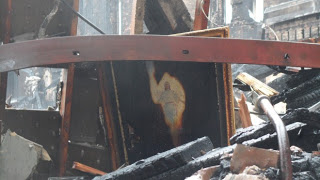
The Provo Tabernacle burned down. It’s a real shame. I went to church there a couple of times in my Utah days, and I remember it as a good old building. It would have made a nice library in 100 years.

One might wonder, of course, why the Mormon god would allow a church building to be destroyed by fire as he watches, pitiless and indifferent to human affairs. One might even wonder what message he intends to send. Perhaps an Old-Testament-style message of anger and vengeance! The fire and destruction symbolic of the wrath to come. A Mormon might get a sense of divine disapproval, and that would never do.

But wait! It’s a Christmas miracle!

As the four-alarm fire raged at the Provo Tabernacle, firefighters and those watching helplessly from the sidewalk observed something truly remarkable. Some are even calling it “a Christmas miracle.”

A painting of Jesus Christ burned in the fire, save for the image of the son of God [yes, that was the wording chosen by Fox News], which was left unscathed.

Yep, the church burning down isn’t the real takeaway here. It’s the painting. That’s the ticket.

This is the Argument from Incomplete Devastation, one of many ways to creatively interpret events in order to sustain a narrative that you already believe. Religious folk are quick to use this one because in the face of disaster, there are only two possible outcomes — either your faith is boosted, or your faith is boosted more. You have to admire their optimism, at least.

Here’s the scorched painting. Coming soon to a fireside near you.

Wait a minute! Forget about Jesus — that outline around it looks strangely familiar! Could it be the hunched figure of…

Nah.

God is good, as long as you keep expectations low

If anyone wants to convince me that a god exists, prayer studies could be one possible avenue. So I noticed this headline:

Prayer May Help Victims of Domestic Abuse

And how ‘may’ prayer ‘help’? By preventing abuse? No, nothing quite so concrete.

Prayer can help victims of domestic violence deal with their situation and emotions by using coping methods such as venting, a small new study suggests.

It included dozens of people in abusive relationships who were interviewed by Shane Sharp, a sociology graduate student at the University of Wisconsin, Madison. The racially diverse participants came from different regions of the United States, were mostly from Christian backgrounds and had varying levels of education.

I wonder if the abuse victims were mostly Christian because of availability. Not the greatest track record on gender equality or anything.

One finding was that prayer offers “a readily available listening ear” to people who were boiling with anger.

“If they vented their anger to their abuse partner, the result was likely to be more violence. But they could be angry at God while praying without fear of reprisal,” Sharp said in a university news release.

Prayer also offers domestic abuse victims an opportunity to see themselves as God views them.

“During prayer, victims came to see themselves as they believed God saw them. Since these perceptions were mostly positive, it helped raise their senses of self-worth that counteracted their abuser’s hurtful words,” Sharp said.

Is anyone else underwhelmed by this? Say you’re the all-powerful creator of the universe, and one of your beings (or believers) is suffering horrifying abuse in a relationship. You’re capable of doing anything to help. What will you choose? Maybe — stop the abuse? Turn the abuser’s heart? (The god of the Bible can change people’s feelings, you know.) How about a mysteriously vague heart attack for the abuser?

Or will you… give the abused spouse vague positive feelings? Until the next cycle of abuse. Thanks a lot.

I don’t suppose I’ll be getting many gloating messages from believers about this study. It’s interesting about prayer, just like other studies are interesting about placebos, but in order to believe that a god was behind the effects, you’d have to believe that God is watching case after case of abuse while doing nothing real. How many cases? Surprisingly many, according to this estimate from the Australian Department of Statistics.

approximately one in five women (19 per cent) have experienced sexual violence at some stage in their lives since the age of 15 and one in three women (33 per cent) have experienced physical violence at some stage in their lives since the age of 15.

If prayer helps abuse victims, then this is a strange definition of ‘help’.

When people talk about the power of prayer, let’s remember that the only benefit we observe is the kind of stuff that people could imagine up anyway, even if no god existed. If this god does exist, he could surely do better. But for some reason, he won’t. Skip the god. Better to talk to people who are there to help this kind of thing.

Word Lens

This has to be the coolest machine translation idea I’ve seen for a while.

Imagine taking this app on vacation in a foreign country. Can language goggles be far behind?

Notice that it doesn’t always try to twiddle the word order, even where it would be appropriate. On the other hand, it must be doing all kinds of text and character recognition under the hood. Not to mention colour and size matching. I bet later on they’ll try font matching.

Now if I can just get a copy to play with on my iPhone.

And an iPhone.

Older posts Newer posts

© 2026 Good Reason

Theme by Anders NorenUp ↑