Good Reason

It's okay to be wrong. It's not okay to stay wrong.

Category: post (page 28 of 125)

Talk the Talk: Now on iTunes!

This is exciting: my podcast “Talk the Talk” is now on iTunes! Yes, you can now hear a fresh dose of linguistics news every week, in convenient podcast form.

Head over to the link by clicking on the nifty graphic below. Subscribing is free, of course.

While I’m thinking about iTunes — I’m still trying to figure out the profanity guidelines for their titles. I noticed that ‘shit’ turns into ‘sh*t’, which is fine. But ‘WTF’ comes out ‘W*F’. They starred the T? Shouldn’t they have starred the F?

WT*?

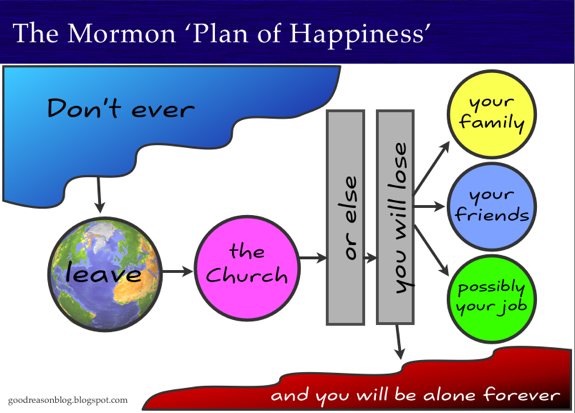
The Mormon ‘Plan of Happiness’

Hey, who remembers this from church? I think I got all the details right.

Really puts things in perspective, doesn’t it?

Of course, it might make more sense if you’ve seen the real chart, or had a missionary draw it for you.

UPDATE: I wrote this as a comment on r/exmormon, and decided to paste it here:

If I had to name the most odious and evil LDS doctrine, I wouldn’t hesitate to say ‘eternal families’.

That may seem like a strange answer, but that’s the thing that allows all the emotional hijacking, even more than heaven and hell. If you don’t keep in line, your family will be broken up and you’ll be in isolation for eternity.

It uses the natural feelings of love we have for our family, and subverts them for its own ends.

Unintentional MLK quote mangling on Facebook

“A lie can travel halfway around the world while the truth is putting on its shoes.”

Mark Twain was supposed to have said that. But I can’t be sure — Mark Twain has been credited with all kinds of sayings that he may not have said. (Note the lazy “attributed” appendage to that last link.) But it’s true that with the increased speed of communication on the Internet, a mistake can spread worldwide and not get picked up.

A case of misattribution might have popped up on your Facebook wall, in light of a recent assassination.

Jessica Dovey did not intend to become the epicenter of an Internet-wide discussion about the nature of quotation, attribution, and Osama bin Laden. Yet that’s exactly what happened when Dovey’s Facebook-status sentiment — “I will mourn the loss of thousands of precious lives, but I will not rejoice in the death of one, not even an enemy” — became entangled with a Martin Luther King, Jr. quote she also posted. Within a day and through no fault of her own, Dovey’s words had gone viral, misattributed to King.

Since I’m the language guy, I got a call from RTRfm 92.1 to comment. Here’s the playback.

If you’re serious about avoiding the misattribution trap, don’t believe a quote unless it’s accompanied by a source, and then follow the source. It’s the only way to be sure.

Yataghan: I feel so dirty

My Yataghan font has been ripping it up lately. Most recently, it’s appeared on the cover of “The Sword” by Daniel Easterman.

And it’s a featured download on PC World’s website. Kate Godfrey gives it a very kind review.

Midgley began his creation with a sketch of a lowercase ‘s’, followed by an ‘n’ that dipped below the baseline. Many reiterations later, the designer found himself with an impressive cast of characters including an owlish ‘o’ and a dagger of a ‘t’. To complete the look, he topped the font’s ascenders with a bone shape. Touché!

The ampersand is worth the download if only to experience the smart transition of centuries old weapon design into a believable text construction.

And to top it off, Yataghan makes a scarcely recognisable appearance on the website of Babylon Rising, which appears to be… a set of religious lectures?

This May, a four-night event called Babylon Rising will take a new look at the age-old controversy between Christ and Satan. From May 25-28, It Is Written’s new speaker/director, Pastor John Bradshaw, will host a timely, interactive series live from the Cashman Center in Las Vegas.

Oh, well. When I released the font, I knew there was a chance someone would use it for evil instead of for good. It’s the risk an artist takes.

Download Yataghan (and other fonts) from the Page of Fontery.

Annoyed, not offended.

The fourteenth Mormon Article of Faith is, as we all know: Ex-Mormons Are Offended. It’s never anything as complicated as a protracted moral struggle in which one tries to reconcile slippery doctrine with tangible reality and realises it can’t be done. Nope. Someone offends us, and we’re out the door.

But really, how can we help being offended when people define the term so broadly? Just recently, Boyd ‘Li’l Factory’ Packer gave this advice:

Around us we see members of the Church who have become offended. Some take offense at incidents in the history of the Church or its leaders and suffer their whole lives, unable to get past the mistakes of others. They do not leave it alone. They fall into inactivity.

See? It’s not that you can’t believe all the bizarro stuff in church history. It’s that you’re ‘offended’ by it. You’re supposed to let it go. Aaand pay tithing.

Wait — am I being offended by sloppy definitions? No. Just annoyed. But there are other things to get annoyed at.

An interesting story out of New Zealand. It seems the owner of a grocery store didn’t program the automatic door to stay closed for Good Friday. At 8:00, as usual, the doors opened with no staff inside. It took shoppers a while to realise the place was unmanned. What would they do?

About half paid for their groceries using the self-scan service, but that stopped working when someone scanned alcohol, which requires a staff member to check a customer’s age before the system is unlocked.

So a lot of people paid, even when no one was watching. We’re fair-minded beings. Some people didn’t. We’re self-seeking beings, too.

But one religious studies professor jumps to the conclusion that you need a god to be moral. How so? Because obviously all the true Christians were in church of Good Friday! Therefore all the cheaters were grubby secularists.

“The Christian Right have tended to think [that] without the Ten Commandments and God’s divining hand we would never have been able to develop a plausible and sustainable morality.

“This [Pak ‘n Save incident] is like some mad experiment, because you’ve sent off to church the religious and it’s the secular who have gone shopping on Good Friday … and you’ve put them to the test.

Given the proportion of Christians in prisons (though c.f.), I’ll wager there were a few in that store.

Also annoying is this column in which Ross Douthat mounts a defense of hell, which for some inexplicable reason appears in the opinion pages of the New York Fucking Times.

Doing away with hell, then, is a natural way for pastors and theologians to make their God seem more humane. The problem is that this move also threatens to make human life less fully human.

Atheists have license to scoff at damnation, but to believe in God and not in hell is ultimately to disbelieve in the reality of human choices. If there’s no possibility of saying no to paradise then none of our no’s have any real meaning either. They’re like home runs or strikeouts in a children’s game where nobody’s keeping score.

I don’t know why he’d imagine that eternal torture for some is what it takes to make life meaningful. I have noticed, though, that people who defend the doctrine of hell never think that they’re going there. Or maybe they know that fear does wonders in keeping believers in line. To hell with that.

Mac people, PC people

Forget “dog” v “cat” people, “left” v “right”, or “tops” v “bottoms”. The real split in personality is “PC person” v “Mac Person”. Hunch.com (via Mashable) gathered a lot of random data about people, and saw how it correlated with their sense of “Mac” or “PC” identification.

A few details are striking.

First off, the prestige of the Mac is evident by the fact that 25% of respondents self-identified as “Mac people”, even though Mac market share is around 10% (When’d that happen?). Either a lot of people are fibbing, or they’re using both, and like Mac better.

Also noticeable:

Mac people are 50% more likely than PC people to say they frequently throw parties.
PC people are 38% more likely than Mac people to say they have a stronger aptitude for mathematical concepts.
Mac people are 95% more likely to prefer indie films.

And most interestingly for me:

Mac people are 80% more likely than PC people to be vegetarian.

Cutting edge cultural trail-blazers, or insufferable hipster trendoids? We report, you decide.

Why I am not a good Christian

Ricky Gervais has written his follow-up to his “Why I’m an Atheist” article, and it’s called

Why I’m a good Christian.

The title of this one is a little misleading, or at least cryptic. I am of course not a good Christian in the sense that I believe that Jesus was half man, half God, but I do believe I am a good Christian compared to a lot of Christians.

It’s not that I don’t believe that the teachings of Jesus wouldn’t make this a better world if they were followed. It’s just that they are rarely followed.

Gandhi summed it up really. He said, “I like your Christ, I do not like your Christians. Your Christians are so unlike your Christ.”

I have always felt this way, even when I believed in God, and in a weird way I feel I am still a pretty good “Christian” who doesn’t believe in God.

I doubt my behaviour differs greatly from people who call themselves Christian, except for all that babbling to imaginary people. I think I’m a pretty solid person who tries to do good things, help others, and so forth, like most everyone else.

And since this behaviour is common to Christians and non-, why call it ‘Christian’? Why not call it ‘human’? Christians aren’t getting their morality from the Bible, with its approval of slavery, misogyny, and child abuse — they’re good because of their innate moral sense, just like everyone else. Humans, as social beings, needed to evolve a sense of ‘morality’, involving social reciprocity, empathy, and fairness. Only after that had been in place for tens of thousands of years did religions then co-opt it for their own ends.

So I think Ricky Gervais is giving Jesus — and Christianity — too much credit.

Jesus was a man. (And if you forget all that rubbish about being half God, and believe the non-supernatural acts accredited to him, he was a man whose wise words many other men would still follow.) His message was usually one of forgiveness and kindness.

Well, usually, except that bit about being tortured in hell forever. With real fire. Jesus said this kind of thing not just once, but over and over. Not even the Old Testament threatened the dead with eternal torture. That doesn’t come across as very compassionate to me, so I guess I wouldn’t be a very good Christian.

Jesus also taught that his system had to come first, even ahead of your own family. If there was a conflict, you were to hate your mother and your father. Imagine how much ostracism that’s caused. I wouldn’t demand that of my followers. That’s the kind of thing a cult leader would do.

I’m not racist enough to be a Christian, either. One time, a Canaanite woman asked Jesus to heal her son from demons, and he called her a dog. (He later relented, but never apologised.) He seemed to be okay with women generally, but not that time. Tone it down, dude.

He even cursed a fig tree for not bearing fruit. And figs weren’t even in season! I don’t care for figs that much, so I probably wouldn’t get that worked up over it. Fig newtons are quite nice. If I had the power like Jesus was supposed to have, I’d make the tree bear fig newtons, but I wouldn’t curse it. How are you going to get any figs that way? Geez.

So I guess I’d be a terrible Christian, unless I were cherry-picking all the nice things Jesus said. But if you’re going to select things that already agree with your moral sense, why not skip Jesus and use your moral sense from the beginning? For most people, that’s better than Jesus to start with.

I guess I should cut Jesus some slack. Maybe if he existed, he was an okay guy, and people just made up all those stories about him. But the way it’s written in the Bible, Jesus was a jerk. Good Christian? Christians are good in spite of their Jesus, not because.

Talk the Talk: It Began in Africa

This week’s Talk the Talk podcast is a corker. Ben and I talk about a new piece of research that traces human language all the way back to Africa. Usually, historical linguists reconstruct languages using words. This one examines the numbers of phonemes. If the serial founder effect works for languages like it does for biology, we should expect to see languages use a lot of sounds when they’re close to language’s place of origin, and fewer sounds in languages that have split off — and we do.

Have a listen here.

Burqa ban

I’ve been ignoring the European burqa ban. It’s fraught. Nonetheless, the issue marches on. Recent attention has focused on France.

French burka ban: police arrest two veiled women

French police arrested two veiled women this morning just hours after the country’s new ban on wearing the burka in public came into force.

The women were arrested along with several other people protesting in front of Notre Dame cathedral in Paris against the new law.

Jourrnalists at the scene said the arrests came after police moved in to break up the protest which had not been authorised.

On Saturday police arrested 59 people, including 19 veiled women, who turned up for a banned protest in Paris against the draconian new law, the first of its kind to be enforced in Europe.

Earlier, French police said they will be enforcing the country’s new burka ban “extremely cautiously” because of fears of provoking violence.

To start off, I think the covering is a repressive religious tactic to keep women under wraps and under control.

On the other hand, if I wanted to flaunt my stuff rocking a burqa (or anything else that covers my bits), why should the government stop me? Good on those protesters for their civil disobedience. (Something one hasn’t always seen from certain quarters.) We don’t want the law to be just another form of coercion, unless some better good is served, like the liberation of women from religious tyranny.

Which brings up a point: Burqa bans do not automatically lead to female emancipation. When the Shah of Iran banned it (I am told), many women were accustomed to it, and would never have appeared outside without it. So they just didn’t go outside. But that just shows that religious tyranny, when entrenched, creates unfortunate situations of moral conflict for believers.

If there is a principle behind the burqa ban, it could be worded like this: People should be allowed to wear what they want, free of coercion. Unfortunately, it’s not simple to tell what someone ‘wants’, or when someone is being coerced. People can report that they want things that they have been coerced into wanting. The fact that the burqa is associated with religion tells me that, ipso facto, there’s some coercion going on. I have no doubt that women who wear burqas will tell you they ‘want’ to wear it, just as Mormon women will happily tell you they don’t ‘want’ the priesthood.

So, let’s give both sides their due. I think forced burqa wearing is coercive, and I’ll even allow that government prohibition of the burqa is also coercive. Which leaves Muslim women caught in the unenviable middle.

(Notice that I’m not touching the ‘security risk’ side of the argument. I think it’s bullshit, like all security theatre.)

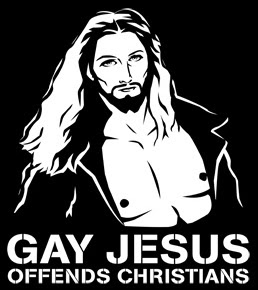
But even though I can’t stand ostentatiously religious and/or oppressive clothing, I’m reluctantly coming down against the burqa ban. Two things are pushing me. One: Legislating against the rights of minorities is a Very Bad Thing, and I can only think of a few things that would justify it. Harming bystanders or children would be two. These women are adults. Maybe they are in a coercive environment. Yes, that is messed up. I wish it weren’t so. But we can fight this in better ways than controlling how people dress. If they can be told what not to wear, I can be told what not to wear. Will I be told not to wear my patently offensive ‘Gay Jesus’ t-shirt? Come on.

Two: The law also gives right-wing jerks the ability to push minorities around. Forget that.

What do you think? I’m still convincible.

UPDATE: A good bit, this.

Talking to creationists

They could block us from the Creation Ministries International event, but they couldn’t stop saying stupid things.

But why wait until then?

Older posts Newer posts

© 2026 Good Reason

Theme by Anders NorenUp ↑