Good Reason

It's okay to be wrong. It's not okay to stay wrong.

Category: post (page 29 of 125)

EXPELLED from Creation Ministries International!

So here’s how it went down. CMI was doing its creationist thing at UWA, and then later at Curtin. As members of a guild club (UWA Atheists and Skeptics), we had approval to attend and hand out information about evolution.

We made up quite a crowd — I’d say 15 or 20 of us from the UWA Atheist and Skeptic Society and the Perth Atheists.

It started well enough. Before the event, we had a discussion with Dr Silvestru himself, who is an affable guy, although it’s scary what must be in his mind. Chatting about science with believers was also quite nice. Strangely, the believers seemed to be almost exclusively young and Asian, and they didn’t talk to us. Only the older CMI helpers did.

When it was time for the lecture to get started, the door was suddenly blocked by about five Christian door blockers, who told us we weren’t welcome to attend.

That blur in the middle is Kylie Sturgess, working to secure our entry.

We explained that we just wanted to attend the lecture, assured them that we weren’t interested in causing any disruption, but it was no go. We explained that it was a public event, advertised on campus, and we wanted to hear the lecture. (Even Dr Silvestru had no problem with us attending.) They said it was a private church service. Now don’t you think that if it were a normal church, they’d love the chance to save an atheist like me?

Negotiations were to no avail, so it was off to Curtin for the second round.

Someone must have phoned ahead to warn the organisers at Curtin, because we were greeted by more security blocking us from entry. I guess when they realised that infiltrators were trying to walk right in to a public event, they decided to tighten things up.

We took this as a challenge to see if one of us could get inside. Kylie tried brazenly walking in, but got stopped and was subjected to a long grilling. David from Perth Atheists was able to breach the first level of security, but was nabbed by the more vigilant second tier. Curses!

The hilarious thing was that Asians were admitted without question, while any Caucasians — even Christians who had no idea what was going on — were given the third degree by security. (Where are all the Asian atheists, by the way? Must remember to get some.) They were actually asking people what church they belonged to! One guy refused my handout, but was then interrogated at the door. I heard one guard say, “Are you sure you go to Victory Life?”

I think it’s revealing that they don’t seem to think that their view can sustain the mere presence of non-believers. So much for peer review.

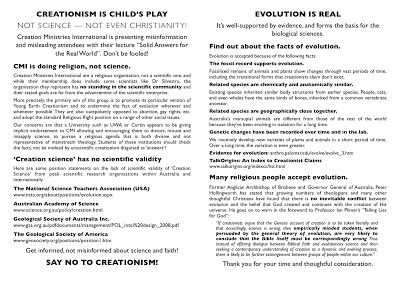
I’d say it was successful. We handed out all 200 flyers. The CMI people were even complaining that in the UWA lecture, people were reading the flyer all the way through the service, instead of watching the presentation!

I don’t know if we changed anyone’s mind, but that wasn’t the point. The point was to raise the cost of spreading misinformation, which we did.

And we didn’t have to attend a silly and fact-challenged lecture.

UPDATE: Ash from UWAASS questions the legality of the church’s actions. Kylie Sturgess gives her take, and I’d like to say that she stole part of my title, right there as we were having coffee. Atheists have no morals.
CMI event at UWA, Curtin

Okay, Perth crew — I have an action item for you.

The Creation Ministries International talk will be at UWA campus, Social Science lecture theatre tomorrow — that’s Sunday, 10 April 2011 — at 9 am. (Friggin’ early birds!)

I’ll be there (along with many members of the UWA Atheist and Skeptic Society and probably Kylie Sturgess) to greet any interested parties with information about what evolution really is. Come and help me have an enjoyable, well-tempered, and good-natured chat with the fundies and the undecided.

Here’s the Facebook event. See you there!

Crossbow control

A horrible story about a gun massacre at a school in Brazil. Sort of like the ones that come out with grim regularity in countries where guns are readily available. I don’t know much about gun control in Brazil, but I do see that voters rejected more controls on guns and ammunition in 2005.

I don’t really want to focus on the religious leanings of the killer. Nor do I want to argue that greater gun availability tends to lead to more gun violence. I guess people do still get killed with guns in Australia, despite the heavy restrictions. (Australia is that tiny sliver down the bottom — it’s kind of hard to see.)

No, I really just want to brag that my state, Western Australia, has implemented a crossbow ban.

WA Police Minister Rob Johnson said the new laws followed an agreement by the Australasian Police Ministers’ Council that crossbows should be banned across Australia.

“The changes will limit the circumstances under which crossbows can be lawfully purchased,” he said.

“We want to reduce the likelihood that a crossbow falls into the wrong hands and is used to injure or kill a person or animal.”

The only exceptions will be genuine crossbow collectors, people engaged in crossbow events who belong to an Archery Australia club, and film producers.

Not only is it hard to get a gun, it’s also hard to get a crossbow. And that’s fine with me.

I used to live in America, so the lack of reaction is puzzling to me. Where’s all the hand-wringing about our right to grab a whole bunch of guns to protect ourselves from people with a whole bunch of guns? Why isn’t anyone saying, “See, if you ban guns, people will pick up crossbows. What’s next, a knife ban?”

Strangely, it doesn’t come up. I guess we’re busy with other issues besides fearing for our lives.

UPDATE: Stephanie from comments informs me that some crossbow fans are indeed chafing under the yoke of oppression. All I can say is, I’m sure glad we’re having this discussion at this level, instead of further on down the track. Aren’t you?

Creationists coming to UWA?

Creation Ministries International (the Australian arm of ‘Answers in Genesis’) is coming to Perth this very weekend. They’ve got their sights set on UWA and Curtin, two universities in Perth. Why would they target universities? Two possible reasons: they’re trying to convert uni students, and they’re trying to borrow the credibility of institutions that do scientific research.

I’m writing a letter to ask UWA to consider whether they really want to be hosting this thing. Not because I want CMI’s views suppressed — I’m happy for them to spread their religious misinformation in church where it belongs. But universities are busy teaching according to the best evidence we have available, and they do not have an obligation to promote anti-science views that undermine their work.

Here’s my letter:

I am writing to raise some concerns about an event by Creation Ministries International, slated for the UWA Crawley campus on Sunday, 9 April. The event is called “Solid Answers for the Real World.”

Creation Ministries International are Young Earth Creationists who teach that the Earth is a few thousand years old, contrary to geological evidence. They attempt to undermine the theory of evolution, which is the basis of the biological sciences. These are fringe views, not supported by evidence, and not generally held by the hard-working and knowledgable members of the UWA faculty who teach in these disciplines.

I would like to ask that the University of Western Australia consider whether hosting this event is appropriate. CMI are, of course, free to espouse their views, but the university is not an appropriate venue for them to do so. By having this event on its campus, UWA could be seen as giving implicit endorsement of the views of CMI. It would allow CMI to trade on UWA’s credibility.

The University exists for the purpose of education and research. It has no compelling interest in hosting an event designed to promote disinformation. And on a personal note, as a lecturer, I find it particularly galling that lecturers at UWA work throughout the week to teach the facts about biology, geology, and science, only to have this work be undone on Sunday.

Thank you for your consideration.

Daniel Midgley
Assistant Professor, Linguistics

What happens if no one listens, and the event goes ahead? Or — gasp — what if I draw more attention to it?

That’s okay, too. In that case, I’ll be there on the day, helping to hand out information, explaining to people what evolution really is, and why the creationist clown show they’ve just seen is nonsense.

What I wish Mike Ash understood

Michael R. Ash is continuing his discussion of testimony over at the Mormon Times with a column titled “What critics don’t understand about testimony“.

Don’t understand testimony? What’s not to understand? I’ve had one and recovered. One thing I wish Mike Ash understood is that testimonial evidence is not good evidence, and relying on it is asking to be fooled.

He’s making an assumption here is that critics of the church don’t understand the church. (It’s a bit like the soggy drunk in a bar, saying “My wife doesn’t understand me.”) Many of us used to be LDS. Some of us served in the church for years, had a testimony, and remember the feelings that kept us believing with more certainty than was warranted by real evidence. So another thing I wish Mike Ash understood is that we do understand the church. We’re critical of the church because we understand it.

While a testimony must be grounded on a spiritual confirmation, the mind is an integral part of gaining our testimony. We are expected to use our minds to study the scriptures and learn what God wants.

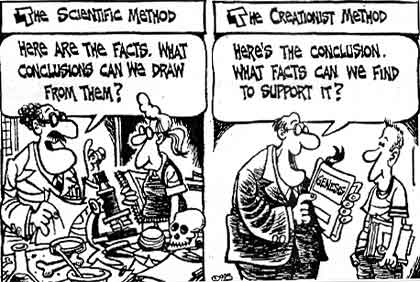
Whoops, presupposition. Whether a god exists is one of the items still under consideration for the testimony-hunter. So the next thing that I wish Mike Ash understood is that if you start from your conclusion, and then try to amass facts to support it, you’re doing it wrong.

It’s not just creationists.

When Oliver Cowdery made his failed attempt at translating the plates the Lord told him: “Behold, you have not understood; you have supposed that I would give it unto you, when you took no thought save it was to ask me. But, behold, I say unto you, that you must study it out in your mind; then you must ask me if it be right, and if it is right I will cause that your bosom shall burn within you; therefore, you shall feel that it is right.”

It’s true that Mormon writings encourage you to think about things that you’re praying about. But encouragement to think does no good unless you learn how to think well — another thing Ash doesn’t seem to understand. That’s not an insult to any Latter-day Saints. Thinking well is a skill. No one’s automatically good at it, and everyone is bad at it when cherished beliefs are on the line. Including me — I’m not nearly as critical of ideas I agree with as I ought to be. But by learning only a few things about how to spot a fallacy and how we fool ourselves, the poor reasoning at church becomes easy to spot.

Here’s a good example:

In 2007, the church published a statement about LDS doctrine which read in part:

“The church exhorts all people to approach the gospel not only intellectually but with the intellect and the spirit, a process in which reason and faith work together.”

It’s no surprise that the church tells people that faith and reason work together. Magical thinkers have been borrowing the credibility of science for years. It’s just a way of muting concerns: Gee, if the leaders say that reason is good, then this testimony thing must be scientifically valid after all. But while reason is concerned with logic and evidence, faith encourages belief without evidence. You can’t use both at once. Faith and reason are opposite and incompatible methods. And that’s another thing I wish Mike Ash understood.

Witty repartée

Behold: the essence of conversation.

Not the words, of course. But the mechanics are all here.

Conversations have orderly patterns that provide the structure.

  • You have to have turn taking; if two people speak at once, they can’t hear each other.
  • There’s elaboration; one person puts something on the table, and the other person expands on it.
  • And we can also see a communicative goal: these boys are getting a lot of enjoyment from their conversational play.

It’s a little surprising that people have this ability at such a young age. But maybe it shouldn’t be. Language is, after all, one of those things humans are good at doing.

Why science is better than religion: The Hell Conflict

Lots of Christian denominations try to downplay the doctrine of Hell, for obvious reasons. It seems inconsistent for a loving god to torture people for eternity, when their sins were of finite duration. Nonetheless, the Bible depicts Jesus teaching that people will be tortured in Hell for eternity. With lots and lots of fire.

One Methodist pastor has been let go because he was humane enough to question this doctrine.

A pastor at a Methodist Church in North Carolina lost his job after questioning traditional views on the nature of hell.

Chad Holtz got his walking papers after posting a note on Facebook supporting a controversial book by an evangelical preacher that rethinks hell as a place for billions of damned souls.

“I think justice comes and judgment will happen, but I don’t think that means an eternity of torment,” Holtz said. “I can understand why people in my church aren’t ready to leave that behind. It’s something I’m still grappling with myself.”

Because eternal torture is, you know, such an appealing notion.

The money quote for me comes from Alfred Mohler, discussing the book at the center of the conflict:

“I just felt like on every page he’s trying to say ‘It’s OK,'” said Southern Baptist Seminary President Albert Mohler at a forum last week on Bell’s book held at the Louisville institution. “And there’s a sense in which we desperately want to say that. But the question becomes, on what basis can we say that?

That is a really good question: On what basis could we say that someone is, or is not, in Hell? Anyway.

Was it right for the church to oust its pastor? Usually you wouldn’t say that someone should be fired for their belief, but when their business is promoting a belief, then belief is no longer a matter of conscience; it’s a job qualification.

This kind of conflict is an inevitable consequence when these three conditions are met (and in most religions, they are all present to some degree):

1. Faith is touted as a supreme virtue
2. Uniformity of belief is considered desirable
3. Beliefs are unmoored from any empirical base

Point 3 ensures that someone will arrive at a different belief than the mainstream, since there’s no way to verify whether beliefs are true.
Point 2 ensures a conflict between believers who believe differently.
Point 1 makes it difficult to abandon beliefs blithely, so this can entail personal dramas and crises of conscience.

Compare what happens in the sciences.

1. Doubt is the modus operandi. Faith is considered an impediment, not a virtue.
2. The group eventually arrives at a consensus. This is different from groupthink, because innovation is also valued. Anyone who can topple an old established theory using evidence becomes famous.
3. The court of appeal is the world of empirical data, so conflicts can be resolved experimentally for well-defined questions.

This is how science can provide a way to answer well-defined questions, and why groups of scientists do not need to excommunicate each other or burn each other at the stake.

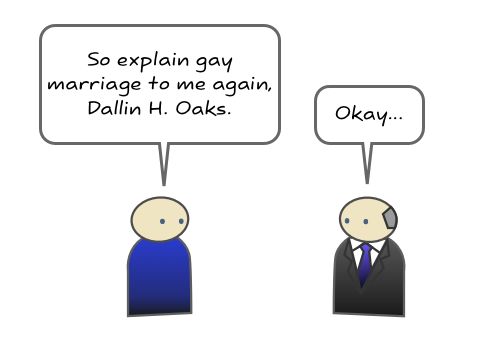
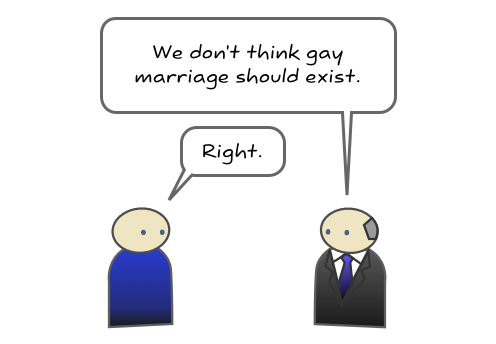
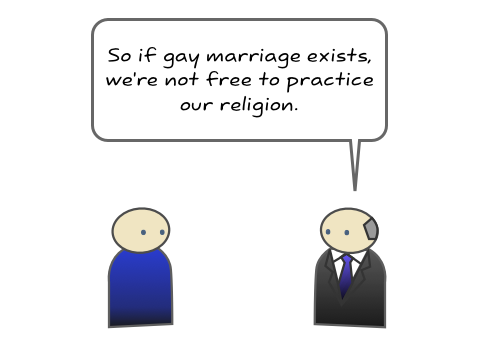
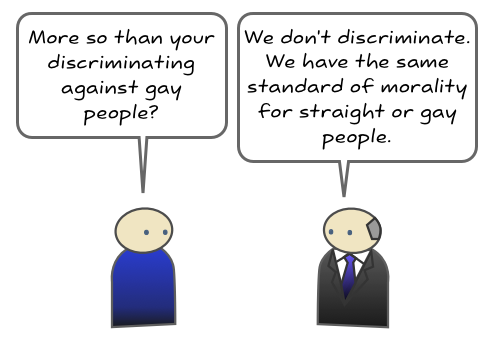
A chat with Dallin H. Oaks

I was talking to Mormon apostle Dallin H. Oaks just the other day, and for some reason, we started talking about gay marriage. He was able to clear up a few things for me.

Dallin H. Oaks has elaborated on these ideas from time to time.

Does going to church make you fat?

This is odd, coming from Time:

Why Going to Church Can Make You Fat

Maybe it’s all the church socials, but a new study finds that those who attend religious activities are more likely to gain weight than those who don’t go to church as often.
Religious involvement is linked to many positive health outcomes, such as happiness, lower rates of smoking and alcohol use, and even a longer life. But research has also suggested that middle-aged adults who are more religious are more likely to be obese. Past data have noted only a correlation between religiosity and weight gain, however; they did not show whether participating in religious activities leads to weight gain, or whether overweight individuals are more likely to seek support in their faith.

I say this is strange because there’s a more obvious correlation: both religious attendance and obesity are tied to poverty.

The link between poverty and obesity is fairly well-known. Unhealthy food is cheaper.

Also well-known is the correlation between poverty and religiosity. (Even the Book of Mormon complains about it.) People in poorer areas rely more on social networks and promises of a better world.

Education level may be driving this as well. Low education is tied to poverty, and there is a connection between education level and religiosity.

The correlation between poverty and religiosity is interesting to me for another reason. The fact that wealthy people are less likely to be religious tells me that religion is what economists call an ‘inferior good‘. Like the no-name brands in the supermarket, religion gets less demand when times are good. People pass it over and go for what’s better if they have a choice.

Proof is not in the eye of the beholder if they won’t show it to you.

I’m not a masochist, but I do check the Mormon Times occasionally. And Michael R. Ash’s latest column is a corker: Proof is in the eye of the beholder.

The next several installments will deal with evidence, proof, faith and Book of Mormon archaeology.

Evidence for the Book of Mormon? At last! Unfortunately, he then spends the entire column making excuses for why we shouldn’t expect evidence. That’s always a bad sign. If he had the evidence, he would rely on it. Instead, there’s tap dancing.

I should note two important points regarding the nature of evidence and the necessity of faith. First, I’m unconvinced that any critic would “convert” because of some alleged “proof” because I doubt that any “proof” could ever satisfy those who have truly hardened their hearts against Joseph Smith.

This is not quite right. When I deconverted, it was not because I had ‘hardened my heart’. In fact, I spent years making excuses for the church and trying to shoehorn the facts into my narrow religious belief. Only when I realised that it had no evidentiary basis did I abandon the religion I’d invested so much in.

Now, as someone who’s doing science, I will change my mind if the facts require. I can think of a few things that would make me reconsider the Book of Mormon. One would be evidence of Hebrew or Egyptian writing in Mesoamerica. Another would be if a Native American language showed good linguistic evidence of Hebrew or Egyptian loanwords — solid patterns of correspondence, not piecemeal lists of ‘similarities’. If Ash has this evidence, let him say so.

I might say that Ash’s presumption may be based on his own attitude. I wonder what evidence he’d accept that his beliefs are in error. I hope he shows up in comments, because I’d really like to ask him that one question.

Here’s his other point.

Secondly, the Lord doesn’t work via secular proofs because that would confound the primary principle of agency. While there are evidences that support religious convictions, there are no intellectually decisive proofs, and there will always be evidences that conflict with our beliefs

Non-LDS philosophers have argued that in order for us to have spiritual freedom — freedom to make choices — God cannot allow us to know — by secular proof alone — that he exists.

If humans had incontrovertible secular evidence for the existence of God, they would be unable to freely choose whether or not to accept God.

So God exists, but he’s not going to give any evidence. And then when I don’t believe in him, he’s going to punish me for not believing in him despite the lack of evidence. If that’s the case, then he values ignorance over knowledge, which is not the kind of being I’d want to worship.

There’s something odd about Ash’s post. Take another look at his two reasons for not giving evidence.

Point 1: If you gave someone evidence, they could still just reject it.
Point 2: If you gave someone evidence, it would destroy their agency because they’d be unable to reject it.

So which is it? Can someone reject evidence, or can’t they? He’s rested his case on two points that contradict each other.

Is this really the best the Mormon Times can do?

Older posts Newer posts

© 2026 Good Reason

Theme by Anders NorenUp ↑