Good Reason

It's okay to be wrong. It's not okay to stay wrong.

Category: post (page 92 of 125)

Evidence for Exodus

Interesting article from the NYT on this Easter holiday:

Did the Red Sea Part? No Evidence, Archaeologists Say

It didn’t look like much — some ancient buried walls of a military fort and a few pieces of volcanic lava. The archaeologist, Dr. Zahi Hawass, often promotes mummies and tombs and pharaonic antiquities that command international attention and high ticket prices. But this bleak landscape, broken only by electric pylons, excited him because it provided physical evidence of stories told in hieroglyphics. It was proof of accounts from antiquity.

That prompted a reporter to ask about the Exodus, and if the new evidence was linked in any way to the story of Passover. The archaeological discoveries roughly coincided with the timing of the Israelites’ biblical flight from Egypt and the 40 years of wandering the desert in search of the Promised Land.

“Really, it’s a myth,” Dr. Hawass said of the story of the Exodus, as he stood at the foot of a wall built during what is called the New Kingdom.

It’s a bit difficult to imagine what evidence there could be for this kind of event. Wave fossils? Sedimentary chariots?

I’m a bit more interested in the idea that the Hebrews were never in Egypt at all. One linguistic argument is that if they had been, we should expect to see lots of Egyptian loan words in Hebrew, and we don’t. From the Catholic Encyclopedia:

[N]otwithstanding the long sojourn in Egypt, the number of Egyptian words that have found a place in the Hebrew vocabulary is exceedingly small.

This is probably something I’ll be posting on more as I learn more about it.
Blind Party mulls one-eyed candidate

Perhaps Giuliani would have made a good Democrat.

Former New York City Mayor Rudy Giuliani told CNN Wednesday he supports public funding for some abortions, a position he advocated as mayor and one that will likely put the GOP presidential candidate at odds with social conservatives in his party.

“Ultimately, it’s a constitutional right, and therefore if it’s a constitutional right, ultimately, even if you do it on a state by state basis, you have to make sure people are protected,” Giuliani said in an interview with CNN’s Dana Bash in Florida’s capital city.

“I’m in the same position now that I was 12 years ago when I ran for mayor — which is, personally opposed to abortion, don’t like it, hate it, would advise that woman to have an adoption rather than abortion, hope to find the money for it,” he said. “But it is your choice, an individual right. You get to make that choice, and I don’t think society should be putting you in jail.”

Like Giuliani, I’d love to see fewer abortions. (I wish they’d promote contraceptives more aggressively in schools, actually.) But how’s the Right going to react to this? When you make an ounce of sense once in a while, it tends to disqualify you in the eyes of those who make no sense.

Schelling games

I opened Monday’s class by splitting my 150+ students into pairs for a few Schelling games. (Seventy-five pairs can be noisy.) To win at a Schelling game, all you have to do is guess the same thing that your partner guesses. And of course, they’re trying to guess the same thing you are. For example, if you can choose between heads or tails, which should you choose? You guessed it — almost everyone chose heads.

Schelling games are relevant to linguistics. Herbert Clark points out that dialogue works because there’s a tendency for people to try and coordinate their activities together using talk. This is true even when you’re working with someone you may not know well. You may not share much common ground with them, but you can still rely on a kind of garden-variety context.

The second round was ‘pick a number’. Here are the choices: 7, 13, 99, 261, 555. Which would you pick if you were trying to match someone who was trying to match you?

People who won tended to pick 13, although there were some interesting other answers. One pair won with 261.

“You both picked 261?” I asked. “That’s rather surprising.”

“We’re brother and sister!” they said.

Which made Clark’s point rather nicely. People who have no common ground will fall back on normal-seeming answers if they want to agree, but when two people have a lot of shared knowledge, unexpected things can take on a salience of their own.

Let’s try a Schelling game now. You win a free trip to any city in the world, but only if you choose the same city that your partner does. And your partner is me, and I’m trying to guess what you’ll guess. My answer is in comments.

Hate the messenger, deny the message.

An interesting opinion piece from Jonathan Chait about Republicans who deny global warming.

Last year, the National Journal asked a group of Republican senators and House members: “Do you think it’s been proven beyond a reasonable doubt that the Earth is warming because of man-made problems?” Of the respondents, 23% said yes, 77% said no. In the year since that poll, of course, global warming has seized a massive amount of public attention. The U.N.’s Intergovernmental Panel on Climate Change released a study, with input from 2,000 scientists worldwide, finding that the certainty on man-made global warming had risen to 90%.

So, the magazine asked the question again last month. The results? Only 13% of Republicans agreed that global warming has been proved. As the evidence for global warming gets stronger, Republicans are actually getting more skeptical. Al Gore’s recent congressional testimony on the subject, and the chilly reception he received from GOP members, suggest the discouraging conclusion that skepticism on global warming is hardening into party dogma.

The politics of the Right have been driven by the limbic reptile brain for a long time. Global warming would normally be difficult to explain away, but the establishment of an anti-Al-Gore meme allows them to do exactly that. The pieces interlock.

Worth a read.

Science v religion

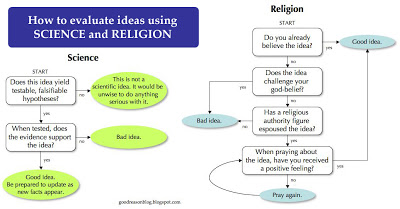
With apologies to Wellington Grey, here’s a comparison of how to evaluate ideas using science versus religion.

Click the image to enlarge in a new window.

Sheeple

I really hate the word ‘sheeple‘.

Let’s say I’m a nutjob with a theory. Here it is: Katrina was an inside job. The CIA controls the weather. I’m not sure if the White House let it happen or made it happen, but the whole thing is prophesied in Revelation (somewhere). You can’t prove me wrong. If I don’t have any evidence, it’s because the secret cabal has covered its tracks so carefully.

The likelihood of most people adopting my idea is low, though I’ll get a few other nutjobs to believe it. But at some point, I’ll have to answer a question: if my idea is so great, why don’t people believe in it?

That’s where the ‘sheeple’ idea comes in. I can blame people for being lazy, complacent, unthinking, and dumb. Anything but accept that my idea sucks.

Now these things may be true. Sometimes people aren’t good thinkers because they aren’t trained in critical thinking, and our existing ideas seem to make so much sense to us, especially when we only look for evidence to support them, not challenge them. I’m constantly seeing these tendencies in myself.

But conspiracy people like the word ‘sheeple’ because it’s easier to criticise people than to educate them, and it’s much easier than learning how to evaluate ideas and challenge them. Why do that when you can pretend you’re the misunderstood noble genius, like Galileo or Prometheus?

For its lazy and cynical misanthropy, I hereby exclude the word ‘sheeple’ from my vocabulary.

The new 30

Many happy returns to my dear friend Jeff, who turns 40 today.


Right behind you, buddy!

What’s Daniel been doing?

  • Teaching a fascinating and well-informed group of students. The ‘Evolution of Human Language’ class is heading for its third lecture out of four. And in the ‘Language and Communication’ class, I teach 220 of UWA’s best and brightest.
  • Arguing with creationists. I must say, I was disappointed. Their best argument was “Well, if there’s no God, then who’s going to resurrect me after I die? Huh? Answer me that, Mister Smarty-Pants! You can’t just resurrect yourself!” I had to admit, their logic was irrefutable.
  • Doing The Thesis. A difficult and time-consuming ritual, about as productive as debating creationists, but somehow more worthwhile.
  • Learning the finer points of MarioWorld DS from the boys. This has an advantage over the Thesis in that results are consistent and progress is easy to measure.

What have you been doing lately?

I hate when people say…

When people learn that I’m a linguist, they sometimes imagine that I am an Official Grammar Arbiter. They say things like “Oh, I hate when people say ‘That was fun.’ Don’t you hate that?” Leaving me to wonder why they’d pick on that poor, innocent, perfectly acceptable sentence. Or something equally innocuous. It would be one thing if they’d complain about something ambiguous like ‘downwards’ instead of ‘downward’ or ‘if I were/was’. But it’s often some ordinary sentence that anyone would say.

Last night, a gentleman told me, “I’ve become more tolerant about grammar since reading the history of English.”

“Oh, really?” said I.

“Yes, I used to hate when people would say ‘That’s so great, or so interesting.”

“Um,” said I.

“But now I realise that English has been changing for a long time, and the English we use was once unacceptable. So I’ve become more tolerant about it.”

“That’s good,” said I.

Hero of the Week: Pete Stark

US Congressperson Pete Stark (D-Ca) has become the first open atheist in Congressional history. Or should we say ‘nontheist’?

Rep. Pete Stark (D-Calif.), a member of Congress since 1973, acknowledged his nontheism in response to an inquiry by the Secular Coalition for America. Rep. Stark is a senior member of the powerful House Ways and Means Committee and is Chair of the Health Subcommittee.

Herb Silverman, president of the Secular Coalition for America, attributes these attitudes to the demonization of people who don’t believe in God. “The truth is,” says Silverman, “the vast majority of us follow the Golden Rule and are as likely to be good citizens, just like Rep. Stark with over 30 years of exemplary public service. The only way to counter the prejudice against nontheists is for more people to publicly identify as nontheists. Rep. Stark shows remarkable courage in being the first member of Congress to do so.”

Indeed. Atheists are the scary monsters of the political scene. Notice how dirty a word ‘atheist’ is. That has to stop. (So does that annoying reference to the Golden Rule. It’s playing into their frame, like saying ‘Look! We can be just as righteous as Christians, the ones who own goodness and light!’ In fact the behavioral differences are minimal.)

Visibility is the key to ending the pariah status of atheists. Pete Stark has opened the door in Congress, and for that, he’s Good Reason’s Hero of the Week.

Older posts Newer posts

© 2026 Good Reason

Theme by Anders NorenUp ↑