
How are you at guessing accents?

I didn’t do so well — only 30 points. You’d think a linguist would have a better grip on the vowels. But it is a bit tricky when it comes down to actual cities.
How are you at guessing accents?
I didn’t do so well — only 30 points. You’d think a linguist would have a better grip on the vowels. But it is a bit tricky when it comes down to actual cities.
UWA people: here’s an event that might be worth attending. It’s a debate between ‘UWA Atheists and Agnostics’ and the omnipresent ‘Christian Union’.
I didn’t even know there was an organisation for atheists and agnostics at UWA. So I’ve no idea who will be on the panel. But get a load of the topic: “Christianity: Truth or Fiction?”
Don’t you think that’s a lot to take on? It’s impossible to establish the existence of the Head Supernatural Being, but then you have to demonstrate which religion is his favourite. So there are a lot of places to deflate this kind of argument. I expect to see a lot of ‘Appeal to Scripture’ and maybe some ‘Appeal to Consequences’ because you know how they love that crap. Hitler and Stalin are expected to make an appearance.
That’s tomorrow (5 August 2008) at 1.00 in the Alexander Lecture Theatre. See you UWA people there, and I’ll have a full report for the rest of you.
I’m checking out Knol, a new project from Google. It’s a knowledge base that’s sort of a cross between Wikipedia and Amazon ratings. Here the focus is on authorship. Authors write their own Knols, instead of contributing to a group’s effort like some amorphous blob author. That means experts in a field can represent.
I can see how this would avoid some Wikipedia problems.
But is having so many separate authors a good way to arrange the world’s knowledge? One thing I’m finding in my language research is that individual points of view are terrific, if they can be aggregated into some kind of group opinion. Wikipedia does this by forcing people to hash out the issues and decide what content will appear on the page. Knol takes a rating approach, where individual votes from readers will (presumably) cause good articles to float to the top of the search results page. So it’d be like a bit like Wikipedia, except that there would be maybe 30 articles on generative grammar instead of one, and while each individual article might not be as strong as a good solid Wikipedia article, the best would come pretty close.
Here’s an example: I tried looking up ‘atheism’, and got one result. (Yeah, it’s early days.) It was a thoroughly useless page by “United Church of God” about how great God is, blah blah blah. Basically it was an old school web page that someone ported to Knol. But it’s getting downweighted mightily, and as more articles appear, it will probably sink out of sight.
The more I think about this, the more it grows on me. The next task will be some kind of true aggregation, where instead of reading only the best article about (say) the existence of UFO’s, you take the 100 top-rated articles on the topic, and automatically generate a group opinion. Sounds like a job for someone who’s into automatic summarisation and paraphrasing.
I bags it.
The Scrabulous lawsuit seems to be going ahead in earnest now:
Scrabulous suspended on Facebook
The developers of the popular Facebook application Scrabulous have suspended the game for some users following legal action by toy maker Hasbro.
The application has been disabled for users in the US and Canada.
Hasbro, the makers of Scrabble, are suing the Calcutta-based founders of Scrabulous, claiming they are infringing its copyright and trademark.
Hasbro had asked Facebook to block access following the launch of its own official version of Scrabble.
A spokeswoman for Facebook told the BBC that the final decision to suspend the game was made by the developers, not the site itself.
If they had to slap a lawsuit on Scrabulous, it was only right that Hasbro should launch its own ‘Scrabble’ Facebook app. I gave it a try this morning (and won). It’s okay, but the tile placement feels sluggish, especially on a timed game when you only have two minutes per turn. Other than that, it seems serviceable.
If you’re blocked from Scrabulous and you don’t like the new Scrabble application, or you just can’t bring yourself to play it on principle, then you have just one question: How am I going to waste time now?
That’s where I come in. Here are my top five games on the Web right now.
5. The Internet Anagram Server

Did you know that if you rearranged the letters in “The Russian Federation”, you get “Oh, unrestrained fiesta”? You didn’t? How about this twofer:
Computational linguistics
I got input, miscalculations
Gulp! I’m uncool statistician.
It shouldn’t be that much fun, but it is. However, it would cheating to use this in online Scrabble.

I think it’s a bad idea for NBC to promote an online version of ‘Deal or No Deal’ because it makes you realise a) it’s essentially chance, and b) it takes about two minutes to play a game, which they then stretch out to an hour or more. But it is useful because you can see what the normal maximum game works out to, which is handy if you ever get on the show. Then you can tell Andrew (or worse, Howie) “Sorry, but I’m going to deal, even though it’s bad television. Going past 100 thou is a sucker’s game. See ya.”
3. Set

Finding a Set means picking cards with shapes whose features are either all the same or all different. Conceptually, it takes some getting used to, and there’s always that last elusive Set that drains all your time. If I can find all six Sets in under a minute, I consider myself to be scorching.
2. Raft Wars

This is basically a variation of Artillery from the Apple ][e all those years ago, except you’re a boat full of kids lobbing tennis balls, rockets, and hand grenades at bad guys who are after your treasure.
It’s surprisingly distressing to see your baby brother get blasted over the edge into the shark-infested waters. Leave him alone, you bastards! He’s two years old! But he is handy with the launcher, so fair’s fair. Watch out for the twist ending.
1. Launchball

Use an assortment of objects to roll, bounce, or blow your ball into the goal. Part of the fun is trying to discover how each item can be used, or which can be used together. A terrific brain game.
And don’t forget the hundreds of games on Orisinal.
What are you into?
Michael Shermer is coming to Perth to give not one, but TWO lectures at UWA’s Octagon on 20 and 21 August.
Shermer’s the author of ‘Why Darwin Matters” and “Why People Believe Weird Things”, and one of the more prominent skeptics around.
Here are some links if you want to know more: Weird Things | Darwin
The “Weird Things” talk appears to be a special school presentation, but the “Darwin” one is more for the public. So you can bet I’ll be soaking it up at the Octagon. Maybe I’ll even get to ask him about the questions I raise in this post, if I don’t take up too much time asking so that they drag me away.
A very encouraging trend:
Homeopathy prescriptions falling
GP prescriptions for homeopathy have nearly halved in two years, figures show.
The number of prescriptions dropped from 83,000 in 2005 to 49,300 last year, GP magazine Pulse reported.
It comes as the overall number of prescriptions in England is on the rise.
This is really good news, but it might change the ground rules for my favourite game to play with homeopaths. It’s called ‘That’s Not Evidence’. Here’s how to play. You find a homeopath, and ask if they have any evidence for homeopathy. They invariably pull out an anecdote or some statistic about the popularity of homeopathy, to which you politely respond, “That’s not evidence.” You explain why, and you ask if they have anything better. Time how long it takes them to either make a personal attack or cry. Someone once made it six minutes. In the many years I’ve been playing, not one homeopath has ever cited a study.
Predictably, the proponents of ignorance and quackery deny the decline.
A spokeswoman for the British Homeopathic Association and Faculty of Homeopathy said about 200,000 NHS patients were treated with homeopathy annually and homeopathic hospitals provided 55,000 appointments a year.
“This situation has not perceptibly changed over the last two to three years,” she added.
“The reasons for the steady fall in homeopathic prescriptions in primary care over the last 10 years may be complex, but we do know that there is no evidence to show that GPs are shunning homeopathy, nor is there evidence to show patients are not seeking homeopathy due to adverse press coverage.”
Homeopath cites lack of evidence. Irony meter: broken.
But, hey, there’s a bright side for homeopaths. The fewer people that use it, the stronger it gets.
Mormon writer Orson Scott Card has written an amazingly deranged piece of frothing about gay marriage. He argues that if the USA allows gay marriage, we should — nay, must — overthrow the government ‘by whatever means is made possible or necessary’. You really have to read it to see how unhinged he is on this issue.
Here are the highlights.
The first and greatest threat from court decisions in California and Massachusetts, giving legal recognition to “gay marriage,” is that it marks the end of democracy in America.
End of democracy? I think of myself as an interpreter of Mormonism, but even I’m struggling to find a context in which this comment makes sense. It’s not enough to point out that Mormons are millennial dispensationalists who expand personal and local conflicts into end-of-the-world issues. You have to imagine that homosexuality is not just a lifestyle choice that you may disagree with, but some kind of magical force of darkness that is politically dangerous.
How dangerous is this, politically? Please remember that for the mildest of comments critical of the political agenda of homosexual activists, I have been called a “homophobe” for years.
Wonder why. You know who Card reminds me of? My missionary companion from Idaho. He once made some disparaging comments about gay people, and I said, “You know what you are? You’re a homophobe.”
“What’s that?” he said.
“Well, ‘phobe’ is like ‘phobia’ — fear. So it’s a fear of gay people.”
He was incensed. “I’m not afraid of them! I’ll bet the hell out of any of them!”
Just for reference, here are his ‘mildest of comments‘ from 1990:
Laws against homosexual behavior should remain on the books, not to be indiscriminately enforced against anyone who happens to be caught violating them, but to be used when necessary to send a clear message that those who flagrantly violate society’s regulation of sexual behavior cannot be permitted to remain as acceptable, equal citizens within that society.
The goal of the polity is not to put homosexuals in jail. The goal is to discourage people from engaging in homosexual practices in the first place, and, when they nevertheless proceed in their homosexual behavior, to encourage them to do so discreetly, so as not to shake the confidence of the community in the polity’s ability to provide rules for safe, stable, dependable marriage and family relationships.
Keep ’em in line. Send ’em a message. Good move. Back to the article.
A term that has mental-health implications (homophobe) is now routinely applied to anyone who deviates from the politically correct line. How long before opposing gay marriage, or refusing to recognize it, gets you officially classified as “mentally ill”?
Well, it would help if you stopped, you know, writing insane things. I’m not an expert, but Card sounds psychiatrically actionable.
If property rights were utterly abolished, and you could own nothing, you would leave that society as quickly as possible — or create a new society that agreed to respect each other’s property rights and protected them from outsiders who would attempt to take away your property.
Marriage is, if anything, more vital, more central, than property.
I got a better one: There are laws against littering. But music is much more important than litter, so we should have laws about what kind of music you’re allowed to listen to.
He then argues that marriage is like some kind of slum that straight people have let run down, which is why those horrible gay people now want in.
A vast number of unmarried men and women have such contempt for marriage that they share bed and home without asking for any formal recognition by society.
How dare they!
What is this ‘society’ Card’s talking about, and how is he so sure what it expects of us? And why does he think that society must approve of all our actions? Is he a utopian socialist?
One thing is certain: Card’s devotion to society is absolute, until the very moment it contradicts his views.
Why should married people feel the slightest loyalty to a government or society that are conspiring to encourage reproductive and/or marital dysfunction in their children?
Why should married people tolerate the interference of such a government or society in their family life?
If America becomes a place where our children are taken from us by law and forced to attend schools where they are taught that cohabitation is as good as marriage, that motherhood doesn’t require a husband or father, and that homosexuality is as valid a choice as heterosexuality for their future lives, then why in the world should married people continue to accept the authority of such a government?
How long before married people answer the dictators thus: Regardless of law, marriage has only one definition, and any government that attempts to change it is my mortal enemy. I will act to destroy that government and bring it down, so it can be replaced with a government that will respect and support marriage, and help me raise my children in a society where they will expect to marry in their turn.
What a terrible monologue. But at least he has his priorities straight. Better to tear down the fabric of the republic than for people to think certain things.
It’s crazy stuff, and it all comes to you courtesy of the Mormon Times, the weekly magazine of the church-owned Deseret Times. I’d love to see if the church leadership has anything to say about this call to insurrection.
The workings of god are mysterious, so here’s some mystery meat.
What looks like the Arabic word for God and the name of the prophet Muhammad were discovered in pieces of beef by a diner in Birnin Kebbi.
He was about to eat it, when he suddenly noticed the words in the gristle, the restaurant owner said.
If I were the supreme ruler of a world full of war, crime, violence, and hunger, I couldn’t think of a better way to manifest myself than by putting my name in pieces of gristle. No, wait. Actually, I’d just be dicking with you.
I like Arabic script, even though I’ve never studied it. So I wanted to find out what the name of Allah looks like. Here it is. Not a terribly complex shape, is it? 
Look like a match to you? Then you’re not looking with the eye of faith. If you were, you’d see the name of god (well, one of the names of god) any place where there are parallel lines. You’d see it everywhere, from tomatoes
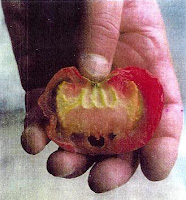
to fish.

I know; it’s like so obvious on the fish. How could you yet disbelieve?
There’s a whole page of this stuff here. As you might guess, it’s pretty weak tea. Finding parallel lines is even easier than finding faces in tortillas, it would seem. And isn’t it strange that everyone finds an image that serves to confirm their own beliefs and not anyone else’s? Truly amazing.
I’d love any Arabic speakers to let me know if they’ve ever seen any blasphemous words in, say, an eggplant. Keep me posted.
Apparently Australian Foreign Minister (and my Member of Parliament) Stephen Smith hit it off really well with US Secretary of State Condoleeza Rice. So well that he invited her to Perth to hang out.
Well, today’s the day.
US Secretary of State Condoleezza Rice is due to arrive in Perth later today.
Dr Rice will be in Perth for about 18 hours, and a spokesman for the Department of Foreign Affairs and Trade says she will attend a dinner tonight and an event tomorrow before flying to New Zealand.
Foreign Affairs Minister Stephen Smith invited Dr Rice to Perth when the pair met in January this year.
He says while the visit will include official business, he plans to show Dr Rice the sights of Perth during her stay.
It is her only Australian destination after the ASEAN meeting in Singapore.
So what’s she getting up to over here?
UPDATE: It appears that she’ll be dining at the UWA University House, mere minutes from where I’ll be working late into the night. They’ll likely confiscate my red spray paint that was intended to symbolise the blood of the nations.
Glad to see someone else is taking the piss out of talking psychic birds besides me.
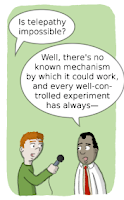
Damn, but the BBC Science press is useless. They’re the ones responsible for that ‘cow accents‘ thing a couple of years ago.
It’s particularly clever that the author also makes a commentary about how people take advantage of the inherent tentativeness of scientific conclusions.
© 2026 Good Reason
Theme by Anders Noren — Up ↑




Recent Comments