Good Reason

It's okay to be wrong. It's not okay to stay wrong.

Category: post (page 70 of 125)

The MWF works through market forces.

You may have heard of Rocky Twyman, the guy who’s behind “Pray at the Pump”. Since April, they’ve been asking a supernatural being to lower gas prices. And holy Regression Fallacy! it seems to be working.

A prayer group in Washington DC is claiming the credit for the recent sharp drop in the US price of petrol.

Rocky Twyman, 59, a veteran community campaigner, started Pray At The Pump meetings at petrol stations in April.

Since then, the average price of what the US calls gasoline has fallen from more than $4 a gallon to $3.80.

“We don’t have anybody else to turn to but God,” Mr Twyman told the BBC. “We have to turn these problems over to God and not to man.”

God, schmod. Isn’t it obvious who’s behind the recent drop in petrol prices? Not supernatural beings or market forces. It’s… the Magical Wishing Ferret!

Meep!

Now it’s true that no one’s been asking the Magical Wishing Ferret for his help. But that’s what makes him so great. He knows what you need, and gives it to you before you ask.

That other ‘god’ makes you go through all kinds of contortions before he’ll do anything. Sometimes you literally have to starve yourself just to get his attention, the sadist.

None of that crap for the MWF. He’s good about getting you what you want, although he needs you do the work for the sake of your character. He doesn’t require any faith (just occasional chocolate), and he’s much more deserving of admiration than other gods I could mention. And you certainly don’t have to hang out at petrol stations shouting at the sky to curry his favour.

I’m also a Eucharist abuse sympathiser.

Man! Some bloggers have all the luck. Towleroad, who I’ve never heard of, has been targeted by closet case Bill Donahue of the so-called Catholic League. He wants the Democrats to drop Towleroad and Bitch Ph.D from the list of media bloggers for the DNC convention, or else he’ll hold his breath and turn blue. How cool would that be to nettle Donahue to that extent? And how can I get on Bill’s big bad list?

You know, I think I’ve got the Catholic League figured out. It’s just Bill Donahue. There’s no one else there. And the Catholic League website is just his blog. But instead of making blog posts and leaving it at that, he sends his blog posts to the media, and calls it a press release!

I’m going to start calling myself the “Good Reason League”. My first press release:

“I advocate contraception.”

There. That ought to get Bill’s attention.

Atheist and agnostic — might you be both?

What’s the difference between an atheist and an agnostic?

One of my atheist friends recently surprised me by describing himself as a Buddhist. I tried not to do a double-take, reminding myself that is possible to distinguish ‘Buddhism the Religion’ from ‘Buddhism the Philosophy’ or ‘Buddhism the Set of Interesting Practices’. Still, it seemed incongruous.

And then there’s my other friend who describes himself as an ‘agnostic’, but doesn’t really disagree with me, the atheist, on any major points. He just seems reluctant to define himself as an atheist.

Deciding what a word ‘means’ can be a tricky proposition, especially on this issue when self-identification comes into it. People are defining ‘atheist’ and ‘agnostic’ by the beliefs of people they know who identify as atheists and agnostics (perhaps even themselves). I’ve met enough meat-eating vegetarians to know that this isn’t the most reliable kind of definition. Then some helpful soul comes running into the discussion with a dictionary, telling us about word parts, and insisting that the etymology of a word is its ‘true meaning’. Which is nonsense, because word meanings change over time, and words mean what speakers think they mean. (Except when the speakers are wrong because they disagree with us more knowledgeable folk.)

Word-watcher that I am, I’d normally observe the debate and not influence it. But as an atheist, it’s a different story. I’ve noticed that the popular definition of these terms is often at variance with what atheists and agnostics actually think, and that ought to count for something. So in this post, I’d like to discuss the definitions of a*ism, and see if we can describe them more accurately in terms of what people (a*ists and not) mean by these terms.

As a English-speaking youth, before I’d thought about this area very much, I absorbed these definitions:

atheist: someone who knows (believes very strongly, is absolutely certain that) there’s no god
agnostic: someone who doesn’t know if there’s a god or not

That is, the difference (I thought) was one of degree of certainty.

At the time, it didn’t seem to me that this ‘atheist position’ was very tenable. How could you be certain that something didn’t exist? You’d have to have a knowledge of everything that existed to know that something wasn’t on the list. Which, ironically, would make you God, or something close.

Well, imagine my surprise to find that no atheist I talked to held that point of view. No atheist I’ve met on- or off-line has professed absolute certainty that god does not exist, though there are some ‘strong atheists’ out there. Instead, atheists I have met reject gods because there’s no evidence for them, and many have expressed willingness to change their minds if evidence turns up.

So if certainty is not the defining characteristic of an atheist, what is? Simply: belief. Atheists believe there are no gods. Here comes the etymology: a, ‘without’ + theos, ‘god’. Someone who is without a god.

Now for agnostic. Etymology: a, ‘not’ + gnosos, ‘knowledge’, or ‘one who doesn’t know’.

A browse of various dictionaries suggests that agnosticism is less about intensity of belief and more of a philosophical stance involving the knowability of god, usually expressed by these two ideas:

1) An agnostic doesn’t know whether gods exist
2) An agnostic thinks the whole question isn’t really knowable

I find both of these ideas perfectly reasonable — to a point. Can we know if a god really exists, if that god hides from people and is perfectly good at covering her tracks? No, any more than we can know about UFO’s or invisible pink unicorns. Where I differ from agnostics is what to do about it. With no supporting evidence, I just assume it’s all bogus, but I’ll re-examine if need be. The agnostic reserves judgement, as though the two possibilities are equiprobable, and that’s simply not justified by the data we have.

What I get from these definitions is that atheism and agnosticism are not mutually exclusive categories. They’re describing two different things. Here are, I think, more accurate descriptions:

agnostic: Someone who recognises that the ‘existence of gods’ issue can’t be proven either way with the evidence we have. Agnosticism tells more about what you know about the ontological issues surrounding supernatural beings.
atheist: Someone who doesn’t believe that gods exist. Whether you’re an atheist or not has more to do with what your conclusion, yes or no, given all of the uncertainty surrounding the issue.

That explains why my self-described agnostic friend and I agree on the issues. He doesn’t know if gods exist, and to be perfectly honest, I don’t know either, I just don’t find the evidence compelling. So in that sense, my friend and I are both agnostic. And neither of us really thinks that gods exist, though we’re open to evidence. So in that sense we’re both atheists. I’m just more willing to call myself an atheist than he is.

We could plot individuals on a graph:
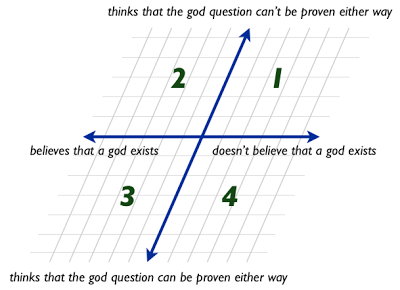

Quadrant 1 is me, the non-believer who nonetheless says you can’t be absolutely certain either way. Quadrant 2 is the believing agnostic, also known as ‘the bet-hedger’. (If I were a god, I would send them to hell for believing in me in such a gain-driven and cowardly way.) Quadrant 3 is the believer, and in quadrant 4 we could perhaps find the ‘strong atheist’.

These definitions are pretty close to what people already think the terms mean. Defining them this way emphasises certain aspects of a*ism in a way that helps to explain the variation in belief that we see, and gets rid of a lot of overlap between the terms.

People will still define atheism and agnosticism variously, but there are signs that this view I have presented has some acceptance. I was somewhat startled at this site, devoted to sorting out frequently confused words. The entry for ‘atheist’ reads:

atheist: one who assumes there are no gods or divinities but will accept the possibility should extraordinary evidence occur
agnostic: one who believes the existence of God cannot be proved or disproved

I fully approve.

Has Junior poisoned the brand? GOPers say no.

Forty-one percent of Americans say that G. W. Bush is the worst president in U.S. history. Thankfully for Bush, 50% said, “Well, maybe he isn’t the worst.”

I’m tempted to side with the 41% percent. The Republic is still standing, and anyone worse than Bush would surely have brought it down. On the other hand, Buchanan or Johnson might have been worse. If the question had been worded “worst president in living memory“, then Bush definitely. And for “worst ever”, Bush is on the short list. I do think, however, that 2001–2008 will go down in history as the time when constitutional government in America was the most endangered.

But there was one stat that reminded me yet again that most people who still identify as Republican are unimpeded by such things as reality and good sense.

While 61% of Americans overall say Bush has been bad for the Republican Party, only 28% of Republicans themselves agree. On the other hand, 81% of Democrats – and 68% of unaffiliated voters — rate the president as bad for the GOP.

Imagine. About 70% of Republicans don’t think Bush has been particularly bad for the GOP brand. Why, no. With GOP party identification dropping, and record numbers of Republican congress-critters retiring, Bush has had what can only be described as a salubrious effect on the Party.

I’d have thought Republicans would throw Bush under the bus what with elections coming, but no, they still hold him dear. They really do live in a different universe.

Viva Severed Heads

I’ve been kind of bummed since finding out that Tom Ellard has broken up Severed Heads, one of the great electronic/industrial/noise/dance bands of the last thirty years. Well, ‘broken up’ is the wrong term, since it’s just Ellard. Perhaps I should say he’s ‘stopped doing it’, but that doesn’t sound quite right. That’s the story though.

Severed Heads is one of my formative bands. One day in 1986, I walked into a record store in Seattle’s U-District, and they were playing “Twenty Deadly Diseases”. It was a great piece of industrial dance electronica, aggressive but cerebral. I immediately realised that whereas I’d been listening to the Art of Noise, it was this that I’d really been looking for. I promptly bought all the Severed Heads I could find, and never listened to the Art of Noise to any real extent ever again.

Listening to a song like “Army” from Come Visit the Big Bigot, it’s hard to believe that it came from Australia. It’s very icy, and many’s the day I would slap on the headphones and walk in the snow with the sound of “Army” mixing with the cold and the howling wind and the gray sky and the long arctic horizon.

Not going to that year’s Severed Heads/Skinny Puppy show in Seattle is still one of the great regrets of my concert-non-going experience. (The other is Kraftwerk in Perth at the Big Day Out 2003, because it was on a Sunday. Shitty religious observance! At least I got the bootleg from the show.)

But now Tom’s hung it up because he’s teaching full-time at UNSW. Academia has sunk many a promising career. Why not both at once, like Dan Snaith of Manitoba, or Brain May from Queen?

However, our loss is our gain, since Mr Ellard has released much of the Severed backcatalogue. There are gems among the free downloads (especially ‘Twister’), but it’s Big Bigot and Bad Mood Guy that really shine. You might also want to check out his thesis, an exploration of how recording format can affect the music itself.

Random House, society, wimps out

This is wrong.

Prophet Muhammad novel scrapped

Plans to release a novel about Prophet Muhammad’s child bride A’isha have been scrapped by US publishers Random House over fears it could spark violence.

Violence? From Islam? But they told me it’s a religion of peace!

Random House is wrong to pull the project just because they assume a small number of violent Muslims will be offended. Yes, they may, but you have to give them the right of reply. They made an awful fuss over the Muhammad cartoons, but maybe —just maybe — they’ll react differently this time. And anyway, people need to realise that we live in a marketplace of ideas, and even their wonderful precious beliefs aren’t immune to some tough scrutiny now and again.

I guess it’s pretty rich coming from me, since I wouldn’t be the one targeted for violence. But I could be. Having my face on this blog and criticising religion like I do could make me a target some day. Any of us could be, just for living in a secular society. That’s why it’s vital to confront violent religious extremism head on, instead of tiptoeing around it hoping it will go away.

Let the adherents of Islam step up and show that they’re a peaceful religion, as they claim. Or let us see the reverse.

L’affaire Edwards

I’ve read everyone in the world’s opinions on John Edwards’ affair. The weird thing is, every time I read someone’s comment, I agree with it, even things that contradict other things I agree with.

It’s none of the public’s business. If Edwards had been some moral crusader, then fair game. Moral crusaders think everyone’s sex life is an open book, ergo so is theirs. But Edwards was not one of these, and I’d rather it be something for him and his family to deal with.

It matters because voters think it matters. I wish everyone thought like me, but they don’t. America contains many puritanical hypocrites, who I suppose want to be represented. And if they don’t like someone’s sexual behaviour, they have the right to not vote for them. That’s the game, and everyone goes into politics knowing it.

I’m disappointed in John Edwards. I quite liked him, and would have been glad to see him take the nomination. Imagine if that had happened, and here we’d be in a state of hosedness.

Edwards was reckless and immoral. Cheating on your cancer-stricken wife really sucks balls. And he was stupid. Have we learned nothing from Bill Clinton? Gary Hart?

I’m angry with Elizabeth Edwards, too. She knew about the affair when John was campaigning, but they both chose to go through with it anyway, and risk instant campaign death and four years of President McCain. I think we Democrats dodged a bullet.

McCain is worse. But there are lots of other reasons not to vote for McCain that are actually good, as in this article about why McCain would make a mediocre president at best.

I hope the Edwardses can make a contribution to American public discourse once again, because I’d hate to have this be the last thing we hear about them.

The 100 most common words in English

Another language game: How many of the 100 most common English words can you name in five minutes?

Of course, the actual words in the list will depend largely on the corpus they’re using. Still, it’s an interesting challenge. As a computational linguist, I must have looked at loads of lists like this, but I only got 50 of them. That was more a function of how fast I could type. You have to bang out one every 3 seconds with no mistakes to get them all.

Hmm. How can I get a hold of their language data? I’d like to know what people thought were the most common words.

Tire gauge Republicans

There’s a group of people in America that refuse to take personal responsibility for their problems. They just want the government to do everything for them. They’re called Republicans.

Look at the current tire gauge flap. Obama mentioned in a recent campaign speech that keeping tires inflated could help improve gas mileage. The McCain team has gone nuts over the matter, claiming (dishonestly) that tire gauges represent the whole of Obama’s energy policy. They’d rather drill the Arctic instead.

See, they could take responsibility for making sure that their cars are tuned up properly and have the tires inflated to the right pressure. But they’re too lazy and irresponsible. So instead they want the government to give the go-ahead on more drilling. But giving them more oil will just keep them addicted.

It seems the Democratic Party stands for personal responsibility. Those Republicans are always looking for government handouts.

UWA Atheist/Christian debate

The debate went pretty well, actually. In the Christian corner was Tim Thorburn, and the Atheist was Michael Tan.

Atheist Michael did a great job, hitting all the main points. Humans have a need to explain things, and sometimes they make explanations that involve magical beings. But we need to use evidence and reason to sort out what’s happening, and the evidence for Christianity is not particularly strong. The most electric moment: Tim said that the Bible contained predictions that have been fulfilled, and Michael responded that many others haven’t yet, especially the return of Jesus. “How long is it going to take before we realise he’s not coming back?” he said, to gasps and applause from the audience.

Christian Tim argued that Christianity was true because the Bible said so. Okay, he didn’t put it as weakly as that. He mentioned that the Bible contained eyewitness accounts of Jesus’ resurrection, and that Paul alluded to the eyewitness accounts so casually that they must have been well-accepted by the Christians of his day. So that’s the evidence.

“Except it isn’t evidence,” I said to Tim as we chatted afterwards. “It’s another claim.”

“How do you mean?” he asked.

“Well, Paul is claiming that Jesus was resurrected and that there were eyewitnesses to it. But that’s not evidence. That’s another claim, and we need to examine it.

“I mean, it’s part of the same story. You can’t use a part of the story as evidence for the story!”

“Yes, I can!” he said, looking rather surprised.

I also asked him about the Book of Mormon. At the front of every copy of the Book of Mormon, there appears the testimony of three men who claimed that an angel showed them the gold plates. There’s also the testimony of eight other men who claimed that they got to see the gold plates without any angel. I believe these testimonies to be false, to which Tim the Christian readily agreed. But if you’re going to accept the testimony of so-called eyewitnesses in the Bible, why wouldn’t you accept the testimonies of eye-witnesses in the Book of Mormon?

Tim responded that the Bible was a very reliable source of testimony because it had many different witnesses whose testimony dovetailed together so well that it couldn’t all be fiction. I’m not doing his response justice because he said it much better than I can remember, and I hope I’m getting the gist of it right — memory is unreliable. But that was basically the idea; the Bible was so much better a source for eyewitness testimony than other books because it was so complex and dense and interlocking that no one could have faked it and it must be true.

But anyone who’s heard the story of the Nottingham Lion or heard conflicting reports from eyewitnesses at accident scenes knows that eyewitness accounts are not reliable sources for what really happened. Especially when the story has had hundreds of years to get itself straightened out.

Anyway, it was a fine outing. Michael and Tim were good gentlemen to talk to. And the UWA Atheist and Agnostic Society has a Facebook group, if you’re a person of the ‘Book.

Older posts Newer posts

© 2026 Good Reason

Theme by Anders NorenUp ↑