Good Reason

It's okay to be wrong. It's not okay to stay wrong.

Category: post (page 40 of 125)

Revelation is not good evidence

I had an exchange with a Mormon friend a little while ago. His interesting but ultimately vacuous argument went something like this:

“You say you rely on evidence for the things you believe. But you’re only relying on physical, tangible evidence. You’re not relying on spiritual evidence, and so you’re only getting part of the picture. I’m using the full range of evidence available to us.”

My response is two-fold:

1) There is no empirical evidence for the claims of religion, including the existence of a god, the reality of an afterlife, or various details such as a Tower of Babel, gold plates, or Lamanites. The key doctrines of religious belief systems are either unsupported by evidence, or refuted by evidence. (Occasionally a religion will teach a principle that turns out to be valid — the Mormon prohibition on smoking seems worthwhile on its face — but these are things that could have occured to someone without requiring revelation.)

2) What my friend was calling ‘spiritual evidence’ is actually not good evidence at all. I think he was referring to something Mormons call ‘personal revelation’ — messages that people think they’re getting through prayer.

This is not a good way of finding out what’s true. How you feel about a proposition has nothing to do with whether it’s true or not. You can feel great about things that are completely false. Yet this method is at the very heart of the Mormon conversion experience — and other forms of Christianity also place an emphasis on emotional reasoning.

Let’s take a step back and see how this plays out in LDS missionary work.

LDS missionaries encourage investigators to ‘experiment upon the word‘. And the experiment that they propose is that you can pray and receive answers about the truth of their message telepathically from a god.

They rely on a scripture from the Book of Mormon, Moroni 10:4, which says to ask God, and the Holy Ghost will tell you if it’s true. By doing this, the missionaries commit the fallacy of begging the question — they claim that a god will tell you that the religion is true, but the existence of said god is the very premise under consideration.

And how does the Holy Spirit let you know?

But the fruit of the Spirit is love, joy, peace, longsuffering, gentleness, goodness, faith,

Meekness, temperance: against such there is no law.

That’s a pretty big list of fruits. Almost any feeling could qualify as a confirmation, especially if that’s the conclusion you want to come to, and you wouldn’t be asking if you didn’t have at least a glimmer of hope that it was true.

It should be obvious that this is not a real scientific experiment, and not just because it falls back on supernatural explanations.

  • Scientific experiments use evidence that is empirical — involving sense data that could be observed by anyone
  • Experiments try and control for bias
  • Experiments are replicable — anyone can repeat the experiment, and they should get about the same result. Ideas are verified by multiple points of view.

But so-called personal revelation doesn’t follow these controls.

  • Your feelings can’t be directly observed by other people. That makes it impossible to evaluate someone else’s religious claims, and that means that religious people have to ‘agree to disagree’ when they get conflicting revelations.
  • There’s no way to tell whether the feeling you’re getting is a real live revelation from a god, something from your own mind, or (worse) a temptation from an evil spirit, if you go for that. Or Zeus, Krishna, or the Flying Spaghetti Monster. It’s easy to distinguish between two competing natural claims, but it’s impossible to distinguish between two competing supernatural claims.
  • A scientific experiment attempts to control for bias, but here, the missionaries are subtlely biasing their subjects by telling them what they should expect to feel. It’s sort of like when you’re playing records backwards for satanic messages — it’s hard to tell what the message is until someone gives you the words.
  • The goalposts for this test are defined very vaguely and can be shifted. A confirmation can be ginned up out of the most meager of subjective data — or no data at all. Many are the members who ask for a revelation, get none, and continue in the church anyway, figuring that if they have real faith, they don’t need a spiritual confirmation. It’s a hit if you have good feelings, and hit if you don’t.
  • In a real experiment, we would try to account for both positive and negative results. But here, no attempt is made to add negative results to the sample. People who report a positive result show up in church, but people who get no result don’t, and are effectively deleted from the sample. In fact, if someone doesn’t get a revelation, it’s assumed that they are to blame for not being ‘sincere’ or trying hard enough. They are encouraged to repeat the test until they get a result that the experimenter will like.
  • Worse still, once someone is convinced that they’ve received a message from a god, Latter-day Saints then make a series of logical leaps to show that the whole church is true, from the Book of Mormon to Joseph Smith to Thomas Monson and beyond. All from good feelings and not from anything solid.

Not everyone is convinced by this test, but the church doesn’t need everyone to buy it — just enough people to keep the system going. And I can tell you from personal experience that when you think you’ve been touched by the divine, it can be very difficult to balance that against real evidence. No good evidence is going to come out of this kind of test. This is not a valid experiment. It is a recipe for self-deception. It is just asking to be fooled.

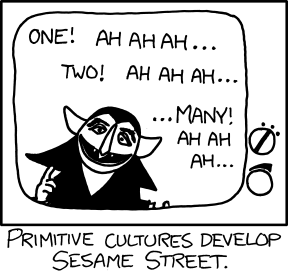
He loves to count things, he just doesn’t go overboard on it.

Fans of language might get a laugh out of today’s XKCD.

Yes, there are languages where anything over 2 is just considered ‘many’. You could probably save some time going through the names of colours in these languages, too. “Ready, kids? Light! Dark! That was fun!”

‘Primitive cultures’, though? I’m no anthropologist, but that seems a bit old school to my ears. And a hint: if they’re watching Sesame Street on TV, their culture is probably not that primitive.

Missionaries or linguists?

Some linguists are saying that the documentation of every human language should be complete by 2015. That’s good, right?

Erm

Protestant translators expect to have the Bible — or at least some of it — written in every one of the world’s 6,909 spoken languages.

“We’re in the greatest period of acceleration in 20 centuries of Bible translation,” said Morrison resident Paul Edwards, who heads up Wycliffe Bible Translators’ $1 billion Last Languages Campaign.

A lot of work in linguistics has historically been done by Protestant missionaries, including the Wycliffe Bible Translators and SIL International. They take their cue from the scriptural injunction to preach Christianity to all nations.

I’m actually glad that they’re documenting languages. Or rather, they’re translating the Bible into various languages, and hopefully documenting more about the language along the way. It needs to be done. I don’t even mind that their translation efforts are focused on the Bible. It’s a good basic text, a little archaic, but not bad for expressing a good number of concepts. And as a bonus, the Bible has already been translated in many languages, and the texts are already aligned by chapter and verse. It’s like the ultimate cross-lingual parallel corpus! Potentially good for machine translation.

What concerns me about these efforts is that they come into it with what amounts to a Christian agenda. Despite protestations to the contrary.

“Wycliffe missionaries don’t evangelize, teach theology, hold Bible study or start churches. They give (preliterate people) a written language,” Edwards said. “They teach them to read and write in their mother tongue.”

The missionaries develop alphabets. They create reading primers. They translate the Bible.

Distributing bibles is evangelising. The difference between making bibles and more overt conversion efforts is a thin line. (Although in one case, the conversion backfired.)

What’s more, this Bible-driven approach to language documentation misses a key point of language. A language — its vocabulary, kinship terms, lexical categories, and even speech acts — encodes some social ideas that are incomprehensible from outside the system. Coming in to promote a Christian worldview can only hamper the understanding of the language.

Watch the line between linguist and missionary vanish as this volunteer waxes rhapsodic about the effort.

“I am excited to put God’s word in all people’s heart language,” Zartman said. “Until people can read the Bible in their own language, God is a foreign concept.”

You mean the Christian god is a foreign concept. And it ought to stay that way. Help them by documenting their language, but leave the imported religion at home.

Talk the Talk: Artificial languages

Just had a fun interview with Arika Okrent, author of ‘In the Land of Invented Languages‘.

I mentioned in the interview that I had a hard time getting excited about yet another fictional language, when so many natural languages are endangered. Wouldn’t it be great if the people behind Avatar had chosen a suitable sounding natural language, instead of inventing Na’vi? I suppose it does no good to complain though — I also think that kids should be memorising stats about real animals instead of Pokémon, but it’ll never happen because real animals don’t shoot fire out their ass.

That said, it was interesting to hear a bit about Esperanto and Lojban. It was also fun to hear some spoken Klingon — yes, Arika is a certified Klingon speaker.

You can check out the interview by heading to our Talk the Talk page on Facebook. Don’t forget to like us!

What comfort is atheism?

A lot of people I care about have come back with some really bad god-damn diagnoses in the last few months. Mom’s not well. Two friends have cancer, but they’re both holding it together.

It’s throwing me, frankly. I’m getting older, and I wonder if I’m due for some similar bad news. Are some of my cells even now going berserk, turning into the cancer that will kill me in five years? I look at Miss Perfect and she looks at me and we wonder how many more days we get to have together.

I know some people get comfort from their belief that after this life, a supernatural being will allow them to live in peace and happiness with loved ones forever. And there will be pie in the sky when you die. It’s a nice thought. I can see why people turn to it in times of existential uncertainty.

By comparison, atheism doesn’t seem to offer much comfort. We’re here, we die, and there’s no reason to think that any supernatural beings exist to revive us. Fine if you enjoy accepting the harsh realities, but not much in the way of comfort. Which is fine with me. I’ve always cared more if something’s true, rather than if it’s ‘comforting’. You could say that drugs offer a degree of ‘comfort’, until they wear off and it’s back to reality.

And for me this is the problem with the comfort offered by religions. It’s a comfort only if it’s true, otherwise, it’s a cruel illusion. If atheism doesn’t provide comfort, the false comfort offered by religion is even worse. It’s expensive and time-consuming.

How, then, do we explain the diseases that strike those we love? If you believe in a god, you have to believe that he has the ability to heal you, but for some reason, might not. (He certainly doesn’t heal amputees.) Then after he lets you go through pain, death, and uncertainty, he’ll whisk you away to paradise. And what kind of heaven awaits? Christopher Hitchens (another unwelcome cancer diagnosis) opened my eyes by pointing out that the Christian version of heaven is not an eternity we should wish for:

We would be living under an unalterable celestial dictatorship that could read our thoughts while we were asleep and convict us of thoughtcrime and pursue us after we after are dead, and in the name of which priesthoods and other oligarchies and hierarchies would be set up to enforce God’s law.

But for those who look to the natural world, the explanation is different. Our bodies know how to carry out the processes we need in order to live, but they don’t always do so optimally. We’re engaged in an evolutionary struggle of survival with other individuals and other life forms. Evolution has seen to it that we survive pretty well most of the time, but sometimes not.

So is that it? We’re just going to die, and then that’s the end?

No. We’re going to live, and then that’s the end. And how amazing to have lived on this world! How unlikely! Some humans made a human child with a brain that could experience consciousness, and that human was me. I may not know how long I have to live my life, but I’m not going to waste any of that time in church, helping to support someone else’s comforting scams. I get my comfort knowing that when it’s my turn to go, as we all do, I will have lived fully, loved deeply, and kept my mind as free of delusion as best I could.

This life is full of people, love, food, knowledge, questions — and, yes, difficulty, pain, and sorrow. Even so, I’ll take it.

There’s a song that keeps coming back to me: What a beautiful life. It makes me feel optimistic when I hear it. Maybe you’ll like it too. It’s true, you know.

Homeopathy cartoon

Beaker has alerted me to this Darryl Cunningham cartoon which is critical of homeopathy. (You may have seen his earlier cartoon about the MMR.)

He points out that homeopathy is ineffective, and dangerous when chosen in preference to real medicine, which (surprise!) is the preference that homeopaths will steer you toward. I like how he explains not only why homeopathy doesn’t work, but also why people feel like it does.

He’s also included a bit about Penelope Dingle. I hope this retelling of her story helps to prevent others from following her course of action.

I confess it still puzzles me why Peter Dingle seems to have no particular qualms about homeopathy. If I’d been through what he’s been through, I’d be trashing it even more than I currently do. But then I’m not overly invested in quackery, so that may be where we differ.

Yes, she is.

Julia Gillard, the prime minister of Australia, is an atheist. For a while there, I wasn’t sure, but she came out this morning in a radio interview.

Do you believe in God?

No, I don’t, John. I’m not a religious person.

I’ll write some more on this later, but I just wanted to light a celebratory sparkler. Isn’t it great that Australia is a country where a politician doesn’t have to pretend to believe in supernatural beings, and can still get elected as a head of government…

Erm. Maybe I should hold off on the celebration until after the elections.

North Am dialects reprezzent!

Did you learn to speak English in North America? Your input is required for the North American English Dialect Survey.

It’s easy — you just use your computer’s microphone to record yourself saying various words. They also ask where you went to high school, and where you live now.

They’re going to love me. I still sound like a dang ‘Merkun, but living in Australia for so long has changed my accent in one respect: I have broken free of the cot/caught merger. I say ‘cot’ like I’m British, but my ‘caught’ sounds like Noo Yawk. It might puzzle them for a bit, but they’ll probably understand once they see my current postcode.

Mobile phones and cancer

A study shows that mobile phone towers do not cause cancer. Good to know.

British scientists who conducted the largest study yet into cell phone masts and childhood cancers say that living close to a mast does not increase the risk of a pregnant woman’s baby developing cancer.

In a study looking at almost 7,000 children and patterns of early childhood cancers across Britain, the researchers found that those who developed cancer before the age of five were no more likely to have been born close to a mast than their peers.

And in this article, Bernard Leikind explains why mobile phones themselves cannot cause cancer.

One watt (the amount of energy emitted from mobile phones) is much smaller than many other natural energy flows that no one suspects might cause cancer. In my Skeptic paper, I show that the average energy production in my body as I go about my life is about 100 Watts. I also show that while I jog on my local gym’s treadmill for half an hour, I produce 1100 or 1200 Watts. This energy, produced in my leg muscles, travels throughout my body including my brain, and I sweat a lot. My body’s temperature does not change much. No one believes that my frequent treadmill sessions cause cancer. If the cell phone’s less than 1 Watt causes cancers, then why doesn’t my exercise session’s more than 1000 Watts cause cancer?

Perhaps if people hear this enough times, they will start to believe it. We live in hope.

Apparently, it did.

Great moments in blokeness:

Aussie men shoot each other in buttocks ‘to see if it hurts’

Two Australian men needed surgery after shooting each other in the buttocks during a drinking session to see if it would hurt, police said on Wednesday.

The men, both aged 34, used an air rifle to fire at each other on Sunday. By Tuesday, both were in hospital to have pellets removed from their buttocks and legs.

Criticise them if you wish for mixing guns and alcohol, but you have to admire their commitment to empiricism.

And there’s something else we can learn from this. You notice how one guy shot his friend (doubtless hurting him), but then it was his turn to get shot? This just shows that an experiment isn’t really valid unless it’s replicable.

Older posts Newer posts

© 2026 Good Reason

Theme by Anders NorenUp ↑