Good Reason

It's okay to be wrong. It's not okay to stay wrong.

Category: post (page 39 of 125)

Collision! Aftermath

Last night saw the screening of ‘Collision‘, a combined event for the UWA Christian Union and the UWA Atheist and Agnostic Society.

Festivities actually got started earlier in the day, as Ben Rae (from the Christian Union) and I got together on RTRFM for a interview on Morning Magazine.

MP3

It went pretty well — I only had one brain fart, which is pretty good for that time of day.

The real action happened at night, when 300 people packed the UWA Tav. Sincere apologies to everyone that had to be turned away. We had an inkling that it would be big, but in retrospect, maybe we should have hired the Octagon. Wait — no beer in the Octagon. Oh, well.

First was the film, and it was great to see Christopher Hitchens at his most fluid and incisive. Douglas Wilson was a surprisingly tenacious fighter, and some of his arguments made me think, I must confess.

Then the discussion with me and Ben. I noticed a couple of things. One, people stuck around for it and didn’t just leave after the film. That was a nice surprise. The other was how quiet the audience was. You’d think 300 tavern-goers would form a boisterous crowd, but they didn’t. It was scary-quiet. I suppose the civilised nature of the documentary set the tone. There was an exception: toward the end one biology maniac could no longer restrain himself, and began explaining to everyone loudly about mirror neurons. There’s always one. I did appreciate the assist, though.

Anyway, I think I managed to address the strengths of atheism, and Ben had a chance to get his message out, too. Overall, a very successful evening, and a fun time.

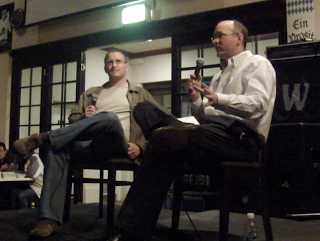
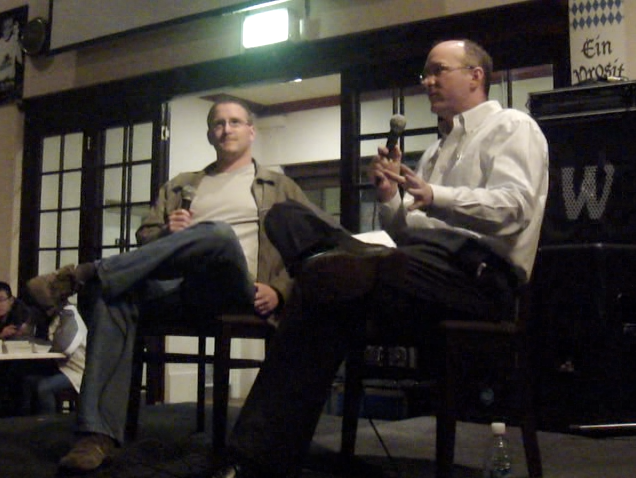
There were cameras, and we’re working on a YouTube version of the discussion. In the meantime, here is a still.

If you were there, put your impressions of the night in comments.

No question: Antoine Dodson owns this speech event

I’m still mesmerised by Antoine Dodson’s incendiary appearance on WAFF news last week. He’s the guy that fought off an attacker who tried to rape his sister. The clip has gone viral. Here it is:

There’s a lot you could learn about AAVE by watching this, but what’s amazing to me is the pragmatic range he evinces in his speech performance. It’s a theatrical display of bravado, anger, indignation, and taunting, all at once. Wow.

Best of all, it’s been Autotuned by the Gregory Brothers.

Gritty.

Newton’s flaming laser sword

Plato’s been causing trouble.

It’s that old Platonic ideal. Imagine an elephant. Not just some elephant you know (if you do know any), but the ideal prototypical elephant. Big, sort of gray, ears, legs, tail, trunk. An idea from which all other elephants deviate. That’s your Platonic elephant. Pure elephanticity.

The Platonic elephant doesn’t exist, except as an idealised abstraction in our minds. But this notion of ideal forms, of Platonism, is so pervasive that we sometimes don’t even see it. Which is why, as I say, it causes trouble.

People who aren’t good at understanding evolution are fond of repeating that there are no transitional forms. But in fact every species represents a transitional form. What we consider the species ‘elephant’ is nothing more than the set of all elephants that exist, which is different today than it was 200 years ago, which was different from 10,000 years ago. Real elephanticity keeps moving. When people think of the Platonic elephant as an immutable concept, they get tripped up.

Christian Platonism’s been dicking with my head for a long time, too. That involves the belief that a perfect version of you existed before this life (if you’re Mormon), or that your essential nature is spirit perfection, if you can keep it unspotted by the flesh. That Paul was horrified by flesh is one of the saddest contributions to Western thought, and goes a long way to explaining how fucked up Christianity is.

Avid comment readers will remember a recent Anonymous commenter (no, not Dieter Pingle) who made it clear that he (or perhaps she) wasn’t going to accept any evidence as good enough, that all evidence was equally valid (or invalid), and that the only way to go was pure reason.

Anon groused:

You put your faith in a system that “works well enough.” Mormons and other religious people do the same. You can’t come up with any real evidence to support your view and you feel that they can’t either.

Let’s ignore the fact that, since Anon didn’t accept that some evidence was better than others, I had already given her (or him) the best evidence anyone could ever provide.

What I realised from this exchange was that I had been accepting empirical evidence because it worked “well enough”, while acknowledging that it was somehow inferior to, and would take second place to, ‘pure reason’. And I had accepted this for as long as I could remember.

I have now come into contact with an article called “Newton’s Flaming Laser Sword” (PDF) by Mike Alder of our own august UWA. It’s the kind of thing everyone else probably knows already, but which I’m only now becoming aware of. (Ain’t larnin’ grand.) His argument is that ‘pure reason’ of the Platonic kind isn’t actually good for anything really, and that empiricism, such as it is, is the real driving force for knowledge.

The scientist’s perception of philosophy is that all too much of it is a variation on the above theme, that a philosophical analysis is a sterile word game played in a state of mental muddle. When you ask of a scientist if we have free will, or only think we have, he would ask in turn: ‘What measurements or observations would, in your view, settle the matter?’ If your reply is ‘Thinking deeply about it’, he will smile pityingly and pass you by. He would be unwilling to join you in playing what he sees as a rather silly game.

So far I have presented the orthodox position of scientists: truth about how the universe works cannot generally be arrived at by pure reason. The only thing reason can do is to allow us to deduce some truth from other truths. And since we haven’t got many truths to start out from, only provisional hypotheses and a necessarily finite set of observations, we cannot arrive at secure beliefs by thought alone. Most scientists are essentially Popperian positivists, they take the view that their professional life consists of finite observations, universal general hypotheses from which deductions can be made, and that it is essential to test the deductions by further observations because even though the deductions are performed by strict logic (well, mathematics usually), there is no guarantee of their correctness. The idea that one can arrive at reliable truths by pure reason is simply obsolete. Plato believed it, but Plato was wrong.

His point is that if a question can’t be settled experimentally, it’s not worth arguing about. Unless you like that sort of thing. I suppose I do like that sort of thing, so I’ll be considering that in due time. For now, I’m still getting my head around the idea of unseating Platonic ‘pure reason’ from the high seat it’s occupied for centuries, and putting empiricism in that place. I think I’ll be reading this article a few times… very slowly.
Health care: Into the too-hard basket.

This is why you do not give power to Republicans. They’ve made a chart showing how confusing the new US health care system will be.

Developed by the Joint Economic Committee minority, led by U.S Senator Sam Brownback of Kansas and Rep. Kevin Brady of Texas, the detailed organization chart displays a bewildering array of new government agencies, regulations and mandates.

And there’s a rather complex and confusing chart. Gee, that chart has a lot of lines and shapes on it. That might take a while to read.

“For Americans, as well as Congressional Democrats who didn’t bother to read the bill, this first look at the final health care law confirms what many fear, that reform morphed into a monstrosity of new bureaucracies, mandates, taxes and rationing that will drive up health care costs, hurt seniors and force our most intimate health care choices into the hands of Washington bureaucrats,” said Brady, the committee’s senior House Republican. “If this is what passes for health care reform in America, then God help us all.”

Yes, the health care system is a complex system. The economy is also a complex system. A country is a complex system. But to them, complexity is always needless complexity. If it can’t be explained in two minutes to someone with no particular expertise, it’s unworkable and should be dismantled.

The Republican health care chart is much simpler.

Please do not give Republicans control over a system that they’re too lazy and stupid to figure out.

Homer, Ill makes English (and discrimination) official.

For this week’s Talk the Talk, the leadership of Homer, Illinois caught my attention. They’ve made English their official language.

Homer Township officials acknowledge illegal Immigration hasn’t been an issue in the municipality of approximately 30,000 people. And documents for the township about 35 miles southwest of Chicago have always been printed in English with no requests for other languages.

But the township’s board passed a resolution without opposition Monday making English its official language.

So why did they do it?

[Steve Balich, the township’s clerk and the resolution’s author] said the opposition to the Arizona law has troubled him and that he believes illegal immigrants burden taxpayers through demands for public services and schools. He hoped the resolution would stimulate more nationwide discussion.

Yes, that’s the Arizona law that

would make the failure to carry immigration documents a crime and give the police broad power to detain anyone suspected of being in the country illegally. Opponents have called it an open invitation for harassment and discrimination against Hispanics regardless of their citizenship status.

Well, you have to admire their honesty. Usually the advocates of ‘English Only’ claim they’re trying to encourage immigrants to learn English (while cutting funds for ESL teaching), or trying to save money by not printing forms in other languages (thus blocking non-English speakers from getting legal or medical help they need). But here, they’re sticking up for the right to harass minorities.

Which is the whole point of English Only in the first place.

The week in Palin

On Sarah Palin’s latest: I think ‘refudiate‘ is a perfectly good portmanteau word, like ‘webinar’ or ‘spork’. Palin wasn’t even the first to use it. But it won’t help the perception that she’s a Bush-style mangler of words, and I think comparing herself to Shakespeare was probably a bit over the top.

While I’m on the topic: In American pollstering: Palin’s favourables are now at 76% among people who still choose to identify as Republicans — higher than any other likely candidate. All sensible conservatives were driven out of the party long ago, or fled in horror.

Who do you write like?

I pasted a longish blog post into I Write Like, and it said:

I write like
George Orwell

I Write Like by Mémoires, Mac journal software. Analyze your writing!

While I appreciate the compliment, I wish it would be more specific as to how it got that assessment. I can make a few guesses.

It seems obvious that this uses some kind of nearest-neighbour search. Take a corpus of authors, break their works into good-sized chunks, and then find the closest match for whatever the user gives you.

But what constitutes a match? We could use n-grams (words, and strings of words), as we do in many computational language tasks, but just matching the words in a book doesn’t mean you write like the author. Sure, Steinbeck and Faulkner wrote different words in their books just because of the topics they treated, but that’s not what we mean by writing style.

My guess is that writing style is more about patterns of words, especially function words like prepositions and conjunctions. (You may have noticed I start a lot of sentences with conjunctions like ‘but’ and ‘and’.) I’d try running all the words through a part-of-speech tagger, and see what matches that data best. Just a guess though.

I wonder if Orwell writes like Orwell. Here are three adjacent passages from Orwell’s Down and Out in Paris and London, with the computer’s assessment.

Or there was Henri, who worked in the sewers. He was a tall, melancholy man with curly hair, rather romantic-looking in his long, sewer-man’s boots. Henri’s peculiarity was that he did not speak, except for the purposes of work, literally for days together. Only a year before he had been a chauffeur in good employ and saving money. One day he fell in love, and when the girl refused him he lost his temper and kicked her. On being kicked the girl fell desperately in love with Henri, and for a fortnight they lived together and spent a thousand francs of Henri’s money. Then the girl was unfaithful; Henri planted a knife in her upper arm and was sent to prison for six months. As soon as she had been stabbed the girl fell more in love with Henri than ever, and the two made up their quarrel and agreed that when Henri came out of jail he should buy a taxi and they would marry and settle down. But a fortnight later the girl was unfaithful again, and when Henri came out she was with child, Henri did not stab her again. He drew out all his savings and went on a drinking-bout that ended in another month’s imprisonment; after that he went to work in the sewers. Nothing would induce Henri to talk. If you asked him why he worked in the sewers he never answered, but simply crossed his wrists to signify handcuffs, and jerked his head southward, towards the prison. Bad luck seemed to have turned him half-witted in a single day.

I write like
H. P. Lovecraft

I Write Like by Mémoires, Mac journal software. Analyze your writing!

Or there was R., an Englishman, who lived six months of the year in Putney with his parents and six months in France. During his time in France he drank four litres of wine a day, and six litres on Saturdays; he had once travelled as far as the Azores, because the wine there is cheaper than anywhere in Europe. He was a gentle, domesticated creature, never rowdy or quarrelsome, and never sober. He would lie in bed till midday, and from then till midnight he was in his comer of the bistro, quietly and methodically soaking. While he soaked he talked, in a refined, womanish voice, about antique furniture. Except myself, R. was the only Englishman in the quarter.

I write like
Charles Dickens

I Write Like by Mémoires, Mac journal software. Analyze your writing!

There were plenty of other people who lived lives just as eccentric as these: Monsieur Jules, the Roumanian, who had a glass eye and would not admit it, Furex the Liniousin stonemason, Roucolle the miser — he died before my time, though — old Laurent the rag-merchant, who used to copy his signature from a slip of paper he carried in his pocket. It would be fun to write some of their biographies, if one had time. I am trying to describe the people in our quarter, not for the mere curiosity, but because they are all part of the story. Poverty is what I am writing about, and I had my first contact with poverty in this slum. The slum, with its dirt and its queer lives, was first an object-lesson in poverty, and then the background of my own experiences. It is for that reason that I try to give some idea of what life was like there.

I Write Like by Mémoires, Mac journal software. Analyze your writing!

No wonder Orwell had writer’s block: schizophrenia.

UPDATE: Thanks to Kuri for that link in comments. It seems the author used

vocabulary (use of words), number of words, commas, and semicolons in sentences, number of sentences with quotation marks and dashes (direct speech).

I’d say this could be smartened up considerably. Just including some simple features would help, like the ratio of singletons (words appearing once) to other words, appearance of conjunctions, or ranking all the words by frequency and comparing lists.

This kind of makes me want to try building a better system. I won’t (for lack of time), but I think I will keep in mind that if you can take interesting work in natural language processing and make a simple web implementation, people will think it is interesting. You can also have a lot of English major hotheads sniping at you because you snubbed Toni Morrison. Wouldn’t that be fun!


Doesn’t do much, does he?

Well done, Argentina. Boo, LDS leaders.

Argentina votes for marriage equality.

It’s worth pointing out again that the leadership of the LDS Church, not content with interfering in the legislation of neighbouring US states, decided to broadcast its opposition in Argentina before the vote.

“The doctrine of The Church of Jesus Christ of Latter-day Saints is absolutely clear: Marriage is between one man and woman and is ordained of God,” said the July 6 letter from church President Thomas S. Monson.

A copy of the letter and its English translation began circulating over the weekend on websites for former Mormons.

Church spokeswoman Kim Farah on Monday confirmed the letter was sent to local leaders in Argentina, where the faith has more than 371,000 members, according to a 2010 church almanac. The country’s population is more than 41 million.

The letter falls short of calling for political activism by members in Argentina, but is an echo of a 2008 letter from Monson to Latter-day Saints in California. Monson had called for Mormons to give their time and money to help pass Proposition 8, a state ballot initiative to ban gay marriage.

So, another step in the wrong direction. I’ve said this before: Homo-hating might have been a winning strategy back in the day, but it’s only going to become less and less popular as time goes on. With such a long paper trail, the Mormon Church is really going to have a hard time walking this back eventually.

So will Catholics.

Mormon leaders, Catholic leaders — there’s less and less to distinguish them now. They are truly loathsome individuals.

Expletives may now fleet

Some taboo words are becoming more accepted, but it’s rare to find a definite point in time when this occurs. One appeared this week in the USA, as a federal appeals court struck down a rule concerning ‘fleeting expletives‘. Before this, TV networks could be fined if, say, Bono said ‘fuck’ on the air during an awards show (which he did). Now, the FCC will have a harder time making it stick.

The court said that policy on so-called fleeting expletives was “unconstitutionally vague” and created a “chilling effect” on the programming that broadcasters chose to air. The court echoed complaints from network executives that the FCC’s standards were nearly impossible to gauge, noting that the agency allowed the airing of the f-word and s-word in broadcasts of the World War II movie “Saving Private Ryan” but not in the PBS miniseries “The Blues.”

The FCC may appeal, but it looks unlikely; FCC Chairman Julius Genachowski hasn’t yet put profanity on the front burner.

So, for now, free speech: Fuck, yeah.

Older posts Newer posts

© 2026 Good Reason

Theme by Anders NorenUp ↑