Good Reason

It's okay to be wrong. It's not okay to stay wrong.

Category: post (page 25 of 125)

Does it matter what a candidate believes?

People are talking about this article by Bill Keller in the NYT about religion in politics.

Asking Candidates Tougher Questions About Faith

If a candidate for president said he believed that space aliens dwell among us, would that affect your willingness to vote for him? Personally, I might not disqualify him out of hand; one out of three Americans believe we have had Visitors and, hey, who knows? But I would certainly want to ask a few questions. Like, where does he get his information? Does he talk to the aliens? Do they have an economic plan?

Hal Boyd of the Deseret News gives a roundup of writers who are shocked — shocked! — at the impertinence of asking candidates about their religious beliefs. After all, isn’t that personal? Well, it could be, if the candidate makes it private. Colbert I. King thinks faith is no big deal, but he makes an exception for candidates who make a big deal out of it. Sounds fair, but it doesn’t go far enough for me.

I’d say that a candidate’s faith is fair game for a much more pragmatic reason. Let me start with evolution. If someone doesn’t accept evolution as true (as all but a few Republican candidates don’t), I won’t vote for them. That’s because this person is going to be making decisions on my behalf, and by rejecting evolution, they’re showing me that they don’t know how to tell if something’s true. They’re not good at making decisions based on evidence. And there’s a high probability that their thinking is compromised by undue influence from the religious sector. Those are all very worrying tendencies in a leader.

And that’s just evolution. I’d say the same goes for Mitt Romney’s underwear, Michele Bachmann’s superstition about a god controlling the weather, Rick Perry’s belief in ritual starving to attract the attention of his god, or anyone else’s beliefs in magical nonsense. Delusion is delusion.

Of course, even if someone is an atheist, they can still be a disappointing leader; check Australian PM Julia Gillard, an atheist who shows a bewildering opposition to gay marriage, and an unaccountable fondness for distributing federal dollars to Christian chaplains in high schools. Nor are religious beliefs the only ones to watch out for. There are also irrational and dangerous secular beliefs involving climate change denialism or free-market fundamentalism. For me, the key is: does this person know how to use science and evidence to find out what’s true? If not, keep them away from the levers of power. Ignorant people should be represented in government, but not by ignorant people.

Markov Everything!

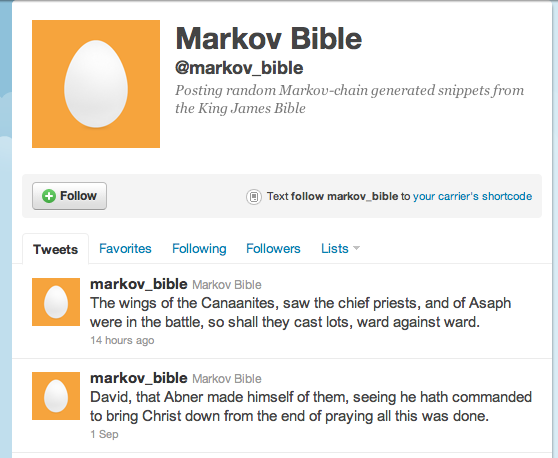
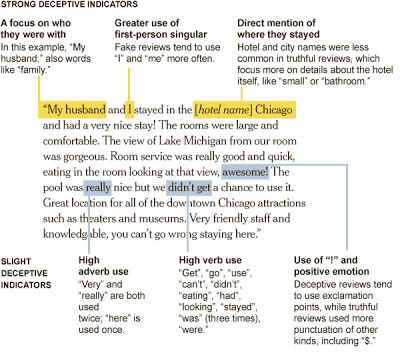
Someone on Twitter has created Markov Bible.

We’ve had fun with Markov chains on the blog before. They’re really quite simple: just take a big file full of text, and pick any two adjacent words at random (let’s say it’s ‘in the’). Then, find every occurrence of the words ‘in the’, and make a list of every word that occurs right after them. Pick one of those at random, and that’s word number 3. Now repeat with your word number 2 and 3 to get a word 4, and so on for as long as you want.

It’s fun to mess around with the Bible, but my favourite thing is to do mashups. Here’s the Bible combined with George Orwell’s 1984.

They say unto you, Ye shall worship at his saying, and nipped off to Canada like cattle. They could do nothing against the children of the same: but the one end of three years old when he would have cast upon a pole, and it was too late–no such thought occurred to me, and on the north corner, he made windows of agates, and thy master’s son? And Ziba said unto Onan, Go in this book.

That last part is funnier if you know who Onan is.

And here’s some of Alice’s Adventures in Wonderland, mixed in with Franz Kafka’s The Penal Colony.

CHAPTER XI Who Stole the Tarts? The King laid his head and, feeling behind him with his face to the Bed. First, I’ll describe the apparatus to you.” The Traveller acted as if a dish or kettle had been asked to attend the execution of a bottle. They all came different!’ the Mock Turtle replied; ‘and then the execution is a very grave voice, ‘until all the players, except the King, who had been sleeping on duty. For his task is to give the prizes?’ quite a chorus of ‘There goes Bill!’ then the other, and making quite a long time together.’ ‘Which is just the case might be, if he had neglected to look down and appeared peaceful. The Soldier showed the Traveller and laid his head sadly. ‘Do I look like one, but it is.’

The longer the sentence, the less likely it is to be coherent, since Markov chaining doesn’t preserve the long-range structure of a sentence. But still, it’s surprising when it works.

Would it be a bad thing to live forever?

‎”Blindly we dream of overcoming death through immortality, when all the time immortality is the most horrific of possible fates.” -Jean Baudrillard

One of the worst things about my deconversion was realising that there probably wasn’t going to be an afterlife. I’d been counting on that all my life, and as a result, I had to do some serious rethinking on my timescale. A universe without me? I’m not an eternal being? My religion had flattered me, made me feel so important, and appealed to my sense of vanity. I hated thinking that I probably wasn’t going to live forever.

I was surprised, then, to find that some people aren’t concerned about it, and don’t particularly want to live forever.

In the Hitchhiker’s Guide to the Galaxy series, one character is immortal, and it’s a curse.

To begin with it was fun; he had a ball, living dangerously, taking risks, cleaning up on high-yield long-term investments, and just generally outliving the hell out of everybody.

In the end, it was the Sunday afternoons he couldn’t cope with, and that terrible listlessness that starts to set in at about 2:55, when you know you’ve taken all the baths you can usefully take that day, that however hard you stare at any given paragraph in the newspaper you will never actually read it, or use the revolutionary new pruning technique it describes, and that as you stare at the clock the hands will move relentlessly on to four o’clock, and you will enter the long dark teatime of the soul.

So things began to pall for him. The merry smiles he used to wear at other people’s funerals began to fade. He began to despise the Universe in general, and everybody in it in particular.

“I think I’ll take a nap,” he said, and then added, “What network areas are we going to be passing through in the next few hours?”

The computer beeped.

“Cosmovid, Thinkpix and Home Brain Box,” it said, and beeped. 

“Any movies I haven’t seen thirty thousand times already?” 

“No.” 

“Uh.” 

“There’s Angst in Space. You’ve only seen that thirty-three thousand five hundred and seventeen times.” 

“Wake me for the second reel.”

Immortality might be horrible. Really: how long can you enjoy the vitality of life? How many more times can you listen to Vivaldi’s ‘Four Seasons’? How many times can you watch your favourite movie? Eventually you’ll have found all the things that do it for you. And habituation’s a bitch. What if I became so accustomed to the sunset, or the touch of my sweetheart through repeated exposure that I could no longer enjoy it? I’d be dead then, but still walking around.

Okay, so I can see that eternity would be a long long time, but I don’t envision a check-out date. There’s too much to learn! There’s enough for fifty lifetimes. I’m doing linguistics now. I think in the next lifetime, I’ll do maths and get really good at that. Then what? A lifetime of typography! What kind of computers will people invent? What will English be like in 500 years? And so on. Seventy years seems so short.

Even so, it’s probably a good thing that people die. Max Planck has been paraphrased to say “Science advances one funeral at a time.” And Steve Jobs has his take on it:

 
Transcript for people who don’t like watching videos.

No one wants to die. Even people who want to go to heaven don’t want to die to get there. And yet death is the destination we all share. No one has ever escaped it. And that is as it should be, because Death is very likely the single best invention of Life. It is Life’s change agent. It clears out the old to make way for the new. Right now the new is you, but someday not too long from now, you will gradually become the old and be cleared away. Sorry to be so dramatic, but it is quite true.

It’s true, but that doesn’t mean I have to like it.

So what do I do about it? Steve continues.

Your time is limited, so don’t waste it living someone else’s life. Don’t be trapped by dogma — which is living with the results of other people’s thinking. Don’t let the noise of others’ opinions drown out your own inner voice. And most important, have the courage to follow your heart and intuition. They somehow already know what you truly want to become. Everything else is secondary.

Have you made peace with mortality? Or do you rage against the dying of the light? I haven’t decided which approach I like best. I guess at this stage I’m just glad to have escaped the liars who make big, empty promises about forever.

Who likes Benny Lava?

Starting out with “Who likes white people?” seemed a little out there, even for Michele Bachmann.

Language Log has done a convincing job of demonstrating that she really said, “Who likes wet people?”, which you can prove to yourself by closing your eyes and listening. You know what it is — it’s those damn subtitles (or are they supertitles?). When you see the words up there, it sure sounds like “white”, even when you know it’s “wet”.

I like this as an example of the suggestibility of perception. Could this be the Benny Lava of American politics?

No, maybe not.

Education in reverse

Aren’t you glad you’re not a kid going to a private Christian school in Perth, Australia? Because if you were, you’d have assignments like this:

Gay sex ‘sickest of sins’

CHILDREN have been asked whether homosexuality is “the sickest sin” in a school assignment.

The homework given to 14 and 15-year-olds at Armadale Christian College, also also points them to bible quotes describing homosexuality as an “abomination”, and describes “coming out of the closet” as “open sinning”.

Way to go, Christians. Imagine you’re 15, trying to figure out what your sexuality is, and you get handed that as homework. High school students are already cruel enough about ferreting out the gay kids in their midst, without the teachers piling on.

Another question asked what God said about homosexuality and pointed to Bible quotes for the answer, which called it an “abomination”.

The assignment also stated that homosexuality was a “compromise for the need to be loved and accepted”, resulting for many from “low self-esteem (and) gender emptiness”.

Also on the assignment was: “Many people say that homosexuality is an inborn trait. Is a person born greedy, jealous, malicious, gossiper, slanderer, thief, child abuser, serial killer?”

Because being gay is just like all those other things.

I managed to procure a copy of the actual assignment (PDF), and yeah, it’s pretty much the standard anti-gay stuff that gives Christians a hate-on, plus Bible scriptures.

Homosexuality
“Do you not know that the unrighteous will not inherit the kingdom of God? Do not be deceived. Neither fornicators, nor adulterers, nor homosexuals, nor sodomites…” (1 Corinthians 6:9)

Preliminary Thoughts

1) What is homosexuality?

2) Is homosexuality a new practice? Why do we hear so much about it now?

3) What are some reasons people give to justify homosexual practices?
a)
b)
c)

4) Why are some people tempted with homosexual feelings and others are not?

5) Are feeling and temptations wrong, or do they become wrong when we do something about them (James 1:12–15)?

6) Is there a limit to the power of any temptation (1 Corinthians 10:13)?

7) The subject of homosexuality is confusing because everyone calls it something different.
• Is homosexuality a physical or genetic disease?
• Is homosexuality “the sickest sin there is?
• Is homosexuality “natural” for some people, being an inborn trait (Romans 1:26–27)?
• Is homosexuality a legitimate “alternative lifestyle” (Genesis 2:24; Hebrews 13:4)?

8) Most people seem to have no idea how homosexuality can be a temptation to anyone. Therefore we are not very helpful to a person who is struggling with the temptation (cf. Galatians 6:1–2; Jude 22–23). Maybe that can change if we understand a few general things about homosexuality.
• God makes every person unique (Psalm 139:13–16; 1 Corinthains 12:12–27). He may be different, but God does not make him “gay” (James 1:13).
• Homosexuality generally has little to do with sex. The sexual involvement with another person of the same sex, is a compromise for the need to be loved and accepted.
• Some inborn factors may contribute to the development of homosexual attractions, but these are not sufficient to make a person homosexual (James 1:14–15; 1 Corinthians 10:13).
• Factors which lead to each person’s struggle with homosexual attraction are different, but certain stages are common to many—low self-esteem, gender emptiness, gender attraction, sexual attraction, homosexual reinforcement, homosexual identity.

What Does The Bible Say?
1) Is homosexuality a new practice (Genesis 19:1–29; Judges 19:1–28; 1 Kings 14:24; 15–12; 22:46; 2 Kings 23:7)” Is there anything new (Ecclesiastes 1:9–10)?
2) What did God say about homosexuality under the Law of Moses (Leviticus 18:22; 20:13)?
3) Many people say homosexuality is an inborn trait. Is a person born greedy, jealous, malicious, gossiper, slanderer, thief, child abuser, serial killer (Mark 7:20–23)? Why would people say that homosexuality is inborn?
4) Is homosexuality a “natural” practice (Romans 1:26–27)?
5) Is homosexuality against God’s law or sanctioned by it (1 Timothy 1:8–10)?
6) Homosexuals advocate “coming out of the closet” and being open with their lifestyle. What does the Bible say about such open sinning (Isaiah 3:9)?
7) Men try to lessen the severity of sin by softening its description. The Bible does not describe homosexuals/lesbians as “gay” or living an “alternative lifestyle“. How does the Bible describe such people?
• 1 Kings 14:24—
• 1 Corinthians 6:9—
• Colossians 3:5—
• Jude 7—

8) What two things does 1 Corinthians 6:9–11 teach us about homosexuality?

9) Those who oppose homosexuality are often called “homophobes” or “gay bashers“. Some people really are—but how would you desribe a caring, concerned Christian who wants to help a person overcome his struggle with homosexuality (1 Corinthians 13:4–7; James 5:19–20)?

Practical Solutions

1) Can a person who is engaged in homosexual practices remain in that condition? What much he/she do (Ephesians 5:1–14)?

2) Does God care about our struggle? What are some practical ways that God gives to overcome this temptation (1 Corinthians 10:13)?
• How did Jesus overcome temptation (Matthew 4:1–11)?
• Who can we turn to for help (Philippians 4:13; 1 John 4:4)?
• How must we respond to the devil’s temptation (James 4:7)?
• What activity helps us as much as anything (Philippians 4:6–7)?
• What do we need to try and master (Philippians 4:8; 2 Corinthians 10:5)?

3) After you rid yourself of this practice, what must you do to keep worse sins from returning (Luke 11:24–26)?

4) How is the church to respond to a practicing homosexual who repents (2 Corinthians 2:3–11)?

5) Do you have a closing thought?

Maybe some parents at ACC wouldn’t mind having this assignment plopped down on their child’s desk, but I suspect more than a couple would. And people in the wider community should definitely be concerned that high schoolers are being exposed to the hateful teachings of the Christian bible — subsidised by tax dollars, no less. Remember, this is happening not in the American South, but in good old secular Perth WA, today. It can happen here.

If you want to write your own answers for this assignment, give it a go in comments.
Spam spotting

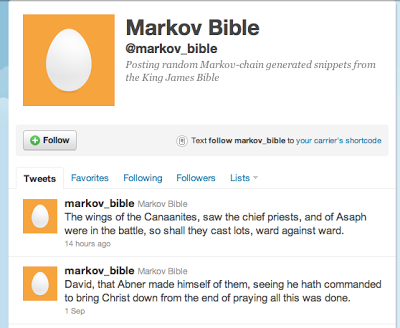
Here’s an interesting application for Natural Language Processing. How do you know if a review for a hotel or a business is real, or just a spammy one written by someone who’s never even seen the place?

Computers can do it. Just get people to write a ton of spammy reviews, then get some reviews that (you suspect) are real, and compare the patterns.

Can’t read the text? Fake reviews were more likely to use “I” and “me”, adverbs like “really”, and explanation points.

Here’s a PDF of the authors’ ACL presentation.

Inappropriate brand identificaton

There’s enjoyment and there’s investment.

Let’s take the band Gomez for an example. I noticed the other day that I have a lot of Gomez albums, and I like them, but I wouldn’t call myself a Gomez fan. There’s some level at which I haven’t identified with them.

On the other hand, when I first heard the Leisure Society or Seabear, it was more than just liking their stuff. I connected with them in some way that made me say “I can get behind this.” I reserved a tiny part of myself for them, and made them a part of my social identity (because listening to music is as much about social alignment as musical enjoyment).

But defining yourself in terms of musical taste might not be such a great idea. What happens if ‘your special band’ releases a disappointing second album (as the Leisure Society and Seabear both did)? Will you be able to update, or will that be too threatening to your self-image? Maybe you’ll just never listen to the new stuff, and keep thinking they’re great.

What I’m talking about is the perils of Fanboi Syndrome, and it’s the topic of this study (thanks to Kuri). Except this is about brands, not bands.

You may think you’re defending your favorite platform because it’s just that good. But, according to a recently published study out of the University of Illinois, you may instead be defending yourself because you view criticisms of your favorite brand as a threat to your self image. The study, which will be published in the next issue of the Journal of Consumer Psychology, examines the strength of consumer-brand relationships, concluding that those who have more knowledge of and experience with a brand are more personally impacted by incidents of brand “failure.”

The researchers performed two experiments, one on a group of 30 women and another on 170 undergraduate students, in order to see whether the subjects’ self esteem was tied to the general ratings of various brands. Those who had high self-brand connections (SBC)—that is, those who follow, research, or simply like a certain brand—were the ones whose self esteem suffered the most when their brands didn’t do well or were criticized. Those with low SBC remained virtually unaffected on a personal level.

Boy, do I hear this. I used to be an Apple fanboi. Well, I still kind of am, partly because I think their stuff is good, and partly because of the thousands of happy hours I’ve spent computing on the MacOS. But a little tiny part of me is heavily invested in Apple, to the extent that I have to try not to feel personally affronted if AppleHaterz bag it, and I’m likely to write off their opinion.

I used to be worse. You should have seen me in the 90s, when the Mac was an endangered species. But brand identification is something of a danger. It’s one more kind of bias that keeps us from seeing clearly. Companies shouldn’t have that kind of hold.

30-Day Blog September

I’m starting something new, and I’m calling it 30-Day Blog September. Every day in the month of September, I am going to blog something. It may be the most interesting news article I found that day, a thought I had, or a longer piece, but it will be something, and it will be every day.

You could try it too, if you have a blog. Maybe it will shake us both out of Blog Lethargy, and help us realise that not every post needs to be a Serious Thought Piece. Want to join me?

UPDATE: I has a graphic.

If you’re up for 30-Day Blog September, slap this graphic somewhere on your blog, and link to this post.

Peace for one day

A friend showed me this TED talk about Jeremy Gilley, who had an idea: What if everyone decided to stop war for one day?

You could say all kinds of things about this. Crazy. Idealistic. Naïve. And you’d be kind of right. For one thing, war happens anyway. For another, getting people to agree not to fight is futile because war is a failure to agree in the first place. That’s the problem. What you’re saying is, “If only we could get people to agree, then we could start to work on the problem of people not agreeing!”

Not everyone wants peace, anyway. One of the worst Christian memes around now is that if a major world political leader brings peace, that’s a sign that they’re the antichrist. Apparently, God is the only one who is supposed to bring peace, and anyone else is a satanic impersonator. So they’re suspicious of peace. Isn’t that lovely? But anyway.

And yet, despite all this, the Peace One Day project has done some good. Even the Taliban agreed to it one year, and violence went down that day.

You have to try stuff, as idealistic as it seems. Maybe, as Gilley says, it won’t work, and nothing will happen. But maybe it will, and someone won’t get blown up or killed for a day. You have to try.

And anyway, whether it “works” or not isn’t the point. As I see it, the point of this exercise is that it’s important to affirm values. It’s important for the world community to state that peace is a collective goal. We need to say “You know peace? Well, we want that.” And we need to keep saying that over and over again, because some people will keep chipping away at that value. We can’t ever assume that any of our values are so universally held and so solid that we can never lose them. We can slip backward. It happened with torture. It’s happening with the right to choose to have an abortion. You think child labour laws are an irretractable value? Public education? Conservatives right now are working feverishly to turn the clock back on our progressive values, even the ones that we think we could never lose. We need to keep affirming that these are the values we have.

September 21 is the day, by the way. It’s not too far off. Maybe there’s something we could do.

Naming rights

The issue of names and naming is interesting. Names are a rich source of cultural information. They tell us about our history, and our social networks.

In a recent Linguistics class, I brought up the topic of names with an exercise that you can do, if you like.

Try making a list of all the names you have. Don’t skip any. Think about nicknames, or alternate versions of your name that you’ve used. Could someone use more than one name for you? What does it mean if they pick one or the other?

Usually people find, as I did, that names tell about our history. No one calls me ‘Dan’ or ‘Danny’, unless they knew me when I went by those names. Internet names can tell about our interests — sometimes I’m ‘fontor’ or ‘GoodReason’. And a lot of names have to do with our social system; family titles like ‘Dad’, or a name that belonged to a relative that’s been handed down (as is the case with my actual ‘first name’, Thomas). There may even be names that people aren’t supposed to know. Maybe you don’t like your middle name, and you’d rather people don’t know it. Sometimes nicknames between intimates are kept private.

Sometimes names are conferred ritually, which brought me to the LDS temple name. I explained to the class that in my former religion, when someone is initiated into the temple rituals, they’re given a new name which is never to be revealed, except under very limited circumstances.

“But that doesn’t make any sense,” said one student. “What’s the point of having a name, when no one can use it?”

Why indeed?

I answered this way: Who gets to name a comet? Whoever discovered it. Who gets to name a person? The parents. In marriage, a man sometimes gives a woman part of his name, which reflects the social agreement of the time that she belonged to him. In other words, the act of naming is done by the one who has ownership (in some way) over the thing being named.

So the act of naming something isn’t just to create a way to refer to someone. By giving a new name to someone as part of a temple ritual, the church could be seen as asserting its ownership.

Older posts Newer posts

© 2026 Good Reason

Theme by Anders NorenUp ↑