Good Reason

It's okay to be wrong. It's not okay to stay wrong.

Category: post (page 24 of 125)

Prisencolinensinainciusol: Oll raigth!

When I was in high school, I asked an exchange student what American English sounded like to someone who didn’t understand the words. She said, “Sort of like pigs.”

For some reason, I wasn’t completely satisfied with this answer. Fortunately, I found this video instead.

The song is total gibberish, but it’s intended to represent the sound patterns and intonation of US English. Trippy.

Tracking the Skipper, part 1

The inimitable Madge comments:

If we’re allowed to make requests, today I was looking up the word “Skipper” and couldn’t find any dictionaries/wiki pages that mentioned its, in my mind, very common meaning of “person who doesn’t drink so they can drive all their drunk friends home from the pub”. Guess it must be an Australian term but what is its history?

Can you use your linguistic prowess to find this out for your adoring fans?!

I think this is a cool use of ‘Skipper’ — it makes the non-drinking responsible friend seem more authoritative. In the NT, they call this person ‘Sober Bob‘, which is just terrible — who wants to be Sober Bob? Sounds like the one who drew the short straw. But ‘Skipper’ — now you’re running the ship, mate! Maybe ‘Skipper Bob’ would be okay. (Don’t mind me: you’re cool for taking care of your friends, no matter what they call you… Bob.)

Anyway, I remember the use of the term ‘skipper’ from the 90’s, which means it probably goes back earlier. The clearest way to nail down its origin is to find its earliest use in print. Madge is right — for such a common term, it’s remarkably difficult to trace. Oxford (paywall) doesn’t even list it among the senses of ‘skipper’, and neither does Etymonline.

This paper by Watson and Neilsen (2008) names a ‘Skipper’ program from 2006, which seems a bit late. However, this paper by Boots and Midford (1999) (PDF) claims that:

The ‘Pick-a Skipper’ campaign was devised by the Liquor Industry Road Safety Association in 1985 as a mass media promotion encouraging drinkers to choose a non-drinking ‘Skipper’ to drive drinkers home.

If that’s right, that would push back the earliest usage of ‘Skipper’ to 1985. Keep in mind: we haven’t really backdated it to 1985 — I’d want to see the promotional materials from the campaign itself — but it does provide a clue as to where to look. For now, we have to plant the flag at 1999.

And there the trail goes cold. Anyone have any skipper-related documentation lingering around the garage? The work of linguistic history is waiting on you!

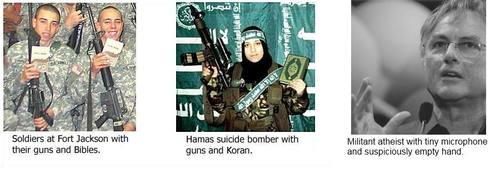
Militant atheists

Is there anything more tedious or lazy than journalists complaining that atheists are ‘just as bad’ as religionists? Especially when they write as badly as Emma Jane.

FANATICAL Christians and fundamentalist atheists are like a couple of kids bickering in the back seat during a long car drive.

As US presidential candidates make shrill demands for the teaching of creationism in schools, British pit bull atheist Richard Dawkins accuses non-evolutionists of being stupid, insane or wicked.

As US evangelical Rebecca Hagelin says there is no greater evil than gay marriage, a schoolteacher is sued for ridiculing a student’s belief in Jesus.

It raises the question of whether intransigent evangelicals and militant atheists should both be sent to the naughty corner. Not to think about what they’ve done (even though both religious and atheist regimes have clocked up appalling body counts) but to consider how much they have in common.

Ostensibly opposites, hardline proselytisers and zealous pagans are like the political Left and Right in that the further they extend into extremism, the more they begin to resemble each other.

It’s the old false equivalency that journalists are so great at. Don’t like either side? Say they’re just the same.

I’m happy to allow that ‘militant religionists’ are more the exception than the rule, but if you’re comparing worst to worst, there’s nothing on the atheist side that compares to the worst of the religious side. Committed religionists kill people, oppress women, rape children. What do ‘militant atheists’ do? Write mean things on the Internet. It’s not an apt comparison.

Or:

But what if atheists were as bad as the religious? What would that look like?

It would look like this guy:

Except that the atheist guy was kind of funny. And you can bet that after this exchange, the atheist guy just took his bullhorn back to work and stopped bothering people, and the Christian guys went bothering people somewhere else.

Prayer

Sandra points me to this episode of Dinosaur Comics.

Click on the image to go to the whole cartoon.

It reminds me of something George Carlin said about prayer:

If you insist on praying, what you need is a Magical Wishing Ferret. You can ask him for anything you want. He works by the power of confirmation bias, so if you don’t get what you want, you’ll never notice.

Monson fondly remembers 9/11

Religions are in the business of providing emotional comfort (among other things), and after 11/9/1, Americans’ sense of stability was rocked. I think this played out in a predictable way for Mormons.

I visited my US home ward in late 2001, and it was the strangest thing: I’d never heard so many references to Satan before. Naturally, when people feel like events are out of their hands (what’s known as an ‘external locus of control’), they develop superstitions, and here it was unseen malevolent agents. I saw something else on that visit that I’d never seen before: In Priesthood Meeting, they’d developed the habit of reciting their ‘group values’ in unison, chanting a sort of ‘we believe’ mantra. Even as a believer, it struck me that here was a group of people too frightened to think.

From a look at this WaPo column, Mormon president Thomas Monson sure misses that time.

There was, as many have noted, a remarkable surge of faith following the tragedy. People across the United States rediscovered the need for God and turned to Him for solace and understanding. Comfortable times were shattered. We felt the great unsteadiness of life and reached for the great steadiness of our Father in Heaven. And, as ever, we found it. Americans of all faiths came together in a remarkable way.

And the bottom line couldn’t have been better.

Side note: what’s with the capital H on ‘Him’? I haven’t seen that in Church publications since the 1920s.

Sadly, it seems that much of that renewal of faith has waned in the years that have followed. Healing has come with time, but so has indifference.

Isn’t it too bad that we don’t have more horrible tragedies to turn our hearts to god? Darned if Monson doesn’t feel some nostalgia for that time of national agony. What a ghoul.

Whether it is the best of times or the worst, He is with us. He has promised us that this will never change.

But we are less faithful than He is. By nature we are vain, frail, and foolish. We sometimes neglect God.

Then we’re even, because God was more than a little neglectful on that day. He failed to save the lives of 3,000 people, but left instead a steel cross. You know, just to let us know he’s there, thinking about us.

If you object to this, saying that ‘super-hero’ isn’t part of god’s job description, consider: What would you have done if you’d had the knowledge of what was about to happen that day, and the ability to do anything? Well, god had all that, and still failed to do what you — a normal human, with all your goods and bads — would have done. Why do people say that god is good?

Mormons talk interminably about what they call the ‘pride cycle’: People get prosperous and prideful, they forget god, then god (that sicko) burns them up in fires, buries their cities in earthquakes, or sinks them into the sea (and that was gentle Jesus, BTW). Then the people remember to grovel sufficiently before him, and he prospers them. Because it’s all about him.

One could rewrite the narrative thus: Tragedies happen, and the feeling of vulnerability drives people into authoritarian religions. But life goes on, and people stop feeling frightened, at which point they abandon superstition, becoming secular or at least joining liberal churches. Until the next tragedy. Rinse, repeat.

Small wonder, then, that Monson is banging the drum for a more godly society. The vacuum cleaner salesman wants everyone to buy vacuum cleaners, and the god salesman… you get the picture. It’s just business.

Reasonably Good Performances

The Mormons had Gordon Jump and Mike Farrell doing their films in the 70s and 80s (remember Gordon as the Apostle Peter? probably not), but the Seventh-Day Adventists had a young Russell Crowe plugging their ministry programme at Avondale College in New South Wales.

I have to say, young Russell brings a certain believability to the role, with his grudging yet growing acceptance of ‘the call’.

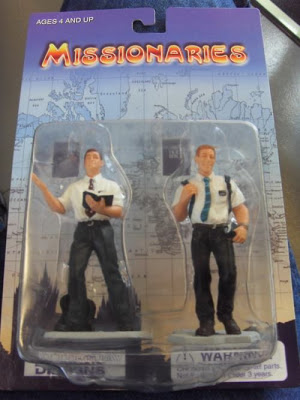
Two by two

Wow — I didn’t know you could get these.

What’s that Elder on the left doing? Ah, he’s expounding.

I think the other one is dusting off his feet. Watch out — that’s like a level 3 Harm spell when they do that. I think you can only recover from that if you’re a Mage.

Denser is slower

A linguistic tidbit from the ‘Obvious in Retrospect’ file:

A recent study of the speech information rate of seven languages concludes that there is considerable variation in the speed at which languages are spoken, but much less variation in how efficiently languages communicate the same information.

Dr. Pellegrino outlined the major findings of the team’s research: “Languages do need more or less time to tell the same story – for instance in our study, the texts spoken in English are much shorter than their Japanese counterparts. Despite those variations, there is a tendency to regulate the information rate, as shown by a strong negative correlation between the syllabic rate and the information density.” In other words, languages that are spoken faster (i.e., that have a higher syllabic rate) tend to pack less information into each individual syllable (i.e. have a lower information density).

In other other words, the more information packed into each syllable, the slower those syllables have to be delivered. Across languages, those two factors balance each other.

It makes sense because human brains have a cognitive limit, and they’ll only put up with so much throughput. Still, nice to see this result in black and white.

Without a trace

I recently learned of L’Anse aux Meadows. It’s a place in Newfoundland, Canada where Vikings settled about 1,000 years ago. It’s the oldest European settlement in the Americas. The Vikings didn’t live there very long — only about 10 years — and it seems that there weren’t that many of them. It’s only a small site — no stables, no burials.

Yet for that small a group in so short a time, they left enough artifacts to fill a small museum.

Long-time readers will see where I’m going with this. The Book of Mormon claims to be the history of a group of people who lived in the Americas for about a thousand years, numbering in the millions. The book discusses their metalwork, their swords, their coins, their money, and much more — no evidence of which occurs in the archaeological record. And they didn’t dwindle down slowly — they were supposedly killed off quickly in wars of extinction. You’d think that something would have survived, but no.

Maybe the Nephites and Lamanites just didn’t build stuff as well as the Vikings. Or else fictional people don’t leave archaeological traces.

Three Card Monte

Everybody knows not to play Three Card Monte, right? It’s an old scam that relies on a little sleight of hand and a lot of psychology.


It’s not just one operator, but a whole team, including confederates who make winning look easy, and blockers who separate you from your more sensible friends. And if you do manage to pick the Ace, a shill will bet more on the wrong card so the dealer will take their fake bet instead. There will even be some ‘muscle’ on hand to give you a few broken ribs if you make trouble.

It’s fascinating to watch, but it’s a dangerous game, and you always lose. Don’t play.

Older posts Newer posts

© 2026 Good Reason

Theme by Anders NorenUp ↑