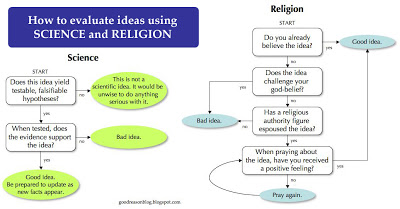
With apologies to Wellington Grey, here’s a comparison of how to evaluate ideas using science versus religion.

Click the image to enlarge in a new window.
With apologies to Wellington Grey, here’s a comparison of how to evaluate ideas using science versus religion.
Click the image to enlarge in a new window.
I really hate the word ‘sheeple‘.
Let’s say I’m a nutjob with a theory. Here it is: Katrina was an inside job. The CIA controls the weather. I’m not sure if the White House let it happen or made it happen, but the whole thing is prophesied in Revelation (somewhere). You can’t prove me wrong. If I don’t have any evidence, it’s because the secret cabal has covered its tracks so carefully.
The likelihood of most people adopting my idea is low, though I’ll get a few other nutjobs to believe it. But at some point, I’ll have to answer a question: if my idea is so great, why don’t people believe in it?
That’s where the ‘sheeple’ idea comes in. I can blame people for being lazy, complacent, unthinking, and dumb. Anything but accept that my idea sucks.
Now these things may be true. Sometimes people aren’t good thinkers because they aren’t trained in critical thinking, and our existing ideas seem to make so much sense to us, especially when we only look for evidence to support them, not challenge them. I’m constantly seeing these tendencies in myself.
But conspiracy people like the word ‘sheeple’ because it’s easier to criticise people than to educate them, and it’s much easier than learning how to evaluate ideas and challenge them. Why do that when you can pretend you’re the misunderstood noble genius, like Galileo or Prometheus?
For its lazy and cynical misanthropy, I hereby exclude the word ‘sheeple’ from my vocabulary.
Many happy returns to my dear friend Jeff, who turns 40 today.

Right behind you, buddy!
What have you been doing lately?
When people learn that I’m a linguist, they sometimes imagine that I am an Official Grammar Arbiter. They say things like “Oh, I hate when people say ‘That was fun.’ Don’t you hate that?” Leaving me to wonder why they’d pick on that poor, innocent, perfectly acceptable sentence. Or something equally innocuous. It would be one thing if they’d complain about something ambiguous like ‘downwards’ instead of ‘downward’ or ‘if I were/was’. But it’s often some ordinary sentence that anyone would say.
Last night, a gentleman told me, “I’ve become more tolerant about grammar since reading the history of English.”
“Oh, really?” said I.
“Yes, I used to hate when people would say ‘That’s so great, or so interesting.”
“Um,” said I.
“But now I realise that English has been changing for a long time, and the English we use was once unacceptable. So I’ve become more tolerant about it.”
“That’s good,” said I.
US Congressperson Pete Stark (D-Ca) has become the first open atheist in Congressional history. Or should we say ‘nontheist’?
Rep. Pete Stark (D-Calif.), a member of Congress since 1973, acknowledged his nontheism in response to an inquiry by the Secular Coalition for America. Rep. Stark is a senior member of the powerful House Ways and Means Committee and is Chair of the Health Subcommittee.
…
Herb Silverman, president of the Secular Coalition for America, attributes these attitudes to the demonization of people who don’t believe in God. “The truth is,” says Silverman, “the vast majority of us follow the Golden Rule and are as likely to be good citizens, just like Rep. Stark with over 30 years of exemplary public service. The only way to counter the prejudice against nontheists is for more people to publicly identify as nontheists. Rep. Stark shows remarkable courage in being the first member of Congress to do so.”
Indeed. Atheists are the scary monsters of the political scene. Notice how dirty a word ‘atheist’ is. That has to stop. (So does that annoying reference to the Golden Rule. It’s playing into their frame, like saying ‘Look! We can be just as righteous as Christians, the ones who own goodness and light!’ In fact the behavioral differences are minimal.)
Visibility is the key to ending the pariah status of atheists. Pete Stark has opened the door in Congress, and for that, he’s Good Reason’s Hero of the Week.
I view religious ceremonies as purely symbolic, but even so, I’d still say that this one is perhaps intrinsically worthwhile:
Priests to purify site after Bush visit
GUATEMALA CITY – Mayan priests will purify a sacred archaeological site to eliminate “bad spirits” after President Bush visits next week, an official with close ties to the group said Thursday.
“That a person like (Bush), with the persecution of our migrant brothers in the United States, with the wars he has provoked, is going to walk in our sacred lands, is an offense for the Mayan people and their culture,” Juan Tiney, the director of a Mayan nongovernmental organization with close ties to Mayan religious and political leaders, said Thursday.
If only it were that simple — alas, in the USA, the priest class is part of the problem. What’s it going to take to fumigate the USA after FratBoy leaves office?
It seems Ann Coulter is stuck in attack mode, which is very GOP. Straight from the Republican Handbook ‘Rules of Engagement’:
1. Attack and attack again.
2. Never admit wrongdoing.
Which didn’t work so well for Bush in Afghanistan and Iraq, and it’s not working very well for Ann. Here’s her rather unconvincing and juvenile Humpty Dumpty impersonation:
“‘Faggot’ isn’t offensive to gays; it has nothing to do with gays,” Coulter said on “Hannity and Colmes” Monday night. “It’s a schoolyard taunt meaning ‘wuss,’ and unless you’re telling me that John Edwards is gay, it was not applied to a gay person.”
So by taking umbrage at being called a ‘faggot’, John Edwards is admitting he’s gay! I only meant he was a wuss! Have you told your mother you’re gay, yes or no? Stop hitting yourself!
In fact, ‘faggot’ is offensive to gays. This author’s view is somewhat representative.
“Faggot,” is the “N”-Word to Gay People. It hurts as much. It is as discriminatory. It is as disparaging.
An aside: If you go on to read the article, please ignore the author’s etymology involving burning people. That’s a common misconception. In fact, our current usage of ‘faggot’ probably derives from its application to old women, perhaps because of their stick-bundle-carrying tendencies. One source from 1862 shows “She..struck at me, she did, the good-for-nothing faggot!” And then the female term was applied to homosexual men. This is a common pattern; words like ‘gay’ and ‘fairy’ have a similar history.
The Republican presidential nominees have condemned Coulter’s usage, but she’s unrepentant.
“Apparently our top three Republican nominees aren’t that smart,” Coulter said. “And by the way, if they’re going to start apologizing for everything I say, they better keep that statement handy cause there’s going to be a lot more in the next year.”
Oh, goody.
So much good music out there! Next time you hear someone complaining that “there’s no good music anymore”, feel free to tip over their walker for me. And what’s playing now, you ask? Usually these days it’s…
 Señor Coconut! The nom de guerre of Uwe Schmidt of Atom Heart. Since his move to Chile, he’s merged his love of electronica and Latin band music by releasing ‘El Baile Aleman’, a Latin-themed collection of (get this) Kraftwerk covers. I listen more to the second album, ‘Yellow Fever!’, Latin reworkings of songs by pioneering Japanese techno band Yellow Magic Orchestra. Part parody, part homage, all very listenable and well-done. Will they take away my membership in the Techno Club if I say that they sound better than the originals? if only because YMO’s production sounds a bit too 80s at times. But Señor Coconut is brilliant. He even throws in a little drill and bass when he thinks he can get away with it, and that’s when you’re getting the real Uwe.
But random songs are enjoyable as well.
 Archangels by The Wild Swans
Album: Bringing Home the Ashes
I think this may be one of the rarest albums I have. I bought this first Wild Swans album in 1989 when it first came out. I liked the way it combined the boyish October sounds of the Icicle Works and The Ocean Blue, while bringing its own fresh British sensibility. The time of day is early morning, it’s cold, and you’re zipping past rows of trees on a motorcycle. Soon the Wild Swans would release their psychedelic-tinged second album Space Flower and lose all their fans, but this album is seriously worth tracking down.
 Wish Coin (Go It Alone) [Diplo Remix] by Beck
Album: Guerolito
I’m not sure how it worked out, but Diplo has managed to work the nervous ska of the English Beat’s Twist and Crawl into Beck’s ‘Go It Alone’. About time someone gave the Beat some props. And it works with the song. Why didn’t Beck think of doing this himself? I guess he can’t think of everything, and he did write ‘Satan Gave Me a Taco’ after all.
 One Minute More by Chris & Cosey
Album: Skimble Skamble
Not everyone likes this Chris and Cosey era, but I’m not sure why. Cosey Fanni Tutti’s vocals are, as always, cold, emotionless, and ever so slightly off-key. The sequencing is, as always, smooth and detailed. Could it be that Chris and Cosey didn’t have many ideas by this point? Or is it just that thing where everyone gets tired of a band’s new material even though they’re still brilliant? No, it can’t be that. Chris and Cosey were never the most brilliant band. But they were awfully good at weaving together weird and dangerous mood pieces, and this is just trancy enough to do the job.
 Everything You Do is a Balloon by Boards of Canada
Album: Boc Maxima
BoC is the best and most memorable band to come out of the IDM (Intelligent Dance Music) genre. To their repetitive drumbeats and damaged layers of sound, they’ve added a fine sense of musical structure. This rather long song comes from their early period, and the structure is tryptich. First, spangly notes hang in the sky, falling, like something a baby might grasp at before falling asleep. Then a heavier-than-usual drumbeat (their signature boom-boom-bop) rolls along with deep slow-moving chords, while a single querulous horn lends the song its hook. The third part of the song sounds like nothing more than Tibetan drums and frogs (though the ‘Hi Scores’ EP version omits this last part). A fascinating piece that I never tire of.
 Tantos Desajos by Suba
Album: Serve Chilled 2
In the battle of Spanish v. Portuguese, give me Spanish. Why? Sensible orthography and sheer comprehensibility. If that’s important, why do I speak English then? Huh? How come? Hey, no dissing English, you malcontent. If that’s the way you’re going to be, why don’t you just listen to this song, which has Portuguese in it. And I must say, the liquid phonology of that language does sound nice coming from this singer, whoever she may be. I was going to categorise this as Latin Chill House, but genres can’t be three words long unless there’s a hyphen.
© 2026 Good Reason
Theme by Anders Noren — Up ↑



Recent Comments