Good Reason

It's okay to be wrong. It's not okay to stay wrong.

Page 89 of 126

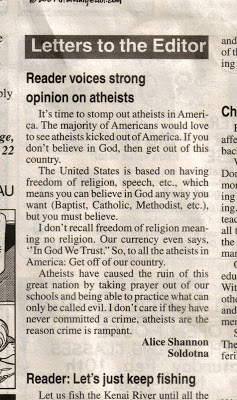
Well, we’re not too fond of you either.

So scary it’s funny! Or… so scared it’s scary!

Click for a bigger image.

Silly writer. Atheists aren’t to be blamed for all the world’s ills. It’s teh gheys.

I like how atheists are responsible for crime, even if they haven’t committed any. Anything’s possible with magic thinking! Still, I guess it does say that on money, so she’s got us there.

I’d love to discuss this in more detail, but I have to do the laundry and shopping — things that could only be described as ‘evil’. While I’m gone, a question for consideration: Is being an unbeliever all it takes to make a believer feel frightened or threatened?

Bridge collapse

I realise it’s been a while since the collapse of the Interstate 35W bridge, but it’s taken me a while to sort out my thoughts on it. I’ve thought about how we trust others as we cross bridges and eat food and breathe air, and for the social contract to be violated in this way I find inexcusable. I’ve thought of how we plan our lives, and how those plans can be cut short.

But the thought that keeps coming back to me is this: No astrologer saw it coming. No one’s horoscope said ‘Don’t cross the I-35W today.’ No psychic predicted the collapse. No tea-leaf reader prognosticated such a tragedy. No readings of entrails gave a hint. And no prophet, priest, or pastor prophesied the event in any way that would have been of any help to anyone.

Foretelling the future is something that they all claim to be capable of, but they never actually do. Because they can’t. The only thing that could was the scientific method — someone inspecting the bridge and looking for things that would signal danger. And it turns out that no one was listening.

Mirror neurons, gesture, and culture

Interesting things, those mirror neurons. They’re in our brain, and they fire not only when we do something, but also when we see someone else doing that thing. They’ve been credited with paving the way for language, since they allow us to not only make noise but also perceive when the other person is making noise. They may even provide an evolutionary explanation for human attributes like compassion and empathy, since they allow us to feel the feelings of others.

But mirror neurons may have some not-so-salubrious effects. I have a suspicion that they may contribute to the deplorable discourse we find on the web. Think about it. Some moronic troll appears and acts like an idiot. Now what happens? Everyone’s idiot mirror neurons fire, and the whole discussion deteriorates unless thinking people make a conscious effort. Trenchant humour is a way out of the cycle; it’s just a shame not everyone’s capable of it.

Now a study from UCLA examines the effect of culture on mirror neurons.

When it comes to the influence of culture, the researchers found that the mirror neuron network responds differently depending on whether individuals are looking at someone who shares their culture or someone who doesn’t.

The researchers had two actors — one American, the other Nicaraguan — perform a series of American, Nicaraguan and meaningless hand gestures for a group of American subjects. A procedure called transcranial magnetic stimulation was used to measure the observers’ levels of corticospinal excitability, which scientists use to gauge the activity of mirror neurons.

Molnar-Szakacs and Iacoboni found that the American observers demonstrated higher mirror neuron activity when observing the American making the gestures — whether they were American, Nicaraguan or meaningless — than when viewing the Nicaraguan. Even when the Nicaraguan actor performed American gestures, the observers’ mirror neuron activity dropped.

At this point, I was thinking, “Why are they calling it ‘culture’? Aren’t their brains just switching off when they see someone with different skin colour?” Apparently not entirely. When Americans watched the Nicaraguan doing Nicaraguan gestures, activity was once again high.

It appears that neural systems supporting memory, empathy and general cognition encode information differently depending on who’s giving the information — a member of one’s own cultural or ethnic in-group or a member of an out-group. Ethnic in-group membership and a culturally learned motor repertoire more strongly influence the brain’s responses to observed actions, specifically actions used in social communication.

“An important conclusion from these results is that culture has a measurable influence on our brain and, as a result, our behavior. Researchers need to take this into consideration when drawing conclusions about brain function and human behavior,” said Molnar-Szakacs.

It’s good to be aware of how deep this in-group out-group stuff can go.

Why did the robot cross the road?

Getting a computer to recognise humour is a tricky undertaking, but some language researchers are attempting it — if you can call puns ‘humour’.

Understanding a pun is sort of like a word-sense disambiguation task. If you’ll forgive an example:

Sign at a drug rehabilitation center: “Keep off the grass.”

Here, two senses of a word play off each other, to somewhat humourous effect. Word-sense disambiguation is a well-studied area in natural language processing, so this is as good a place as any to start.

Here’s an account of one such attempt.

To teach the program to spot jokes, the researchers first gave it a database of words, extracted from a children’s dictionary to keep things simple, and then supplied examples of how words can be related to one another in different ways to create different meanings. When presented with a new passage, the program uses that knowledge to work out how those new words relate to each other and what they likely mean. When it finds a word that doesn’t seem to fit with its surroundings, it searches a digital pronunciation guide for similar-sounding words. If any of those words fits in better with the rest of the sentence, it flags the passage as a joke. The result is a bot that “gets” jokes that turn on a simple pun.

That sounds simple, but the main problem is how to tell when words don’t seem to fit with the other words in the sentence. For this project, it sounds like they’re generating co-occurrence tables, or statistics about how often any given word is likely to be seen with any other given word. That way, if a word shows up with other words it’s not likely to co-occur with, the system will flag it.

Click on the graphic for an example:

This approach might work well for puns that rely on similar-sounding words, but what about our ‘Keep off the grass’ example above, where the pun relies on two senses of the same word? This system will fail to notice that a pun exists because there’s nothing to suggest that a “Keep off the grass” sign is anything out of the ordinary. And ‘drug’ and ‘grass’ do happen to co-occur in texts, so the system will see no incongruity.

To recognise these kinds of jokes, I might try scanning words in the sentence for multiple senses, and then seeing if groups of words show interesting properties. Perhaps ‘grass-1’ will co-occur frequently with ‘keep’, ‘off’, and ‘sign’, but ‘grass-2’ will co-occur with ‘drug’ and ‘rehabilitation’. We might then infer that since both senses of ‘grass’ are well-linked to different words in the sentence, a pun is going on.

This kind of approach, where we look for unexpected word occurrences, comes close to the essence of humour. Many things are funny because they’re unexpected, yet somehow right. To a small child, slipping on a banana peel is funny because it’s unexpected. Walking down the street unimpeded is normal, and therefore not funny. As humans, we have a lot of experience with the world, and we know what’s likely to happen and what’s not. Giving this informaton to computers is a difficult task, but it may be the key to humour recognition.

Hey, guys, don’t fight! You’re both insane.

Brownback and Huckabee trading barbs over whose religion is better is like watching clowns whacking each other with big fish, but slightly less entertaining.

[A] pitched battle has broken out involving two lesser-known candidates who are trading accusations of religious bigotry and hypocrisy. The battle has become the most heated and personal rivalry in the Republican field.

The current tensions stem from an e-mail message sent to two Brownback supporters by Rev. Tim Rude, the pastor of an evangelical church in Walnut Creek, Iowa. In the message, Mr. Rude, a Huckabee volunteer, compared the religious backgrounds of Mr. Huckabee, a Baptist pastor, and Mr. Brownback, who is Roman Catholic.

“I know Senator Brownback converted to Roman Catholicism in 2002,” Mr. Rude wrote. “Frankly, as a recovering Catholic myself, that is all I need to know about his discernment when compared to the Governor’s.”

While it’s refreshing to see the term ‘recovering Catholic’ in print, I’ll just put something out there that I’ve been thinking for a while: Insane people hate competing insanities. I mean, both Huckabee and Brownback put their hands up as evolution deniers in a debate. They’re both religious nutters. Why can’t they get along?

Bibles in newspapers

I noticed this:

Everything from detergent to computer discs is packaged with the Sunday newspaper. So why not Bibles?

International Bible Society-Send the Light is planning on spending hundreds of thousands of dollars to distribute Bibles with 11 newspapers during 2007 and 2008. New Testaments would be packaged in pouches on the outside of newspapers, much like soap or other sample products.

But not everyone is happy with the move:

“Do you have any idea how blatantly offensive this boneheaded move is to the thinking public?” a Fort Worth reader wrote in one of several letters to the editor on the topic.

Oh, come now. They’re just trying to share their beliefs. And grow their market share. Any business would do the same.

The project leader can’t imagine what the fuss is about.

“It’s disappointing that anyone would object to getting a Bible, which is the best read book in the whole world and has been for hundreds of years. They have the right to do with it what they want to,” he said. “Do they object to getting a bag of Quaker oatmeal or Tide detergent or an AOL disc?”

Except that those other things are demonstrably useful. Well, not the AOL disc.

But this advertising gimmick rests on a couple of bad assumptions.

Assumption 1: There just aren’t enough Bibles around.

In reality, almost everyone either has a Bible or could easily get one if they wanted one. There’s no shortage, and there’s certainly no reason to go packaging them in the morning paper.

Assumption 2: A good way to get someone to become a Christian is to have them read the Bible.

In my experience as a missionary, almost no one joins a church because they read the book and think it’s true. Not all by itself. How many people already had a copy of the Book of Mormon? Tons. Our work would have been much easier if that were all it took. Instead, we had to arrange hours of teaching appointments, get them to meet people in the church, have them make commitments to start doing churchy things, and generally massage them into being Mormons. It was exhausting. You couldn’t just fling scriptures around and expect to have people walk in the door. Not surprisingly, people were most receptive when they had a family member or close friend that was already in the church. That was a shortcut because then it wasn’t just about the book, it was about the relationship. Communal reinforcement and personal investment did the rest.

So I don’t expect Bibles in newspapers to lead to conversions. But I’m not offended by the campaign. In fact, I find it rather appropriate that religion is being flogged like soap or oatmeal. It’s a commodity, after all, and one that relies on need creation and brand loyalty, just like anything else.

It’s that Random Five again

Broken Cloud by The Lilac Time
Album: Looking for a Day in the Night

A favourite track from a favourite album. In 1999, Looking for a Day in the Night marked the return of the Lilac Time, and this album is a fantastic return to form. Nick Duffy, brother of Stephen and multi-instrumental talent in his own right, wrote this instrumental.
Speaking of the Lilac Time, Stephen mentions on his blog that the new album is almost finished, and he’s very pleased with it. I am in a state of intense anticiption.

Cuyahoga by R.E.M.
Album: Life’s Rich Pageant

This was my first R.E.M. album. I always liked this track, even when I didn’t know that background. Apparently the Cuyahoga river was so polluted that it once caught fire.

The Judgement is the Mirror by Dali’s Car
Album: The Waking Hour

Dali’s Car is my favourite Peter Murphy project. Mick Karn appears on his trademark wobbly bass, and the mood is dark and misty. Slap a Maxfield Parrish painting on the front and the whole thing’s a winner.

The video’s up on YouTube, as is everything else, so you might as well.

Around. Around. Around.

Ironically this video might have been the only time they saw each other during the entire project.

Home by the Range by The Cure
Album:

An excerpt from a 1986 interview with the Cure. Robert Smith explains why it’s better for everyone in the band to do what he thinks. It’s worked for him, but perhaps not for everyone. It’s a tightrope. If a band has a strong central member, it can survive line-up changes, but you’ll have to work to allay other band members’ feelings of stifledness.

Whilst we meditate on this, let us see a clip from the interview.

Little Drummer Boy by Chet Atkins
Album: Christmas With Chet Atkins
Christmas is months away, but I am powerless to control the vageries of the Random Five. Ol’ Chet has a special place in my Christmas memories, mostly because of his wonderful medley of ‘Coventry Carol’ with ‘God Rest Ye Merry, Gentlemen’. And also this track. Both songs show the softer side of Atkins’ guitar work. My advice: get the album and ignore the cover.

Hindu fundamentalists and Sanskrit supremecists

Once I was at the UWA Open Day, answering questions at the Linguistics table. We get a few — what’s the deal with Yiddish? Is the Tower of Babel story plausible? What was the original language? and so forth.

But a gentleman came up to the display, and after seeing the language genealogy chart, said to me, “Are you saying that Sanskrit is not the oldest language?”

“That’s correct,” said I. “Sanskrit itself came from an earlier language, which we call Proto-Indo-European.”

“This is not possible,” he said. “Sanskrit is the earliest language.”

“Well, not really,” I explained. “Proto-Indo-European is the parent language for a lot of other languages, including English, Latin, Greek, and Farsi. And Sanskrit,” I added, as he began to look steamed. “Of course, Proto-Indo-European is so old that we’ve had to reconstruct it. All we know about it has been hypothesised from looking at later languages.”

He thought about that, decided that he had no significant objections, and went away.

“What in the world was that all about?” I asked. Had I met a Sanskrit supremacist? Would there be more?

Well, I have just run across this page full of fun facts about fundamentalist Hinduism.

Indian Civilization has unceasingly existed for 1,972 million years ago as the fully developed Ganges civilization

Yep, nearly 2 billion years old and counting. So Indian civilisation existed in its present form sometime during the early Proterozoic period.

Sanskrit has been in its perfect state since its origin millions of years ago.

So while humans have existed only about 100,000 years, Sanskrit is millions of years older. One wonders who might have spoken it. Perhaps trilobites.

I suppose the Fundamentalist Hindu gentleman decided not to press the question because Proto-Indo-European was hypothesised by scientists, and could therefore be ignored.

Are there fundamentalist Buddhists? Do I need to prepare? Only one thing is for sure. When you see someone making no sense, religious doctrine can’t be far behind.

Fallacy of the Day, part 2

The fallacy of today is Appeal to Consequences, courtesy of Michael Gerson.

What Atheists Can’t Answer
By Michael Gerson
Friday, July 13, 2007; Page A17

Proving God’s existence in 750 words or fewer would daunt even Thomas Aquinas. And I suspect that a certain kind of skeptic would remain skeptical even after a squadron of angels landed on his front lawn. So I merely want to pose a question: If the atheists are right, what would be the effect on human morality?

And on he goes for the rest of the column.

Well, perhaps atheism has some bad consequences, and perhaps some good, but this is irrelevant to whether a god actually exists or not. There would be many good consequences of being able to make hot pieces of pizza come out of my ears, but that isn’t a good reason to believe that this is so. I could also list some bad consequences of theism, but again.

And actually, yes, I would be skeptical if a squadron of angels landed on my lawn. I could hallucinate angels, or UFOs, or I suppose a good many other things. I’ve been wrong before. However, if the landing could be examined and verified by many people, reproducibly, then that would be good evidence.

Teaching children about religion

Only a couple of years ago, I would have been horrified if my kids hadn’t wanted to be active in the Church. Now, after my deconversion, I’ll be horrified if they do. I realise it’s a major flip, and it must be confusing for the little dears. Their mother is still taking them to church, and as I watch them go every Sunday, I feel a sense of dread. I think it’s the same feeling as the mom from that scene in Erin Brockovich. You know the one:

INT. IRVING HOUSE, LIVING ROOM – DAY

Another copy of those DOCUMENTS, now in Donna’s hands. She’s
on her couch with Erin, reading them. Outside, Donna’s two
daughters are playing in the pool. She reads the last page
and looks up at Erin, bewildered.

DONNA
An on-site monitoring well? That means —

ERIN
It was right up on the PG&E property over
there.

DONNA
And you say this stuff, this hexavalent
chromium — it’s poisonous?

ERIN
Yeah.

DONNA
Well — then it’s gotta be a different than
what’s in our water, cause ours is okay.
The guys from PG&E told me. They sat right
in the kitchen and said it was fine.

ERIN
I know. But the toxicologist I been talking
to? He gave me a list of problems that can
come from hexavalent chromium exposure. And
everything you all have is on that list.

Donna resists this idea hard.

DONNA
No. Hunh-uh, see, that’s not what the
doctor said. He said one’s got absolutely
nothing to do with the other.

ERIN
Right, but — didn’t you say he was paid by
PG&E?

Donna sits quietly, trying to make sense of this. The only
sound is the LAUGHING and SPLASHING from the pool out back.
Then, gradually, Donna realizes what it is she’s hearing —
her kids playing in toxic water. She jumps up …

DONNA
ASHLEY! SHANNA!

… and runs out to the pool. Erin follows her.

EXT. DONNA’S HOUSE – DAY

From the door, Erin watches Donna run to the edge of the pool
in a frantic response to this news.

DONNA
OUT OF THE POOL! BOTH OF YOU, OUT OF THE
POOL, RIGHT NOW!

SHANNA
How come?

DONNA
CAUSE I SAID SO, THAT’S WHY, NOW GET OUT!
OUT! NOW!!!

Erin watches compassionately as Donna flails to get her kids
out of the contaminated water.

Now surely that’s too dramatic, isn’t it? Swimming in a toxic pool isn’t the same as going to church. What harm is religion going to do them? The harm is this: religion kills critical thinking skills in people who are most devoted to it.

Religion offers a substitute for reason. It offers faith instead of evidence. Instead of teaching that something’s true because it’s well-supported, it teaches that something’s true because

a) the holy book said,
b) the man at the pulpit said, or
c) it ‘feels right’.

Psychological traps such as wishful thinking, anecdotal evidence, communal reinforcement, selective sampling, and confirmation bias are part and parcel of the religious experience. Their use is encouraged and rewarded by the group. With all these fallacies in play, religious devotion is going to hamper good reasoning and encourage fallacious thinking. And this will cause bad decisions along the way. What parent wants to see their children make bad decisions? Or what parent wants to hinder their child’s thinking skills? Yet this is what religion does.

So even though all the ‘golden rule’ talk is pretty innocuous, I sometimes want to grab my boys out of Sunday School, tuck one of them under each arm, and run out of the building to make the brain damage stop.

What can the deconverted parent do to help children reason despite the influence of religion? While it’s difficult for me not to be negative about religion (as you’ve noticed), on better days I use a more positive approach:

Teach reason. Learning how to examine ideas is a skill children will use throughout their lives. And it’s less controversial to believing family members than bagging religion to the kids. When Youngest Boy asks, “Do you think the Golden Plates are real?”, I like to ask “How could we find out?” I get them to think about what sort of evidence would be adequate, and what sources would be reliable. Sometimes I show them optical illusions, and I tell them about crop circles and Bigfoot, and how easy it is for people to be fooled.

It’s usually in the car that we talk about logic and fallacies. Yesterday in the car, the boys were arguing about something, and Oldest Boy said, “You made the claim, so it’s up to you to provide the evidence!” Once I blew on the lights to ‘change’ them, and when I said, “Look, it worked,” Youngest Boy said, “That’s post hoc, Dad.” And I thought, I must be doing something right.

I suppose I should add that I like teaching reasoning skills rather than teaching that Religion Is Bad because, you know, I could be wrong. They’ll need to work that one out themselves.

Teach religion. Under most circumstances, I’d fight hard to keep religion out of schools. But my kids’ school teaches a lot of religion, and I couldn’t be happier. Why? Because they teach everything from Norse myths to Hinduism. They go through Greek and Roman mythology, the lives of Catholic saints, and Australian Aboriginal creation legends. By presenting Christian fables as one set of stories among many, it naturally raises the question: what claim does this religion have as the ‘true one’ when so many other people have believed so many things? Why does Mom believe in Jesus and not Zeus?

There’s an added benefit to telling my kids religious stories: it inoculates them. Parents who raise their children without religious instruction run the risk of them contracting it in a world of infected people. I’ve seen a number of cases where parents do a great job of raising kids secular, but then later in life someone gives them a copy of ‘Mere Christianity’ and they think it’s the greatest thing they’ve ever seen. If they’d been taught about Christian mythology (and Greek, and Norse, etc), they’d realise they’d heard it before, and we wouldn’t get them in church saying “My family doesn’t know about the Gospel.”

So I don’t mind so much when the boys go off to church with their mother. I just wave and say “Bye kids! Remember to ask for evidence!”

I don’t envy their Sunday School teacher.
« Older posts Newer posts »

© 2026 Good Reason

Theme by Anders NorenUp ↑