Good Reason

It's okay to be wrong. It's not okay to stay wrong.

Page 85 of 126

Find yourself in the census.

The U.S. Census Bureau has just released some data from the 2000 Census: Most frequently occurring surnames.

‘Midgley’ is ranked at 18,854, somewhere between ‘Commander’ and ‘Dummer’. That’s down from 17,653 ten years ago — falling more than a thousand points! So there aren’t a lot of us. But at least when I google my name, almost all the hits are me.

A related article from the New York Times observes that Vargas is the new Thompson.

Census data isn’t just interesting; it’s useful for language researchers. For example, I use it to plow through dialogue corpora to find first and last names, and change them all into ‘#firstname’ and ‘#lastname’. That way, my classifier can find (for example) introduction sequences more easily because it’s not trying to look for a hundred different names.

Life from conception: How likely are they to be right?

Women of the world: think of yourself as a box. LGM has the video.

Are you surprised that Catholics might think of you as some kind of holy receptacle? Hope not.

This is an argument I’ve heard a few times: if there’s even a chance that life starts at conception (whatever that means), then we should err on the side of caution and prohibit abortion. My answer is: who are we taking care of here? A fetus that might be alive, or a real woman who is alive, and whose quality of life will be messed with by forced childbirth?

But there’s something else to add to the equation that I haven’t yet heard. My work in machine learning deals a lot with probabilities. I use computer algorithms to classify text, and I hope the computer sorts the text into the right bins. But I don’t just want to know what answer an algorithm gives me. I also want to know how likely that answer is to be right. It’s not enough to say what might somehow be possible. I want to know some likelihoods. So let’s add that into the mix: how likely are the various parties to be right?

The pro-choice side: Claims that women are alive. Pretty good evidence for this. Very likely to be correct.

The pro-life side: Claims that there’s a chance that a just-conceived fetus might be alive as a separate being, like you’re alive. I suppose there might be a small chance. But how often have religions been right before? Well, let’s just say they don’t have a great track record. They’ve gotten so many things wrong, including heliocentrism, evolution, the age of the earth, language, geography, astronomy, and more. And they get things wrong because of their methods. They start from beliefs, and ignore contradicting evidence. And it’s all true if you feel it’s true. Why should they be right this time, when their methods haven’t improved in thousands of years? So while it’s good to be cautious in uncertain conditions, we have to take into account the likelihood that our caution is justified in view of the expense to real live people.

This ‘just in case’ argument is convincing to some people because of the minimax principle. Because humans are usually risk averse, we try to avoid bad outcomes rather than go for good outcomes. This argument takes advantage of uncertainty, in the interest of a socio-political agenda. And so, as always, religions find and exploit our congitive blind spots.

Paranormal restraining order

Sick of supernatural beings? Hate the way they follow you into the toilet? Tired of being probed by aliens or visited by Santa Claus (or vice versa)?

Well, if you’re being harrassed by metaphysical entities, it may be time for a Paranormal Restraining Order.

At $5, the price is nice. It may not deter Satan, the bastard. And God has some jurisdictional issues. But you’ll have done everything you could do.

Of course, if you’re still in grad school at 40…

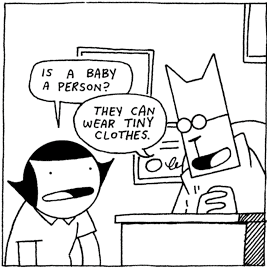
Cat and Girl tackles the issues: When does life begin?

I believe that life begins at 40. Seriously.

Oh, and the comic improves measurably if you mentally read Girl with a Lisa Simpson voice.

Understand the liberal-conservative divide, before it’s too late!

A political message from Tom Tancredo:

ZOMG! They’re gonna kill you in your beds at night KABOOOOMMMMM!!!!!1!!!

Someone had to say it.

What kind of person would make this kind of argument, and what kind of voter would buy into it? A cynical fear-mongering manipulator, and an awfully scared bed-wetter, respectively.

I have moved on from my “Bad Person” theory of political conservatism, and am now working on a new model. Here it is.

Let’s say there’s a guy over there that you don’t know, who looks kind of different.

  • You might think, “Watch out for that guy. He might try to beat you up and steal your wallet.” You’d be a conservative.
  • Or you might instead go up to the guy and say, “Hey, cool shirt.” In this case, you’d be a liberal.

Fear of perceived threats v. openness to experience. I think it goes a long way toward explaining the difference between the two political tendencies.

And the reason conservatives have had their victories in the last decade is that they’ve been very successful at joining with a third group of people: the people who would go up to that guy, beat him up, and steal his wallet.

Don’t you wish your country had a Secular Party?

Elections are coming soon, and I’ll definitely be voting for the Secular Party of Australia. Religious groups are nowhere near as politically influential here as in some other countries I could name, but I’d like to keep it that way. And the wall of separation between church and state can always use some shoring up.

But isn’t it a waste of a vote? Not here. Australia uses a system of ‘preferences’, where votes for minor parties aren’t discarded — they flow on to whoever the party (or you) specifies. It does mean that we get a proliferation of single issue parties like the Fishing Party. But then you might think the Fishing Party is a good idea. Also, some scary fringe parties can agglomerate power — like Family First or the Christian Democrats. (Or the Secular Party.) But at least you can throw your vote to someone you’d actually like to see win, instead of playing the cynical gamesmanship that American voters have to engage in. My vote will probably be passing through a few parties — probably Greens, then Labor.

Still glad I paid.

Amazingly, many people chose to pay nothing for the new Radiohead album, rather than pay something.

I don’t think any economist could have seen that coming.

Values voters all switch to Oreos

I’m way behind in the War on Christmas — I haven’t even started on my War on Christmas shopping yet. But I was heartened to see this latest salvo in the push to get Jesus out of the holidays.

See that? Xmas trees! Not only are Doritos celebrating paganism in tasty tree form (in defiance of Jeremiah 10), but even the name of Christ has been replaced by an X.

This might seem like a minor thing. Some may even point out that the X in Xmas is actually the Greek letter chi, the first letter in ‘Christ’. But at this special time of year, let’s savour even the small and delicious victories. And keep it up! Perhaps in just a couple of years, we can convert Christmas into a bland, secular holiday focused mainly on commerce. Forward, comrades!

Stay safe — dob in someone swarthy today!

America could learn some lessons from Australia.

Back when Ashcroft suggested that Americans spy on each other to protect themselves from terrorism, the American public somehow noticed, squawked, and the plan was dropped. But here in Australia, the Citizens’ Domestic Spying Squad is set to ‘operative’! Here’s the ad currently running on TV.

Even now, Australians can flood the hotline with nuisance calls, and turn in neighbours and friends for any behaviour that looks ‘unusual’.

In fact, this ad seems a bit more to the point.

Australian dollar catching up?

The Canadian dollar recently passed the U.S. dollar in value. Can the Australian dollar be far behind?

Just five years ago, the U.S. dollar was more than double the Aussie dollar, and as of today, the two are approaching parity (as hasn’t been the case since 1982). I’ve never seen the AUD at 0.926 before.

I’d love to say I’m pleased because I can now afford to visit the USA, but:
a) I’m not overjoyed to see the US dollar tank for psychological reasons, and
b) selling things to Americans is less lucrative, so my eBay experience now sucks.

Part of it is that Australia’s commodity-based economy has been doing well, and that it goes through different cycles than that of the USD. But this article warns of a steep decline as investors pull out. Perhaps Gisele Bundchen is onto something.

h/t This Modern World.

« Older posts Newer posts »

© 2026 Good Reason

Theme by Anders NorenUp ↑