Good Reason

It's okay to be wrong. It's not okay to stay wrong.

Page 79 of 126

Australians inexplicably irked about ‘beaver ad’

New limits on taboo terms? Not only can you not use bodily euphemisms, some folks get huffy if you even suggest them.

A tampon company may be forced to cancel TV ads that show an attractive, young woman going about her day with a beaver in tow.

Here’s the ad.

Just think: every woman is walking around with one of those things. Interesting. But it got some people feeling all hot and confused.

The Advertising Standards Bureau in Canberra received a “large number” of complaints as soon as the ad aired on Sunday – the day after International Women’s Day.

I wonder how large a number it was. Wouldn’t you think someone that uptight would be too clueless to even get the reference? On second thought, nah. Anti-sex people have minds like sewers, and it scares them.

What might those two guys on the beach be saying, by the way? My guess was too predictable.

You better not mess with the Friday Random Five.

The quest for the perfect IDM/downtempo/ambient album has yielded some new candidates. Let’s take it from the top.

Drøn‘s 2001 album Xenologic requires a bit of patience, and tends toward the random glitch a bit much for my taste. Take it track by track. Start with the otherworldly ‘Spool’, and then try ‘Plateau’.

For something a bit more active, try the Push EP from Lusine. Sophisticated and listenable.

I’m really enjoying everything by Kiln, especially their 2004 EP Sunbox and the new Dusker. Both albums are more musical than I’d expected, which is a plus, and the effects are interesting instead of wearing, as is sometimes the case with IDM. Very worthwhile and sort of relaxing.

And now on to the random.

Flame (Demo 1) by Alphaville
Album: Dreamscapes
There’s a lot more to Alphaville than ‘Forever Young’. They’re an extremely creative band with a gift for fantasy-laden electronic pop, which is better than it sounds. Dreamscapes is an 8-disc set (yes, eight) of demos, rarities, live versions, and remixes. Fans will be interested to hear these sketches of early songs from a great period in their career.

Adios Mi Chaparrita by Pérez Prado
Album: Our Man in Havana: The Very Best of Pérez Prado
I keep a lot of Pérez Prado in the collection, not only because it’s great Latin music, but also because when it comes on randomly at 3 am, it conveys such a sense of strangeness. You’re in a different place and time, and there’s someone going “Uugh!” at odd intervals. Who needs drugs? Or even maté?

Cantara by Dead Can Dance
Album: Toward the Within
Even though I’m only a casual listener of CDC, I think this might be the best live album ever. Lisa Gerard, Brendan Perry, and a team of instrumentalists tackle an amazing range of eastern-influenced music. I’m impressed by two things: the astounding musicianship of a band that got it right on the first take, and the way the audience is clearly entranced.

Ashes to Ashes by David Bowie
Album: ChangesBowie
When was the last time you watched this video? That’s too long. But we can fix that.

The image that stays with me is that of the grandmother. She’s a bit of normal in this very strange world, where the heaving sea is black, and odd people make obsequies despite the oncoming and ominously silent steamroller.

Crystal (Digweed & Muir Bedrock Mix) by New Order
Album: Ministry of Sound: The 2002 Annual
A pretty good mix of the new-classic New Order track. I was so pleased to see New Order doing something new and sharp again. On a slightly related note, the producer of Get Ready, Steve Osbourne, has most recently been enlisted to produce the new B-52’s album Funplex, and how could you not be curious about the first B’s album in 16 years? Less than two weeks away, folks. There’ll be fun. Have a listen.

A rational look at Steiner schools

I can tell I’ll be browsing the pages of Australian Rationalist in my spare time. The latest issue is of some interest to me — the cover story is a rational look at Steiner (or Waldorf) schools. My sons went to a Steiner school, and Youngest Boy still does. While I can’t speak for Steiner (or Waldorf) schools everywhere, I find my local Steindorf school to be dangerous in theory, but harmless in practice.

To the article (PDF). What did they get right?

Rudolf Steiner was a fruitcake. But a renaissance fruitcake. As a boy, he thought he was clairvoyant. As an adult, he promulgated his philosophy of ‘Anthroposophy’, and investigated what he called ‘spiritual science’ — an oxymoron. He invented biodynamic farming, sort of a mix of homeopathy, astrology, and organic farming. His followers today think he is the reincarnation of Aristotle. He believed in gnomes.

And because he was concerned about the development of children, he began what is known today as Waldorf education. But it isn’t based on anything empirical. It’s just whatever Steiner thought. From the article:

The whole basis of Steiner education… comes from Steiner’s excursions into what he called ‘spiritual’ or ‘occult science’, which was code for him going into a meditative state, free-associating around a topic, and writing down the results of his ruminations as though they were incontrovertible truth.

This is the essence of cultism — a group where the leader claims special knowledge, and adherents accept his or her teachings as indisputably true, whether the evidence supports them or not.

Using this method he came up with a number of amazing break-throughs in modern thought, such as the importance of burying stag bladders full of yarrow flowers in a field to stimulate the growth of crops!

Yes, it really does get that bad. The local Steiner school is full of this stuff. Homeopaths and crystal-wavers ply their wares at the Open Day. If a kid bangs his or her head in the playground, parents are quick to proffer Bach flower essences. Parents are also enlisted for ‘stirrings’: they use their hands to slosh around water mixed with tiny amounts of manure that has been buried in a cow horn at the Autumn Equinox, which is supposed to be good for crops. I’m not kidding. The Steiner hardcores don’t even seem to want an empirical basis for their beliefs.

And the fruitcakery carries over into the education. Steiner kids aren’t taught to read until age seven — that’s when, according to Steiner, a child acquires its etheric body — again, no evidence for this is provided; Steiner said it, and acolytes believe it. One parent in Australia was told his child would be held back for an unusual reason.

“She thought his soul wasn’t fully incarnated yet, which was strange thing for me to hear at a parent-teacher interview,” he said.

“And then she pulled out some drawings that he’d done which showed him, I guess, looking down, like a plan view of what he was drawing.

“And she used this as evidence that his soul was hovering over the earth and looking down on the earth and so, therefore, she felt that he wasn’t quite ready to move into the following year.”

The point of all this is that if your philosophy of teaching is empirically based, at least you have a pretty good shot of getting it right. If you’re going by what the Guru said, your odds of getting it right will be no better than random chance.

There is clearly no evidential or experiential evidence for such ideas, nor for the many other gratuitous absurdities that riddle Steiner education, so any resemblance between Steiner education and good educational practice is purely coincidental. That a number of children have survived it, and some even thrived, says more about the resilience of the human spirit than about the efficacy of this empirically groundless theory.

Steiner school promote religion in a way that is incompatible with state-funded secular education. This is the one that secular folks should be getting irked about. Steiner schools work as a separate alternative schools. I pay a lot in school fees to make up for the lack of public funding in the local school, and that’s the way I think it ought to be. Anthroposophy may not be a religion, but it is based on esoteric mystic Christianity, and blending it into the state system poses an unacceptable risk of promoting religious beliefs.

Steiner education may not look ‘religious’ on the surface, but it is in fact a bundle of religious ideas dressed up as educational ones. This is what is insidious about it and this is why it has no place in the secular public system.

With all this in mind, I’d say the article somewhat overstates the hazards of Steiner education, especially in raising the specter of German fascism. As a Steiner dad, I haven’t caught any hints of this at all. The tone at the school is warm and fuzzy.

If there is a saving grace for Waldorf education, it’s that, in my experience, very few of the rank and file parents believe the hype. You do get a core of Steiner believers, including the teachers, but almost no one else takes Anthroposophy seriously. Many parents roll their eyes at Eurythmy and such. The kids are usually pretty down to earth about it, too. At a recent Winter Festival, some parents were trying to foster a reverent attitude during the bonfire, but the kids were chanting “More kerosene! More kerosene!” They keep it real.

I also think that the teaching of religion is handled well, as I’ve mentioned before. Many world religions are represented, and I think this has an inoculating influence on kids. They’re more likely to fall for religion in adulthood if it hasn’t been presented to them before, and the Christian myth is presented at school along with all the other myths.

If you’re a rationalist, and you’re considering Steiner education, or if (like me) you’re already in and you’re only just becoming more of a critical thinker, it’s not impossible for it to work. My kids enjoy their school, and it’s been pretty positive. But here are some suggestions.

  • It should be used only for younger children. I know perfectly intelligent and capable people who have gone all the way through a Waldorf high school, but I feel bad for anyone who’s been under the influence of Steiner believers for so long. Anyone who believes in gnomes and Atlantis has absolutely no business teaching science at a high school level.
  • You must talk to your children about what they’re learning. That way, you can help to moderate any strange ideas they encounter, like fairies. It can even be a good critical-thinking exercise.
  • Watch out for areas where they may be falling behind. Steiner kids start reading late, and some may have trouble. For Oldest Boy, some math problems went unnoticed late. This may be because of the absence of testing. Steiner teachers hate standardised tests, even to the point of encouraging parents to opt out of state-mandated tests. (Wonder why.) Give your kids the tests, and monitor the results for areas where they may be falling behind. Help them in a low-pressure way to grasp the concepts they’re going to need when they get to high school. A simple math workbook or reading together can be all it takes. You may be doing those things anyway.

The greatest danger from Steiner schooling is to the rationalist parent, not the child; you may go insane from exposure to crackpottery, or you may eventually bite through your tongue.

Ethnicity v. religion

Islam is my least favourite religion. Has been, even before 9/11. It’s a very problematic religion; it hasn’t gotten a grip on its most extreme elements, it does the most harm to its believers (physically and mentally), and its adherents are, in general, the least tolerant of any religion I know. Its size and influence only serve to magnify the difficulty.

But I always felt uncomfortable about Islam-bashing, not because it was disrespectful of others’ beliefs (they have to be true to earn my respect). The discomfort was this: take a walk around the seedier right-wing hate sites like Redstate or Malkin, and you’ll see Islam-bashing in spades. So if I’m saying something against Islam, what’s the difference between the right-wing haterz and me? Might I not be mistaken for the racists I despise? Even good ol’ Christopher Hitchens, when he gets going on the danger of Islam, seems to blend in with the racists on the right. And it’s taken him to some horrifying conclusions: the invasion of Iraq, and some saber-rattling on Iran. Even Ayaan Hirsi Ali, whose anti-Islam cred is impeccable, isn’t usually mentioned with Dawkins or Harris, and I think it’s because the Left feels uncomfortable with her since she sits so comfortably with the anti-immigration nutbars in the Dutch right-wing. And so my criticism of Islam, if I were inclined to make any, has been muted.

Only recently have I been able to see a crucial distinction that would resolve this conflict. It’s the difference between religion and ethnicity. I’ll oppose the religion of Islam — by means of reason, science, and education — because it teaches absurdities, and it’s dangerous. I’ll oppose every other religion on earth for the same reason. I’m an equal opportunity opposer. But when it comes to Arabs, Indonesians, Africans, or any other ethnicity, I have nothing to say.

When I was a kid, there were lots of Iranian uni students in my hometown. This was at the height of the Iranian hostage crisis in 1979. Listening to the Charlie Daniels Band on AM radio does something to a kid, and some of those Iranians seemed pretty scary. Scarier than normal uni students, which is pretty scary anyway. Fortunately, I had a wise father who took me to some cultural events on campus and got me to meet the students. (He liked the lamb.) I came to realise that even though Iran had just gone crazy, there was a segment of Iran that was secular and moderate, and who hated the new government. Understanding the difference between religion and ethnicity could have helped me a bit.

In connection with this, I’d also like to echo the sentiments of Dave at exchristian.net, who feels that while opposing religion is fair game, being horrible to actual people sucks. I now feel embarrassed when I think about the believer I used to be. Some are okay people, I was not. I knew the truth, dontcha know, and Jesus was my homeboy. I was good at getting around objections to the one true faith, and I must have been an intolerable pain. Fortunately I reformed and learned to question my received wisdom without fearing the wrath of hypothetical beings. Maybe someone in a religion now might be a future unbeliever. No need to be horrible to my future friend. I’ll point out bad reasoning, but I hope I’ll spare the messenger. Just in case I can learn something from them.

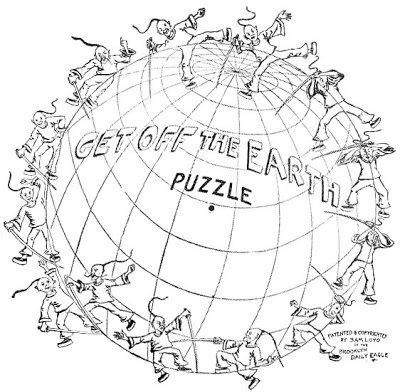
‘Get Off the Earth’ puzzle

Sam Loyd invented this enormously popular puzzle in 1898, and it’s one of my favourites. You’ll have to excuse the stereotyped artwork, though.

The puzzle shows some warriors around a globe. The inside circle is a separate piece of paper, attached at the center so that it can turn freely.

Behold the globe with 13 warriors.

But give the globe a turn…

and one warrior disappears.

What’s happening here? How does the thirteenth warrior disappear? And don’t say the Rapture.

If you want to print it out and try it yourself, you may want to use the very nice PDF available on this page.

Blasphemy laws dropped in UK

Time was, if you denied that gods existed loudly and publicly enough, you were considered a threat to the social fabric and arrested under blasphemy laws. This Wikipedia page mentions James Naylor, who in 1656 suffered flogging, branding and the piercing of his tongue by a red-hot poker.

No more. The little-used and anachronistic blasphemy laws have been revoked.

After an acrimonious debate in which the bogeyman of secularism was repeatedly invoked, the House of Lords on Wednesday March 5 2008 accepted the amendment to the Criminal Justice and Immigration Bill that abolishes the common law of blasphemy and blasphemous libel.

I liked the comment from the Earl of Onslow:

On the question of blasphemy, it has always struck me that if Jesus Christ exists, and if Jesus Christ in his Godlike form was capable of creating the universe, then he could quite easily hack the bit of left-wing obscurantism and b-mindedness that writes things such as “Jerry Springer: The Opera”. If he does not exist, nothing will happen; if he does exist, it is up to him to get hold of the chap who wrote it and make sure that he does time in the diabolical house of correction. The offence is unnecessary.

It also seems that the provision applies only to the Church of England, not to the doctrines of the Roman church, as far as I can gather. You can be just as rude and insulting as you like about the doctrine of the Assumption of the Blessed Virgin Mary, papal infallibility, or what the Church of Rome says about contraception; you can be blasphemous about those without any possibility of being prosecuted.

Blasphemy is a crime that is open to intense mockery. As the Minister said, something that is open to mockery and has been used only four times since 16-something-or-other has no place on the statute book.

Please let us now get rid of the crime of blasphemy. It is unnecessary and otiose.

Not everyone was happy.

Lord Armstrong of Ilminster: …The fact that one has not had a flood for a very long time does not mean that one should destroy the floodgates. My fear is that the removal of this provision will be seen as encouraging people to make outrageous statements that are needlessly offensive to a great many people. They will only do it to annoy, because they know it teases.

He then burst into tears, sucking his thumb while rocking and whimpering quietly to himself.

What happens when you stop believing in god?

Youngest Boy asked me, “What happens when you stop believing in God?”

“Absolutely nothing!” I said. “You’re still the same person you were, and everything goes on like normal.”

And that’s one way to tell that God’s not real. If you stop believing in cars and decide to walk out in the road, reality will soon disconfirm your belief. If you disbelieve in food and water and stop eating and drinking, you die. But if you stop believing in supernatural beings… it’s amazing how irrelevant your past belief can seem, so quickly.

It’s like Philip K. Dick said:

“Reality is that which, when you stop believing in it, doesn’t go away.”

Youngest Boy thought about all this and said, “But you could not believe in atoms, and nothing would change.” He’s very smart. You have to watch yourself with this kid.

“That’s true,” I said, “With atoms, it would take a long time to notice you were wrong. You probably wouldn’t know until you tried to do some research involving atoms. Then you’d realise that people who know about atoms could predict things you couldn’t.”

But what does belief in god help you predict? You can’t work out who will be cured of illness when you pray. Most people get better with most diseases, some don’t, and some die. Then you say, well, that was god’s plan. It lends itself to loads of ex post facto rationalisation, but not prediction.

It’s not all true that nothing changes though. You are finally able to embrace reason without having to fear it. Because, post-deconversion, reason has already knocked down your rickety system. There’s no more harm it can do you. You are free.

Obama and religion

American secularists. Try bringing up god in relation to politics, and watch them bristle. And for good reason, too — did you see what the Christians did to the place once they got in power? We’ll never get our bond back.

Expect a nuclear allergic reaction from reading them this passage (and others) from Barack Obama:

And during the course of that sermon, I was introduced to someone named Jesus Christ. I learned that my sins could be redeemed and that if I placed my trust in Christ, He could set me on the path to eternal life.

Ideally, a rational thinker would be in the White House. Someone who knows how to think critically, and who knows the difference between evidence and not-evidence. (Which disqualifies Grandpa McCain.) But until that day, we’re stuck with either a politician who panders to religion, or (worse) a politician who actually believes it. Obama comes uncomfortably close to the latter.

But maybe we’re not all sunk. Consider the situation we faced over here in Australia with Kevin Rudd, leader of the center-left ALP. From the outset, he made it clear that not only was he a believer, but that he didn’t intend to abandon faith to the Right, and that his religious beliefs were going to inform his politics.

At the time, I found this inappropriate. Australia’s secular! Couldn’t we just let the right-wing have religion, and then the grown-ups can get on with the work? But of course, I voted Labor. (Well, Secular, with preferences to Labor.) And lo and behold, Labor did turf out the Liberals, and there was much rejoicing.

And then what did Rudd do when he got into office? He ratified Kyoto, he apologised to the Stolen Generation of Aboriginal Australians, and he introduced legislation to dismantle Workplace Agreements (which allow employers to pay you less than scale if you ‘agree’). He sent Navy ships to monitor Japanese whalers, for Pete’s sake! And that’s just the first 100 days. Not a bad start.

Everyone picks and chooses out of scripture. As a credit to his character, Rudd picked and chose parts of the Bible that happened to correspond to not being a moralistic cretin. The Religious Right loves Deuteronomy because that reflects what they like — especially hating on gays. Rudd’s more of a Sermon on the Mount kind of guy.

But if our starting point in this debate is supposed to be Christianity (and therefore a Christian view of morality), then my challenge to the Coalition is as follows: isn’t our preparedness to feed the hungry and give shelter to the homeless a moral value; isn’t our preparedness to respond humanely to those who seek refuge in this country from political oppression elsewhere a moral value; and is not our response to the 1.5 billion people around the world in abject poverty also a question of moral values?

Obama’s not as gung-ho on the separation of church and state as a Democrat ought to be (a bit like Rudd), but he does agree that faith has been hijacked (as does Rudd). He has reached out to non-believers. His rhetoric seems more inspirational than doctrinal. I think (or perhaps just hope) that Obama might be more a Rudd-style Christian, and less a Huckabee-style one.

I can live with that, at least until the coming Glorious Age of Rationalism bursts upon us.

More questions from the search logs

People posed questions to Google, searching for wisdom, and instead found themselves here, looking at posts that were only tangentially related. Well, now I’m answering their questions. Too bad they left in disgust before they could read these responses, but you’re in luck.

is there ever a good reason for children to work

Why, yes, there is. My boys and I have just finished cleaning up Australia. (It took a while, but now it’s done for another year.) We spent a couple of hours picking up rubbish at a public park nearby with other volunteers. The boys got to do some public service, and they now have little patience with people who litter. I also learned that every volunteer thinks they’re going to find a body in the leaves, like at the beginning of a CSI episode.

But I think the question refers to child labor. Employers would love to get their hands on children because they’re cheap, compliant, and don’t unionise. Thank goodness progressives in the last century worked to pass laws to stop the exploitation of child workers. But you’d expect the current generation of conservative vipers to wish for a return to the Gilded Age, and argue for rollbacks. And so they do.

Meet Connor. He’s a constitutional conservative, a Mormon, and is currently in training to become a member of the next generation of apologists for unreconstructed small-government conservatism. He sharpens his rhetorical chops on his blog, where you’ll sometimes find me disrupting the social fabric. And the most jaw-dropping post so far has been this one where he argues that government has no business dictating the terms of child labour, and that it should be left up to financially desperate parents and their children. Can’t see any problems coming there!

This is why I say that movement conservatism is a pathology. Allowing employers to exploit children like in the old days would cause untold problems. And what problems would it solve? The problem of not enough conservatism? It’s madness. And since no one’s going to implement their program in totality, there’s no way to show them it’s madness. They’ll always claim that their program hasn’t been followed in an ideologically pure fashion.

Have a look at the post and prepare to shake your head in amazement. This is the logical conclusion of small-government libertarianism. They really are amoral cretins.

fatherly quotes

My father had a lot of quotes, mostly because he liked to say the same things over and over. As an educator, he called it ‘reinforcement’, but as a kid I called it ‘boring’. But at least I still remember a few things he said, so maybe he was onto something.

When, as a kid, I would get my shoelaces in a knot, Dad would untie them for me, and as he did, he’d say:

If a string is in a knot,
Patience will untie it.
Patience can do anything.
Have you ever tried it?

And now I say it to my boys, and the cycle continues. Cycle of what, I won’t say.

And my favourite:

When in danger,
When in doubt,
Run in circles.
Scream and shout.

I have followed this advice many times.

does milk cause mucus
do dairy products cause mucus
does dairy cause mucous
does dairy cause mucus
milk causing mucus

How many ways can we ask this question? Can we spell ‘mucus’ any differently? What if we include the various spellings of ‘yoghourte’?

But however you ask it, the answer is still: nope, milk does not cause mucus or mucous. Here’s a recent (2005) study entitled Milk Consumption Does Not Lead to Mucus Production or Occurrence of Asthma. From the abstract:

There is a belief among some members of the public that the consumption of milk and dairy products increases the production of mucus in the respiratory system. Therefore, some who believe in this effect renounce drinking milk. According to Australian studies, subjects perceived some parameters of mucus production to change after consumption of milk and soy-based beverages, but these effects were not specific to cows’ milk because the soy-based milk drink with similar sensory characteristics produced the same changes. In individuals inoculated with the common cold virus, milk intake was not associated with increased nasal secretions, symptoms of cough, nose symptoms or congestion. Nevertheless, individuals who believe in the mucus and milk theory report more respiratory symptoms after drinking milk.

So if you believe dairy causes mucus, and if you think you’ve just drunk some, you’ll report more mucus. Even if you haven’t had any.

40 and still in grad school

Hey, that’s a bit harsh. Go somewhere else if you’re going to be like that.

Taxonomy of morality

We interrupt our normal schedule of godless religion-bashing to talk about something important: morality.

How do you know what’s moral? Why do good people differ on moral issues? When people’s ideas of morality conflict, is that because different people focus on different aspects of morality? Has anyone tried to construct a taxonomy of morality?

For the last question, yes, and here is one such attempt that I found intriguing.

Moral Foundations Theory proposes that five innate psychological systems form the foundation of “intuitive ethics.” Each culture constructs its particular morality as a set of virtues, values, and ideas based on or related to these five foundations (as well as to many other non-moral aspects of the evolved mind).

The five parameters they’ve come up with are:

  • Harm/Care
  • Fairness/Reciprocity
  • Ingroup/Loyalty
  • Authority/Respect
  • Purity/Sanctity

I’m not sure what they’re basing these groups on (I can think of better values than ‘Ingroup/Loyalty’), but if you don’t like them and you can show them some other empirically-based reason to split or lump them, they’ll change it and pay you. (What would that experiment look like?)

Where things get interesting, and where you actually get some predictive validity, is the application to politics.

The current American culture war can be seen as arising from the fact that liberals try to create a morality relying almost exclusively on the Harm/Care and Fairness/Reciprocity foundations; conservatives, especially religious conservatives, use all five foundations, including Ingroup/Loyalty, Authority/Respect, and Purity/Sanctity. In every sample we have examined (including samples in the US, UK, Europe, Latin America, and Asia), political conservatism correlates negatively with endorsement of the Harm and Fairness foundations, and positively with endorsement of the Ingroup, Authority, and Purity foundations.

At first, I didn’t like the idea that conservatives use all five parameters — what’s fair about regressive tax laws or lack of health care for the very poor? But after looking at a few cases, it seems to me that conservatives do use the first two parameters, but their ability to do so accurately is challenged by their over-reliance on bad information and emotional reasoning with respect to the other three.

Let’s try it out. Pick a political issue. My lovely and talented assistant Miss Perfect has chosen ‘immigration’.

According to this taxonomy, we should expect Liberals to be geared towards maximising fairness and minimising harm. Certainly putting children in detention camps, as Australia does, falls short of fairness and care. Conservatives would care about fairness and care, too — for themselves (they’re taking our jobs!), but their feelings about these would be mingled with ideas about Ingroup/Loyalty (They come over and don’t speak the language!) and Authority/Respect (They know they’re here illegally!).

Pornography. Our Standard Liberal (let’s call him Mr Liberal) would oppose pornography only to the extent that someone’s being harmed by it. Which is to say that for most forms of non-violent erotica involving adults, Mr L would say, “Eh.”

Mr Conservative might also oppose porn where people are being harmed, but his ideas about harm would be mingled with his ideas about purity and sanctity. He might argue that porn does harm its users, perhaps defining harm so broadly as to include everyone in a society where pornography is being made.

Gay marriage: Mr Liberal might say, “It’s not hurting anyone. And it doesn’t seem fair that gay people are being denied the right to get married, along with the insurance and inheritance perks.”

But Mr Conservative would say “It does harm the institution of marriage. And it’s defiling the Purity/Sanctity of marriage.” He’d also want to keep the gays out of the marriage club (Loyalty/Ingroup), though he’d probably keep that to himself around Mr Liberal.

Mr L and Mr C are both moral actors, but Mr Conservative defines harm in a very self-referential way. If something is good for his in-group, it’s good. Out-group? Not so much. And Mr C is more fearful. He thinks that things he doesn’t like have a magical ability to reach in and hurt him. Possibly a result of all that magic thinking he learned in church.

This taxonomy gave me some interesting thoughts to chew on. What do you think?

(h/t Jewish Atheist)

« Older posts Newer posts »

© 2026 Good Reason

Theme by Anders NorenUp ↑