Good Reason

It's okay to be wrong. It's not okay to stay wrong.

Page 119 of 126

Or perhaps semantic wrestling.

A friend and I were having the “Bible: Gay or not gay?” discussion.

“I don’t think this is a very important or fruitful discussion to have,” said I. “Quotes can be pulled to support any interpretation you’d care to have.”

“Yeah, I guess so,” said the friend. “Because the Bible contradicts itself.”

Something about that struck me funny. As little as I regard the Bible (or insert your own favourite scripture here), I still wouldn’t say it contradicts itself. For that to happen, there would have to be two unambiguous (and opposed) statements. I don’t see that this is the case. Everything in there is ambiguous! Think of the possibilities: Does this passage refer to a past event or a prophetic future event? This reference to ‘life’: does it refer to ‘life of the body’ or ‘spiritual life’, or both? Are these beasts real or do they represent something? Does this instruction apply to me, or just to who was being addressed at the time? Not only is interpretation on multiple levels possible; it’s actually necessary in some cases (think John’s Revelation).

“Let’s just say,” said I, “that a complex text like the Bible is sufficiently rich to support a variety of diverging interpretations.

“What I find interesting is not what a text means or doesn’t mean, but the semantic gymnastics that true believers engage in to support their privileged reading of the text.”

Now that’s interesting.

Case in point: here’s a lone voice in the wilderness wondering why Latter-day Saints aren’t vegetarians despite LDS scriptures suggesting this should be so. (There’s also an amusing bit of shoehorning about the number 666 and current events, but wash your hands afterwards.)

Both the veg reading and the meat reading are valid interpretations from the text. Yet the meat interpretation is currently the privileged reading. Why might that be so? And why do Mormons defend their meat habit so vociferously?

My observation: when religious belief comes head to head with prevailing cultural practice, the cultural norm wins. And for the Western U.S., that means meat. Let the gymnastics begin!

But I’m not a gymnast of any description. I’m a much better spectator. So feel free to perform for me sometime. You can defend your reading of whatever text you like, and I’ll listen politely. But you won’t be telling me about the issue. You’ll be telling me about yourself.

Have fun!

Do you get a lot of people who say “Have fun!” when they mean “goodbye”? I’ve been hearing a few lately, and it’s making me think.

‘Goodbye’ derives from ‘God be with ye‘. People invoked God’s blessing upon someone when departing, almost like a ritual. What’s our sacrament today? Have fun! Is having fun the highest good to which we as a society can aspire?

The linguist in me steps in and says don’t be silly. When someone says something, they don’t even think of the words that the expression derives from. ‘Goodbye’ became a ritualised conversation-ender, like ‘Have fun’ is now. We do the same thing with “How are you?” The literal meaning has been subsumed in the ritual act of greeting.

And yet… cultural values are transmitted in just these kinds of rituals. Millions of times a day, people choose this kind of good-bye instead of some other kind of good-bye, and there’s a reason for it. It expresses, for better or worse, what we treasure.

Infinity is the darndest concept.

From the seven-year-old mathematicians in the back seat, on the way to school this morning.

Son: What’s infinity plus infinity?
Other kid: Two-finity.
Son: Yep.
Other kid: What’s three-finity plus three-finity?
Son: Six-finity.
Other kid: Indeed. What’s one-finity plus another finity?
Son: Point one thousand five thousand ten thousand finity.
Other kid: How did you work that out?
Son: I got it from my experience.

I’d better check the school’s curriculum, just in case.

Mmm… linguistics

Anything you need to say about linguistics (101) can be found in the Simpsons.

Fortunately, Heidi’s done the work of cataloguing all those quotes, on her blog. Now you can include witty and relevant Simpsons quotes in your linguistic work with the merest of effort. Not bad for browsing, either.

I’d like to add my favourite, though. Used in many an ESL class.

Topic: Modal ambiguity, ability v. tendency

Homer the Great, 1995, production code [2F09].

Marge: Kids can be so cruel.
Bart: [walking by] We can? Thanks, Mom!
Lisa: [from another room] Ow! Cut it out, Bart!

Requiem, or [rekviɛm]

I’m performing Mozart’s Requiem with Collegium Musicum this month. The first time I performed it was with Mack Wilberg as conductor, in the historic Tabernacle on Temple Square in Salt Lake City. Though my religious inclinations have changed since then (to say the least), I still do I enjoy coming back to the Requiem, and getting together with musical people for the purpose of making some great music. This is the smallest group I’ve ever sung it with — only twelve of us! Usually it’s one or two hundred singers. I’ll have to be more precise than usual.

There has been a bit of controversy over which pronunciation to use. We’re using German Latin (instead of Roman Latin) because it was first performed in St. Michael’s Church in Vienna. German pronunciation of Latin involves some differences over Roman Latin:

  • ‘qu’ -> [kv], so ‘requiem’ would be pronounced [rekviɛm]
  • initial and intervocalic ‘s’ -> [z], so ‘supplex’ is realised as [zuplɛx]
  • initial and intervocalic ‘c’ -> [ts], so ‘cinis’ is pronounced [tsinis]

and many more.

The controversy is this: did they use Roman or German Latin in St. Michael’s in 1793? They were German, after all, and so the case for German Latin seems reasonable. Unless — and here’s the rub — unless they were aiming for a faithful Roman pronunciation, which they might have been, given that Vienna was a major city and St. Michael’s would therefore have been ‘high church’.

The debate rages. I’ll keep you posted.

The Smiths are still dead

Has there ever been a band so persecuted by reunion rumours than the Smiths? (Besides the Beatles.)

Pioneering U.K. modern rock band the Smiths turned down a $5 million offer to reunite at the upcoming Coachella Valley Arts & Music Festival in southern California, former frontman Morrissey said Thursday.

His revelation, during a public interview at the South By Southwest Music & Media Conference in Austin, triggered gasps from the audience. When journalist David Fricke asked if he had considered it, Morrissey replied, “No, because money doesn’t come into it,” a response that drew applause from the crowd.

No, it’s not about money; it’s about acrimony. Morrissey will never appear in the same room with Mike Joyce again, unless it’s a courtroom.

But who cares if there’s no reunion? The Smiths were wonderful, but only Morrissey has shown his talent consistently over the last decade and a half. We all wanted to see Johnny Marr make music so good that it would make us forget the Smiths, but it hasn’t happened, and probably never will. Marr needed that misanthropic genius Morrissey to make the music he did.

Coming soon

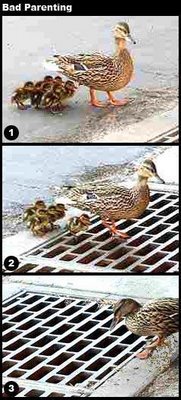
Bad parenting


Accompanying story

This reminds me of the time I had Oldest Boy on my shoulders, and klonked his head on a doorway because I forgot to tell him to… um… duck.

He’s fine now though. Really.

Orwell websem doubleplus soon.

The ugliest neologism I have ever heard would have to be ‘webinar‘. Defined for you by the equally ugly-named Webopedia.

And just to show that I’m not just an unproductive complainer, I’ll suggest an alternative: Websem. It’s not much more attractive, but it has two advantages: it’s somewhat intuitive, and it sounds like Newspeak.

Context is hard. Let’s go shopping!

I pointed out a curiosity to my linguistics students: we can see that all the following sentences could be construed as a request to open the window.

  • Please open the window.
  • I need someone to open the window.
  • It’s hot in here.

Of course, that last one only works in certain cases, namely if you’re willing and able to open the window, and I say it in such a way that you realise I’m not just making an idle comment on the room temperature.

The curiosity, though, is these two sentences.

  • It’s hot in here.
  • It’s cold in here.

Both of these could encode the same request.

My students had two ready answers for this:
1. We have a lot of real-world knowledge about what windows are for, and the likely effects of opening one.
2. We have an understanding of context.

But context is a horribly complex and poorly-defined notion. Our context involves all the objects around us, our goals and reasons for being where we are, the sum total of our cultural knowledge, everything we see and everything we know. Yet somehow we are able to quickly weed out all the extraneous information and decide what aspects of our context are relevant to the utterance at hand.

An example of this:
1) I pulled a real Homer Simpson last night.
2) I was at a restaurant last night, and I pulled a real Homer Simpson.

The interpretation for 1) may be that I did something pathologically stupid, or (if you saw the relevant episode) I fluked a victory. However, the inclusion of ‘restaurant’ in 2) leads us to another interpretation: I made a pig of myself.

Is Homer Simpson contextual? Here, certainly, but not in every conversation. To make this kind of reference, I make a guess about your cultural knowledge and ability to decode the reference, I bring the Homer reference up out of nowhere, and then I go on with the utterance as though nothing happened.

This is the kind of thing that gives us dialogue modelers conniptions.

I said no.

I remember what I was doing about three years ago. It was that fantastic Sunday when the world broke out in protests against the war in Iraq. You were there.

My wife and I skipped church (because you shouldn’t let religion get in the way of morality) and took the kids to Perth city where we marched and shouted.

Oldest Boy was eight. I was explaining about why we were protesting, and he said, “So if George Bush sees us, and knows we all don’t want war, then he may decide not to attack Iraq. Right?”

Dear child.

“No,” I said. “He’s already decided to attack Iraq, and he will.”

“Then why are we doing this?” he asked.

“Because it’s important for us to do the right thing. Whatever happens, we want it to go down on the record that we said no.”

And we saw what a fat lot of good our sign-carrying and sloganeering did.

Yesterday, Oldest Boy asked me, “So is Bush going to bomb Iran?”

“Yes,” I said. “He is.”

Because Iran is next. We’ve done such a crackerjack job in Iraq that now it’s time to extend the neocon experiment. And I don’t know of any protests, though there may yet be. And I’ll carry out the same silly exercise that I did three years ago. And the bombs will fall anyway, and the empires will crumble. And Americans will still send me emails about peeance and freeance to convince themselves that the death they unleash from the sky and the torture of other people’s children is in fact God’s will.

I don’t know what to do to stop it. I don’t have very much power. I have a little money, which I can direct where I want. I can vote, but I’m only one vote. I have a blog that gets read by 10 people on a good day. It’s nothing, really.

But I will use any power I have, however pathetic and futile, to say no.

« Older posts Newer posts »

© 2026 Good Reason

Theme by Anders NorenUp ↑