Good Reason

It's okay to be wrong. It's not okay to stay wrong.

Category: post (page 88 of 125)

What are you listening to this very second?

For me, it’s a little ditty by Severed Heads entitled ‘New Explosions’ off the Stretcher album. A disturb-o-rific slice of early IDM, which you can listen to here. I already downloaded the CD version of Clifford Darling, Please Don’t Live in the Past because I thought my (extremely rare) vinyl version was grievously scratched. Turns out the song just sounds like that. Never mind; I should have known.

After that, I’m going to listen to the new track by Stephen Duffy and the Lilac Time. It’s called Desert Shore, from the new album Runout Groove. Reward your ears, but not before you tell what you’re listening to this very second.

The Authoritarians

I’m going through an excellent book called The Authoritarians by Bob Altemeyer (available for free here online). You could say there are two kinds of people in the world: those who are looking for an authority figure to surrender to, and those who take instructions from their own conscience. Political conservatives are notable for the former tendency, which may also include illogical thinking, failure to integrate contradictory ideas, hypocrisy, and ethnocentrism. Of course, everyone is subject to all of the above unless they’re careful, but right-wing authoritarians (or RWAs) seem to score higher on the scale. You’d have to, wouldn’t you? to think that war is great foreign policy or that doubling the size of Gitmo would bring safety or that immigrants threaten us all. I might add that I’ve never seen an entire political party rely on this kind of thinking for its day-to-day existence like the GOP of today, though I was kind of young during the Nixon years.

The author also investigates why people surrender their rationality to authoritarian (or fundamentalist) religions, and why some people leave them. Chapter 4 described my deconversion quite neatly. You young fundamentalists (and by that I mean anyone who was taught that their religion’s teachings were factually true), see if this resonates for you.

From its earliest days fundamentalism has drawn a line in the sand over scripture versus science, and some of its young people eventually felt they had to step over the line, and then they kept right on going.

Still the decision to leave was almost always wrenching, because it could mean becoming an outcast from one’s family and community. Also, fundamentalists are frequently taught that no one is lower, and will burn more terribly in hell, than a person who abandons their true religion. What then gnawed away so mercilessly at the apostates that they could no longer overpower doubt with faith?

Their families will say it was Satan. But we thought, after interviewing dozens of “amazing apostates,” that (most ironically) their religious training had made them leave. Their church had told them it was God’s true religion. That’s what made it so right, so much better than all the others. It had the truth, it spoke the truth, it was The Truth. But that emphasis can create in some people a tremendous valuing of truth per se, especially among highly intelligent youth who have been rewarded all their lives for getting “the right answer.” So if the religion itself begins making less and less sense, it fails by the very criterion that it set up to show its superiority.

Similarly, pretending to believe the unbelievable violated the integrity that had brought praise to the amazing apostates as children. Their consciences, thoroughly developed by their upbringing, made it hard for them to bear false witness. So again they were essentially trapped by their religious training. It had worked too well for them to stay in the home religion, given the problems they saw with it.

From a child, I was taught that the Book of Mormon was “the most correct book“, and I taught this to others on my mission. It was later that I saw how the Book of Mormon made claims that either failed to be confirmed by evidence, or else contradicted it entirely. As a result, I came to realise that the Book of Mormon was, well, not even a correct book. What then? One agonising deconversion later, I can still appreciate the respect for truth that my religion instilled in me, even as it taught things that were not literally true.

I’d be happy to have a book club sort of discussion in comments. Paste any thought-provoking prose you find and we’ll hash it over.

Calling god ‘Allah’

The danger of being an atheist blogger writing about Islam is that someone will mistake you for a far-right blogger, like some hyper-aggressive LGF jerk with a berserk preputial gland. So, in advance, let me explain that I’m equally against all religions, and that any anti-Islam rantings of mine are not intended to advance the Glorious Conservative Cause of the Bush Dynasty for World Domination, nor as a thin mask for any xenophobic sentiment. For the record.

I have to get that out of the way, because the Keyboard Konservatives are all over this story:

A Roman Catholic Bishop in the Netherlands has proposed people of all faiths refer to God as Allah to foster understanding, stoking an already heated debate on religious tolerance in a country with one million Muslims.

“Allah is a very beautiful word for God. Shouldn’t we all say that from now on we will name God Allah? … What does God care what we call him? It is our problem.”

From the comments around the web (e.g.), it would appear that people do care what to call their favourite sky buddy. Never mind that this hits people’s always-touchy language buttons. It would be like calling your best friend some new name. I have a friend who changed his name his first year of uni, twenty years ago. (Hello, O’Neil!) But I still want to call him Steve. You could see how people would worry that their prayers would get misdirected, even to an omniscient being.

Naturally, for an atheist, what to call an imaginary being is rather a moot question. Theists have believed in many gods in human history. Here is a most impressive list of gods, all once believed in by many people, most now extinct. Time to add more to the list of Gods past. Let’s just call him (or her) nothing at all.

Latest spam technology

New from the Junk box: Watch as spammers use thesaurus-based substitution to turn a normal paragraph into unintelligible gibberish!

You’ll be whizgiggling like never before. Or perhaps srieking.

Chicks always laughed at me and even men did in the not private WC!
Well, now I sriek at them, because I took M eg ad ik
for 3 months and now my putz is quite bigger than national.

Baronesses always whizgiggled at me and even boys did in the unrestricted bathroom!
Well, now I giggl at them, because I took Meg, a dik.
for 4 months and now my phallus is badly more than average.

Virgins always whizgiggled at me and even boys did in the national water closet!
Well, now I whizgiggle at them, because I took Me – ga – Di k
for 5 months and now my cock is greatly greater than world.

I’ll bet.

Well, we’re not too fond of you either.

So scary it’s funny! Or… so scared it’s scary!

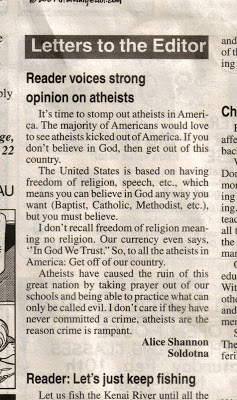
Click for a bigger image.

Silly writer. Atheists aren’t to be blamed for all the world’s ills. It’s teh gheys.

I like how atheists are responsible for crime, even if they haven’t committed any. Anything’s possible with magic thinking! Still, I guess it does say that on money, so she’s got us there.

I’d love to discuss this in more detail, but I have to do the laundry and shopping — things that could only be described as ‘evil’. While I’m gone, a question for consideration: Is being an unbeliever all it takes to make a believer feel frightened or threatened?

Bridge collapse

I realise it’s been a while since the collapse of the Interstate 35W bridge, but it’s taken me a while to sort out my thoughts on it. I’ve thought about how we trust others as we cross bridges and eat food and breathe air, and for the social contract to be violated in this way I find inexcusable. I’ve thought of how we plan our lives, and how those plans can be cut short.

But the thought that keeps coming back to me is this: No astrologer saw it coming. No one’s horoscope said ‘Don’t cross the I-35W today.’ No psychic predicted the collapse. No tea-leaf reader prognosticated such a tragedy. No readings of entrails gave a hint. And no prophet, priest, or pastor prophesied the event in any way that would have been of any help to anyone.

Foretelling the future is something that they all claim to be capable of, but they never actually do. Because they can’t. The only thing that could was the scientific method — someone inspecting the bridge and looking for things that would signal danger. And it turns out that no one was listening.

Mirror neurons, gesture, and culture

Interesting things, those mirror neurons. They’re in our brain, and they fire not only when we do something, but also when we see someone else doing that thing. They’ve been credited with paving the way for language, since they allow us to not only make noise but also perceive when the other person is making noise. They may even provide an evolutionary explanation for human attributes like compassion and empathy, since they allow us to feel the feelings of others.

But mirror neurons may have some not-so-salubrious effects. I have a suspicion that they may contribute to the deplorable discourse we find on the web. Think about it. Some moronic troll appears and acts like an idiot. Now what happens? Everyone’s idiot mirror neurons fire, and the whole discussion deteriorates unless thinking people make a conscious effort. Trenchant humour is a way out of the cycle; it’s just a shame not everyone’s capable of it.

Now a study from UCLA examines the effect of culture on mirror neurons.

When it comes to the influence of culture, the researchers found that the mirror neuron network responds differently depending on whether individuals are looking at someone who shares their culture or someone who doesn’t.

The researchers had two actors — one American, the other Nicaraguan — perform a series of American, Nicaraguan and meaningless hand gestures for a group of American subjects. A procedure called transcranial magnetic stimulation was used to measure the observers’ levels of corticospinal excitability, which scientists use to gauge the activity of mirror neurons.

Molnar-Szakacs and Iacoboni found that the American observers demonstrated higher mirror neuron activity when observing the American making the gestures — whether they were American, Nicaraguan or meaningless — than when viewing the Nicaraguan. Even when the Nicaraguan actor performed American gestures, the observers’ mirror neuron activity dropped.

At this point, I was thinking, “Why are they calling it ‘culture’? Aren’t their brains just switching off when they see someone with different skin colour?” Apparently not entirely. When Americans watched the Nicaraguan doing Nicaraguan gestures, activity was once again high.

It appears that neural systems supporting memory, empathy and general cognition encode information differently depending on who’s giving the information — a member of one’s own cultural or ethnic in-group or a member of an out-group. Ethnic in-group membership and a culturally learned motor repertoire more strongly influence the brain’s responses to observed actions, specifically actions used in social communication.

“An important conclusion from these results is that culture has a measurable influence on our brain and, as a result, our behavior. Researchers need to take this into consideration when drawing conclusions about brain function and human behavior,” said Molnar-Szakacs.

It’s good to be aware of how deep this in-group out-group stuff can go.

Why did the robot cross the road?

Getting a computer to recognise humour is a tricky undertaking, but some language researchers are attempting it — if you can call puns ‘humour’.

Understanding a pun is sort of like a word-sense disambiguation task. If you’ll forgive an example:

Sign at a drug rehabilitation center: “Keep off the grass.”

Here, two senses of a word play off each other, to somewhat humourous effect. Word-sense disambiguation is a well-studied area in natural language processing, so this is as good a place as any to start.

Here’s an account of one such attempt.

To teach the program to spot jokes, the researchers first gave it a database of words, extracted from a children’s dictionary to keep things simple, and then supplied examples of how words can be related to one another in different ways to create different meanings. When presented with a new passage, the program uses that knowledge to work out how those new words relate to each other and what they likely mean. When it finds a word that doesn’t seem to fit with its surroundings, it searches a digital pronunciation guide for similar-sounding words. If any of those words fits in better with the rest of the sentence, it flags the passage as a joke. The result is a bot that “gets” jokes that turn on a simple pun.

That sounds simple, but the main problem is how to tell when words don’t seem to fit with the other words in the sentence. For this project, it sounds like they’re generating co-occurrence tables, or statistics about how often any given word is likely to be seen with any other given word. That way, if a word shows up with other words it’s not likely to co-occur with, the system will flag it.

Click on the graphic for an example:

This approach might work well for puns that rely on similar-sounding words, but what about our ‘Keep off the grass’ example above, where the pun relies on two senses of the same word? This system will fail to notice that a pun exists because there’s nothing to suggest that a “Keep off the grass” sign is anything out of the ordinary. And ‘drug’ and ‘grass’ do happen to co-occur in texts, so the system will see no incongruity.

To recognise these kinds of jokes, I might try scanning words in the sentence for multiple senses, and then seeing if groups of words show interesting properties. Perhaps ‘grass-1’ will co-occur frequently with ‘keep’, ‘off’, and ‘sign’, but ‘grass-2’ will co-occur with ‘drug’ and ‘rehabilitation’. We might then infer that since both senses of ‘grass’ are well-linked to different words in the sentence, a pun is going on.

This kind of approach, where we look for unexpected word occurrences, comes close to the essence of humour. Many things are funny because they’re unexpected, yet somehow right. To a small child, slipping on a banana peel is funny because it’s unexpected. Walking down the street unimpeded is normal, and therefore not funny. As humans, we have a lot of experience with the world, and we know what’s likely to happen and what’s not. Giving this informaton to computers is a difficult task, but it may be the key to humour recognition.
Hey, guys, don’t fight! You’re both insane.

Brownback and Huckabee trading barbs over whose religion is better is like watching clowns whacking each other with big fish, but slightly less entertaining.

[A] pitched battle has broken out involving two lesser-known candidates who are trading accusations of religious bigotry and hypocrisy. The battle has become the most heated and personal rivalry in the Republican field.

The current tensions stem from an e-mail message sent to two Brownback supporters by Rev. Tim Rude, the pastor of an evangelical church in Walnut Creek, Iowa. In the message, Mr. Rude, a Huckabee volunteer, compared the religious backgrounds of Mr. Huckabee, a Baptist pastor, and Mr. Brownback, who is Roman Catholic.

“I know Senator Brownback converted to Roman Catholicism in 2002,” Mr. Rude wrote. “Frankly, as a recovering Catholic myself, that is all I need to know about his discernment when compared to the Governor’s.”

While it’s refreshing to see the term ‘recovering Catholic’ in print, I’ll just put something out there that I’ve been thinking for a while: Insane people hate competing insanities. I mean, both Huckabee and Brownback put their hands up as evolution deniers in a debate. They’re both religious nutters. Why can’t they get along?

Bibles in newspapers

I noticed this:

Everything from detergent to computer discs is packaged with the Sunday newspaper. So why not Bibles?

International Bible Society-Send the Light is planning on spending hundreds of thousands of dollars to distribute Bibles with 11 newspapers during 2007 and 2008. New Testaments would be packaged in pouches on the outside of newspapers, much like soap or other sample products.

But not everyone is happy with the move:

“Do you have any idea how blatantly offensive this boneheaded move is to the thinking public?” a Fort Worth reader wrote in one of several letters to the editor on the topic.

Oh, come now. They’re just trying to share their beliefs. And grow their market share. Any business would do the same.

The project leader can’t imagine what the fuss is about.

“It’s disappointing that anyone would object to getting a Bible, which is the best read book in the whole world and has been for hundreds of years. They have the right to do with it what they want to,” he said. “Do they object to getting a bag of Quaker oatmeal or Tide detergent or an AOL disc?”

Except that those other things are demonstrably useful. Well, not the AOL disc.

But this advertising gimmick rests on a couple of bad assumptions.

Assumption 1: There just aren’t enough Bibles around.

In reality, almost everyone either has a Bible or could easily get one if they wanted one. There’s no shortage, and there’s certainly no reason to go packaging them in the morning paper.

Assumption 2: A good way to get someone to become a Christian is to have them read the Bible.

In my experience as a missionary, almost no one joins a church because they read the book and think it’s true. Not all by itself. How many people already had a copy of the Book of Mormon? Tons. Our work would have been much easier if that were all it took. Instead, we had to arrange hours of teaching appointments, get them to meet people in the church, have them make commitments to start doing churchy things, and generally massage them into being Mormons. It was exhausting. You couldn’t just fling scriptures around and expect to have people walk in the door. Not surprisingly, people were most receptive when they had a family member or close friend that was already in the church. That was a shortcut because then it wasn’t just about the book, it was about the relationship. Communal reinforcement and personal investment did the rest.

So I don’t expect Bibles in newspapers to lead to conversions. But I’m not offended by the campaign. In fact, I find it rather appropriate that religion is being flogged like soap or oatmeal. It’s a commodity, after all, and one that relies on need creation and brand loyalty, just like anything else.

Older posts Newer posts

© 2026 Good Reason

Theme by Anders NorenUp ↑