Already it is Post 400. You may use this thread for any discussion you wish, like all the other threads. Maybe this would be a good place for comments about the ‘Who is the most batshit insane?” poll. For my part, I have to report a glaring omission: I forgot to add ‘9/11 truthers’ to the list. Oh well, maybe next time.
Good Reason
It's okay to be wrong. It's not okay to stay wrong.
Category: post (page 86 of 125)


Background on Milgram’s experiment.
How much would you pay for the new Radiohead album?
Then that’s what you’ll be paying.
The new album ‘In Rainbows‘ will be available only from the website, and if you opt for digital download, you may pay exactly what you like. You enter the amount you’ll pay in a field. If you click on a question mark link, it simply says, “It’s up to you.”
Would you pay less than usual, since Radiohead has a lot of money anyway, and, well, they’re offering? Or would you pay slightly more, figuring that other artists are watching, and you’re hoping they’ll try it as well?
I settled on ten pounds. You can decide from that which group I’m in.

 Does this picture look like a face to you? It’s been generated somewhat randomly, along with tons of others at Mutating Pictures. You decide how much it looks like a face, and the more facey ones get to produce more offspring.
It’s not really natural selection, but it is a good example of how randomness plus feedback can cause certain features to recur. It even works when the feedback is very vague — you’re not saying exactly what it is that’s more face-like, but the more facey ones survive anyway.
Maybe I’m a little careful about the word ‘cult’, since my church of origin copped a lot of the cult talk. To me, the practices and doctrines of my church were normal and not cultish. Yet my dear old normal church, with its gold bible and temple ceremonies, topped the list of cults in book after book. Christianity was a Jewish cult in the early days — and I don’t mean to be pejorative when I say that it remains sort of a death cult even today, its central image a tortured man nailed to a cross.
I’m still looking for a good definition of ‘cult’. Here are the most common I’m aware of:
1. A cult is a religion that is weird.
That is, it has beliefs or practices that lie outside the mainstream. But every religion is weird to someone. This very afternoon, Youngest Boy and I saw a rather large number of Evangelical Christians singing loud songs in the city. Hands raised, and so on. Substitute “Hare Hare” etc, and it wouldn’t have sounded any different. Yet the Hare Krishnas are a cult and the Christians aren’t? for no one denounces cults like those Christians.
2. A cult is a religion that uses coercive, manipulative, or deceptive tactics to retain its membership.
Cults tend to isolate their members, get them dependent on the approval of the group, and restrict their access to family. But every religion has its bag of tricks: tell people if they don’t do what god wants, they’ll go to hell or otherwise be ineligible for heaven; use communal reinforcement to keep people tied into the values of the group; start them when they’re young and dependent. And in extreme cases, threaten apostates with ostracism.
3. A cult is a religion that focuses on adoration of an individual.
Like Jesus? Next.
4. A cult is a religion that hasn’t become well-established yet.
Getting closer. If Catholicism had a hundred followers, its followers would seem darned peculiar. Population and history have a way of lending legitimacy. But Hinduism and Buddhism, with their many millions, were considered cults when they arrived in the West.
5. A cult is a religion that we don’t like.
That’s about as close as we’re going to come.
I’ve never seen a definition for a cult that doesn’t also implicate all other religions. My religion is a religion; yours is a cult.
Sorry to abandon the site — I’ve been beset by the worst influenza strain I’ve seen since the winter of ’83. Doing better now though. I’ve tried to make it up to you by including a poll in the right sidebar.
And then this week, my mailbox coughed up a bookmark.
Dear Neighbour
This year, the members of St Luke’s Anglican Church in Maylands are praying for the welfare of our neighbourhood. This week, we have chosen the people in your street.
Please contact us with any special needs you may have.
The St Luke’s Community
Dammit, people! Cut it out! My life has sucked since you started praying for me! Don’t you know that prayer can actually increase post-operative complications? Are you trying to give me secondary pneumonia?
It’s very sweet that you’re offering to help with my ‘special needs’ (ahem), but I’m already using the Magical Wishing Ferret plus the Secret, so really I’m doing fine. Also a very kind GP is taking care of me, and I have evidence that she actually exists, kthxbai.
Here’s the story: Boy has brain surgery, and comes out with a posh London accent instead of his unlistenable Northern accent.
“We noticed that he had started to elongate his vowels in words like ‘bath’ which he never did before,” said Mrs McCartney-Moore, 45, a music teacher from York.
“He no longer has short vowel sounds – they are all long. It’s bizarre.”
This is reminding me of Foreign Accent Syndrome, where someone will have (say) a stroke and come out with a new accent. Here’s the current explanation for FAS:
Now researchers at Oxford University have found that patients with “foreign accent syndrome” seem to share certain characteristics which might explain the problem.
A small number of them all had tiny areas of damage in various parts of the brain.
This might explain the combination of subtle changes to vocal features such as lengthening of syllables, altered pitch or mispronounced sounds which make a patient’s pronunciation sound similar to a foreign accent.
But for this case, the surgeon has a slightly different idea: the patient had to relearn his accent after the operation, and did so according to the people around him.
Brain surgeon Paul Eldridge, who works at the specialist Walton Neurological Centre, Liverpool, said it was possible that the infection and abscess had affected the area of the brain which controls language skills, forcing William to learn how to speak again.
“It’s as if he’s re-learnt how to talk from listening to language from sources different to those that prompted his speech first time around.”
The key here is: is he really speaking with an upper-class accent (which could have been learned from someone else), or is it just the elongated vowels that makes people think he’s talking with an upper-class accent? How long does it take to acquire an accent, anyway?
I used to be a language maven before I reformed and became a linguist. Now I don’t care what anyone does, I’ll just document it. But I used to decry the incorrect usage of others.
For example, the word ‘orientate’. I used to hate it! Just say ‘orient’! You don’t need to ‘orientate’ yourself! Just orient yourself.
But now trawling through the language archives, I’ve found that some people used to do the same thing to ‘jeopardise’.
Merriam-Webster’s Dictionary of English Usage, 1994, pp.570f.:
jeopardize. Richard Grant White called jeopardize “a foolish and intolerable word” in 1879, and he was not the only one who thought so. A popular view among American critics in the 19th century was that the proper verb was jeopard, an older word which, according to the OED, had fallen into disuse by the end of the 1600s.
No one complains about ‘jeopardise’ anymore. And this is how it goes in language change. Would you jeopard the future of ‘orientate’? Me neither.
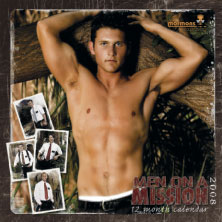
This calendar is all kinds of awesome, even though it makes me feel all funny and confused. Beefcake photos of returned LDS missionaries.
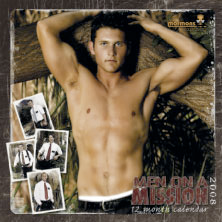
I only work out on P-day, President, honest.
Everyone seems to love juxtaposing the straight arrow image of LDS missionaries against their complete hottness. Everyone except Latter-day Saints; either they know better (many of my mission companions were intolerable; few were hott) or they place missionaries in the no-sex zone occupied (in theory) by Catholic priests.
Not that Mormonism doesn’t blur sex and spirit. Christianity is a patriarchal religion; it has a father-god, and it centers on love for Jesus. And with all that man-love going on, we shouldn’t be surprised if we find some sublimated (homo)eroticism in there somewhere.
Or not so sublimated. Here’s one t-shirt design that was popular a few years back:
But if you think this project will make people uncomfortable, imagine if a calendar came out with cheesecake photos of returned sister missionaries. What would happen? Would it go under the radar because sister missionaries are somehow less iconic to the church’s image? Or would it raise more of a fuss because they’re women?
Gods have been interfering in construction projects.
A canal in India may not go forward over protests of an unusual nature.
Hindu hardliners say the project will destroy what they say is a bridge built by [Hindu god] Ram and his army of monkeys.
Scientists and archaeologists say the Ram Setu (Lord Ram’s bridge) – or Adam’s Bridge as it is sometimes called – is a natural formation of sand and stones.
In their report submitted to the court, the government and the Archaeological Survey of India questioned the belief, saying it was solely based on the Hindu mythological epic Ramayana.
They said there was no scientific evidence to prove that the events described in Ramayana ever took place or that the characters depicted in the epic were real.
Hindu activists say the bridge was built by Lord Ram’s monkey army to travel to Sri Lanka and has religious significance.
In the last two days, the opposition Bharatiya Janata Party (BJP) has launched a scathing attack on the government for questioning the “faith of the million”.
Sometimes people ask me if I ‘believe in X’, and like Carl Sagan, I wish they’d ask instead: ‘How good is the evidence for X?’ Here, the BJP is claiming that the beliefs of millions must not be questioned, but they don’t examine the evidence for the belief. Seems to me that respect for the belief should be consonant with the evidence for it.
Now I’d hate to see a natural bridge destroyed, even if some people think it was built by a mythical being and an army of monkeys. (Because that would actually be pretty cool.) In fact, I wouldn’t care to destroy an object of ‘religious significance’ to anyone because people seem to like things that make them feel spiritual, and that’s okay.
What I think is interesting about this story is that the government decided to tell people that a deity was imaginary. A very encouraging tendency, but it’s a shame that the government caved in when fundamentalists freaked out.
In a similar story, roads in Iceland are sometimes diverted or delayed because people think it will annoy elves. Seriously.
“There are all sorts of beings beneath our stones,” said Brynjolfur Snorrason, a folklorist often asked to advise contractors on how best to avoid the lairs of Iceland’s elves and other seldom-seen creatures whose presence nonetheless still seems to permeate this far northern island nation.
Highway engineers in recent years have been forced to reroute roads around supposed elf dwellings. Similarly, builders of the country’s first shopping mall took care to lay electrical cables and other underground installations well away from suspected abodes of gnomes and fairies. Couples planning a new house will sometimes hire “elf-spotters” to ensure the lot is free of spirit folk.
What do you do? Elf-spotter.
One resident reported seeing one.
Despite having seen the elf only once in 15 years – enough time to determine that she was “bigger than life and dressed like my grandmother, in a 1930’s national costume” – Ms. Hakonardottir, 67, has no doubt of her existence. “My daughter once asked me, ‘How do you know where elves live?’ ” she said. “I told her you just know. It’s just a feeling.”
And if you feel it, it must be true. Intuition over evidence. You just know.
Another resident reports:
Recently, she said, some elves borrowed her kitchen scissors, only to return them a week later to a place she had repeatedly searched. “My philosophy is, you don’t have to see everything you believe in,” she said, “because many of your greatest experiences happen with closed eyes.”
Please remember, these are real people. Who believe in elves. The evidence they accept is feelings, intuitions, and unusual occurrences. They also disdain the need for physical evidence.
But of course, no one you know would be so silly.
© 2026 Good Reason
Theme by Anders Noren — Up ↑
Recent Comments