Good Reason

It's okay to be wrong. It's not okay to stay wrong.

Category: post (page 68 of 125)

In what respect, computer?

Someone’s invented the Palin interview generator, so I don’t have to.

It works by Markov chaining, which I’ve had some fun with before (see here and here).

Basically, you pick — let’s say — two words from a corpus (in this case, Palin’s interviews), and use them to choose a likely third word (also from your corpus). Then pick a fourth word using words two and three. Word by word, you assemble whole sentences. Which I think might be how Palin constructs sentences herself, so bonus points for psychological reality.

Here’s a snippet.

Q: What is the role of the US in Iraq and Afghanistan?

Afghanistan will lead to war and it doesn’t have to lead, as I said, to a position like we are at a point, here, seven years later, on the side of the United States. I want you to not lose sight of the earth. That’s not a part of, I guess, that culture. The way that I have understood the world is through education, through books, through mediums that have provided me a lot of perspective on the side of the message that Americans are getting sick and tired of politics as usual, that embracing of the status quo, the politics as usual, that embracing of the status quo, going with the Bush administration that we have to stand for that.

Cut to shot of Katie Couric, brow furrowed.

Random Five, in six words.

I try not to play one album too much because the other ones get jealous. But that hasn’t stopped me from playing quite a lot of Beck’s latest release, “Modern Guilt”.

  • This time the sound is sunshine pop mixed with surf rock and deep paranoia. Maybe Beck didn’t get it all from Caribou, but if I were Dan Snaith, I’d be feeling pretty vindicated.
  • Every song cuts off abruptly, so you don’t get too comfortable.
  • Best lyric: ‘Sic a dog on all you know/Cut it loose before you go.’
  • I think this album contains the best song in Beck’s long catalogue, and that’s ‘Volcano’. If you can ignore the Dianetics implications, you’ll find a worn-out beat glued to a beautiful choral setting. I can’t get it out of my mind.

If you don’t want to stray too far from Beckland, you could try my other album of the week, ‘The Sophtware Slump’ by Grandaddy. Man, this is a depressing album, but sometimes it rocks out, and at times it’s quite touching. “Underneath the Weeping Willow” is a simple piano piece about the need to stop and sleep once in a while. Even though there’s sadness, we may yet wake and feel happy again. It was a song that found me sitting in the car at the grocery store parking lot while the song finished. I watched everyone going by, and the world got quiet.

This time I’m describing the random songs using only six words.

Born Slippy by Underworld
Album: Triple J Hottest 100, Volume 4
Never got this. Too much pummeling.
Snot by Isan
Album: Salamander
Early stuff here. They’ve gotten better.
Bowl of Oranges by Bright Eyes
Album: Cold Front: The Winter Chill Collective
Clever lyrics. I like hopeful music.
Offend in Every Way by The White Stripes
Album: White Blood Cells
They have a simple earthy appeal.
Speed Dial No. 2 by Zero 7
Album: When It Falls
Not my favourite. But nice chill.

Hangin’s too good fer ’em.

Linguistic prescriptivists. They’re a clever bunch of swine, aren’t they? At least they think so. It’s not easy to correct people’s usage while looking down your nose at them and patting yourself on the back at the same time. It takes talent and coordination. Oh, sorry: ‘coördination’.

We have a joke about them.

I was walking across campus with a friend and we came upon half a dozen theoretical linguists committing unprovoked physical assault on a defenseless prescriptivist. My friend was shocked. She said: “Aren’t you going to help?”

I said, “No; six should be enough.”

All in fun, but these irritating self-satisfied vermin don’t just waste your time on the Net. Sometimes they’re capable of damage.

Two obsessive grammarians who changed a historical handpainted sign at the Grand Canyon national park have been sentenced to probation for vandalism.

Using a marker, [one of them] replaced an erroneous apostrophe and added a comma to the yellow lettering on a black fibreboard sign.

However, the pair did not realise the sign had been made by Mary Elizabeth Jane Colter, the architect who built the watchtower and other landmarks in the Grand Canyon area.

They pleaded guilty to conspiracy to vandalise government property and were sentenced to a year’s probation during which they cannot enter a national park or change any public signs.

They were also told to pay £1,500 to repair the sign.

One of the things I try to beat into my first year linguistics students is that language is always changing, and this is neither good nor bad. The language we think of as ‘correct’ has been going through this same process, and would horrify earlier speakers of English.

But in private moments, I consider shenanigans such as we see from these two nincompoops as a sign of a pathological superiority complex and/or an age over 60.

Conversations with the Priest: The lucky hat

The Priest was another try at reviving my sense of spirituality. He’s a good chap. He really does try. He’s hoping that I’ll get a Big Feeling and realise the error of using evidence and reason. Imagine if I did have a big teary spiritual experience. That would just show that I’m as susceptible to emotional thinking as anyone else. I already know that.

This time he was talking about prayer.

“I’ve found that the Lord never lets me down,” he said. “I always get what I pray for, if I’m praying for the right thing. It doesn’t always happen immediately, though.”

“No, it sure doesn’t,” I said. “Remember that fast that happened last year, to end the drought?”

“Ahem,” he said.

“There’s still a drought, isn’t there?” I said. “And have you heard anyone mention it in church since?”

He looked uncomfortable. “Yes, well… we have had an increase in precipitation….”

He was moving the goal posts, but I ignored it.

“I have something that works like that,” I said. “I have a lucky hat. I believe that when I wear my lucky hat, lucky things happen to me. One time I found some money. Another time, I found a parking spot right where I wanted. It’s the hat that does it.

“It doesn’t always happen immediately, though.”

My lucky hat uses the same principle as prayer, the Secret, and all other superstitions. It uses selective observation, or counting the hits and ignoring the misses. And it uses the power of having no evidence and believing what you like anyway.

“You know,” said the Priest, “you’re asking for empirical evidence. I admit that such evidence isn’t available. But I think the Lord does it that way on purpose… to see if we’ll exercise faith in him. If we had evidence, it wouldn’t require us to have faith.”

I said, “That’s exactly what I would expect someone to say if they couldn’t support their claims with evidence, but they didn’t want to abandon the claim.”

NB: The Priest is not a real person. He’s an amalgam of many religious people I’ve spoken with. I only write down a conversation with “the Priest” after I’ve heard the same claims from at least three different people. As a result, the dialogue is almost entirely made up, in order to make myself sound cool. Or it could be 100% accurate. I forget.

Another political experiment

How likely are you to be a conservative? It may depend on how easily you scare.

Subjects were tested for political opinions, and categorised as liberal or conservative.

The participants were then given two laboratory tests, to establish their physiological responses to frightening or unexpected stimuli. In the first test, they viewed 33 images, three of which were distressing or threatening: a large spider on the face of a frightened person; a dazed person with a bloody face; and maggots in an open wound. The scientists measured the electrical conductance of the skin, a standard measure of distress and arousal.

In the second test, the volunteers were subjected to a loud, unexpected noise, with scientists measuring the involuntary blinking that followed. A strong startle response is indicative of heightened fear and arousal.

No points for guessing which group contained the bigger scaredy cats.

Those with “markedly lower physical sensitivity to sudden noises and threatening visual images” tended to support liberal positions, while those with strong responses tended to be more conservative.

Acting conservatively is an appropriate response to uncertain and risky situations. Conservatives know this, and therefore try to emphasise the scary side of our world. As a result, modern conservatism is a laundry list of over-stated grievances and fears intended to exploit feelings of resentment and victimhood. They’re coming for your job. Your guns. Your women. Taxes, children, bible, flag. Conservatives, then, are the ones who respond most to this fear-mongering and paranoia.

Courage, citizens.

Calm down, all of you.

The scripture of the day:

“We’re sensitive to the fluid dynamics of the campaign, but we have a game plan and a strategy,” said Mr. Obama’s campaign manager, David Plouffe. “We’re familiar with this. And I’m sure between now and Nov. 4 there will be another period of hand-wringing and bed-wetting. It comes with the territory.”

Democrats last week were in a panic over Palin, prompting the run on adult diapers that reverberated through the economy, inadvertently destroying Lehman Brothers, fomenting global warming, and hastening the eventual heat death of the universe.

I admit to indulging in a bit of the panic. One night I woke up at 3, worrying that Obama was going to lose this thing. Another night I dreamed that McCain had asked me to be his running mate. There I was thinking, “What am I doing on the Republican ticket?” (It has occurred to me since that I’d be a stronger running mate than Palin. I don’t have any foreign policy experience, but I do have a degree in International Relations.)

We Democrats do this. We fret and fume, and watch helplessly as the worst people in the world control the dialogue and capture everyone’s attention with the dumbest things. And we worry that, yet again, the scumbags will win.

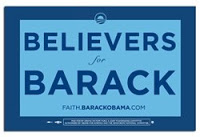
And every time the polls show the race to be closer than we’d like, we get people telling us that there’s something wrong with what we’re doing. It always seems to be about… the good people. Yes, those simple humble folk who bow their heads and pray around the dinner table every night (with no fancy lettuce, mind you). They’re founts of wisdom, these common decent souls, issuing simple homilies as they hook their thumbs into their armpits and rock back and forth. And we Democrats abuse them mercilessly as we look down our urban noses at their pious ways. We’re losing… (wait for it!)… people of faith.

Here’s a prognosticator now. Scott Atran.

I’m an atheist liberal academic who strongly leans Democrat. But I’m stunned at how blind so many of my colleagues and soul mates are to the historical underpinnings of American political culture and the genuine appeal of religious conservatism for so many of our fellow citizens.

Among many Republican conservatives, one factor strongly correlates with patriotism and national security, is of even more overriding concern in daily life, and stands inseparable from love of country. Religion.

Well, it’s one thing to understand the appeal religion has for people, and quite another to be infected with it yourself. I only wish Democrats were more immune to it — they’re nowhere near as secular as Atran is suggesting.

Or this article from Jonathan Haidt. I’ve linked to him before.

When Republicans say that Democrats “just don’t get it,” this is the “it” to which they refer. Conservative positions on gays, guns, god, and immigration must be understood as means to achieve one kind of morally ordered society. When Democrats try to explain away these positions using pop psychology they err, they alienate, and they earn the label “elitist.” But how can Democrats learn to see—let alone respect—a moral order they regard as narrow-minded, racist, and dumb?

Now, how is this view different from the “Democrats need to learn some respect” meme seen here? Only in tone, not in substance. If we don’t tell the believers (you know, the ones who are trying to block certain kinds of marriage and birth control) that their views are perfectly valid and very nice, they’ll never vote with us.

As though they ever would. When did Republicans ever concede any ground to us? Now that they’re down in the popularity polls, are they abandoning parts of their social agenda? No-sirree! Are the radio hate jocks acting more conciliatory? With rare exceptions, no. Do we hear Republicans saying that they need to reach out to secular Americans and try to understand us? No, they still think we’re vermin, and they wonder whether we can have any sense of morality at all.

But that could be the point. The antagonistic approach (surprise!) doesn’t win friends. So the question Haidt, Atran, and other concern trolls pose is: Do you want to win elections or don’t you? It’s all very well for you to be right, but do you want to be president?

Well, I understand the concern. I’ve seen the disaster that political and religious fundamentalists have wrought and I’m not anxious for more. But I am not certain that it is worth winning elections at any cost, if part of that cost is abandoning rationality and sinking into the mire of fuzzy-headed spiritism. That’s an approach that’s guaranteed to make the problems we face worse, not better.

And suggesting that Democrats need to mend their ways is silly. How do conservatives magically know what individual Democrats think? How do they know your individual views? Have they asked you? Or are we just being stereotyped — again? I think the latter, and if you feel like modifying your behaviour so others won’t stereotype you, frankly you need to grow a set. If we all changed our ways tomorrow and acted like Atran, Haidt, et al wanted, how long would it take hardcore conservative fundamentalists to even notice? They haven’t yet noticed that Bush is an incompetent liar and they still think Iraq was a fine idea. The reality lag for these people is measured in geological time.

So don’t wait for them. Have your facts straight, pick your battles, and tell people (politely but firmly) when they’re wrong on factual matters. Realise that it may not be possible to be ‘right’ on moral matters — they often won’t be good at realising this — so you may need to state your values clearly, and stay open to change.

Sam Harris’s response to Haidt is my favourite:

How should we live? Is it wrong to lie? If so, why and in what sense? Which personal habits, uses of attention, modes of discourse, social institutions, economic systems, governments, etc. are most conducive to human well-being? It is widely imagined that science cannot even pose, much less answer, questions of this sort.

Jonathan Haidt appears to exult in this pessimism. He doubts that anyone can justifiably make strong, realistic claims about right and wrong, or good and evil, because he has observed that human beings tend to make moral judgments on the basis of emotion, justify these judgments with post hoc reasoning, and stick to their guns even when their post hoc reasoning demonstrably fails…. This reliable failure of human reasoning is just that—a failure of reasoning.

Haidt often writes, however, as if there were no such thing as moral high ground. At the very least, he seems to believe that science will never be able to judge higher from lower. He admonishes us to get it into our thick heads that many of our neighbors “honestly prefer the Republican vision of a moral order to the one offered by Democrats.” Yes, and many of them honestly prefer the Republican vision of cosmology, wherein it is still permissible to believe that the big bang occurred less than ten thousand years ago. These same people tend to prefer Republican doubts about biological evolution and climate change. There are names for this type of “preference,” one of the more polite being “ignorance.” What scientific purpose is served by avoiding this word at all costs?

And second is Roger Schank.

It is all very nice to come up with complex analyses of what is going on. As is often the case, the real answer is quite simple. Most people can’t think very well. They were taught not to think by religion and by a school system that teaches that knowledge of state capitals and quadratic equations is what education is all about and that well reasoned argument and original ideas will not help on a multiple choice test.

We don’t try to get the average child to think in this society so why, as adults would we expect that they actually would be thinking? They think about how the Yankees are doing, and who will win some reality show contest, and what restaurant to eat it, but they are not equipped to think about politics and, in my mind, they are not equipped to vote. The fact that we let them vote while failing to encourage them to think for themselves is a real problem for our society.

Republicans do not try to change voter’s beliefs. They go with them. Democrats appeal to reason. Big mistake.

Well, that’s pretty dark. But maybe (just maybe!) this time the good guys will win. I think so, but I’m an optimist. Obama beat the Clintons, he can beat McCain. Even if he doesn’t, you have to live with yourself more than other people do. So quit your hand-wringing and your bed-wetting. You’re already part of the community on the Web that’s waging the battle of opinions, and setting the agenda for the next Information Age, comment by intelligent well-supported comment. Take heart! Be your own freaky self. Vote.

That is all.

Zombie memes and the ‘backfire effect’

Some memes just don’t die. Okay, memes about McCain and Palin stay alive because they repeat them even after they’ve been debunked. But what about Obama being a Muslim? What about that creationist on your blog who gets slapped down every week, but who keeps coming back with the same arguments?

There’s an interesting study out of Duke University (PDF here) about how some people resist correcting bad information.

They gave some conservatives and some liberals bad information about politics, and saw how it changed their opinions. When they then gave correct information, liberals adjusted their opinions back, but never quite all the way back to their former level.

When conservatives got the facts, however, they didn’t adjust their views at all. In fact, they actually believed the wrong information more.

Details:

Political scientists Brendan Nyhan and Jason Reifler provided two groups of volunteers with the Bush administration’s prewar claims that Iraq had weapons of mass destruction. One group was given a refutation — the comprehensive 2004 Duelfer report that concluded that Iraq did not have weapons of mass destruction before the United States invaded in 2003. Thirty-four percent of conservatives told only about the Bush administration’s claims thought Iraq had hidden or destroyed its weapons before the U.S. invasion, but 64 percent of conservatives who heard both claim and refutation thought that Iraq really did have the weapons. The refutation, in other words, made the misinformation worse.

A similar “backfire effect” also influenced conservatives told about Bush administration assertions that tax cuts increase federal revenue. One group was offered a refutation by prominent economists that included current and former Bush administration officials. About 35 percent of conservatives told about the Bush claim believed it; 67 percent of those provided with both assertion and refutation believed that tax cuts increase revenue.

In a paper approaching publication, Nyhan, a PhD student at Duke University, and Reifler, at Georgia State University, suggest that Republicans might be especially prone to the backfire effect because conservatives may have more rigid views than liberals: Upon hearing a refutation, conservatives might “argue back” against the refutation in their minds, thereby strengthening their belief in the misinformation. Nyhan and Reifler did not see the same “backfire effect” when liberals were given misinformation and a refutation about the Bush administration’s stance on stem cell research.

False ideas spread quickly when people like them, and they’re incredibly difficult to quash.

Since conservatism is currently the view of choice for the most extreme reality-denying Christianists, I think it’s fair to say that religious (non-)thinking bears more than a smidgeon of the blame for this. Religious thinkers (with whom I have had many discussions) don’t change their minds easily. They think it’s good to live in a fantasy world, and anything that would dissuade them from it is actually a trick from the Crafty One. Add in all the good ol’ folks who don’t trust those fancy-pants ‘experts’ who ‘know things’ and present you with ‘facts’, and you’ve got a sizable group of conservatives.

I find this result unsurprising, but incredibly depressing. How can we have government and consensus in a country where half the people in it won’t accept accurate information, and insist on remaining delusional? And I’m not too sure about you guys in the other half, either.

Thank goodness our Democratic candidates are aware of science and reason, and aren’t trying to pander to the… the… um…


Never mind.

Those wacky Muslims

Someone’s been watching TV, and the scantily clad women are making him feel all hot and bothered.

The most senior judge in Saudi Arabia has said it is permissible to kill the owners of satellite TV channels which broadcast immoral programmes.

Sheikh Salih Ibn al-Luhaydan said some “evil” entertainment programmes aired by the channels promoted debauchery.

Dozens of satellite television channels broadcast across the Middle East, where they are watched by millions of Arabs every day.

The judge made the comments on a state radio programme.

He was speaking in response to a listener who asked his opinion on the airing of programmes featuring scantily-dressed women during the Muslim holy month of Ramadan.

“There is no doubt that these programmes are a great evil, and the owners of these channels are as guilty as those who watch them,” said the sheikh.

“It is legitimate to kill those who call for corruption if their evil can not be stopped by other penalties.”

This isn’t some local imam. This is the highest ranking judge in Saudi Arabia.

This is the problem when you try and apply a bronze-age moral system to modern times. It leads to certain obvious moral contradictions. Apparently, killing people is permissible, but nudity on TV? Are you nuts? That’s just way out there!

Run, children! Run!

This ad is airing on Perth television stations on Saturday mornings, presumably in an effort to proselyte children. It features Barry Hickey, Catholic Archbishop of Perth.

There’s something deeply inappropriate about Mr Hickey taking his mythology directly to kids on their Saturday morning TV. In fact, I think this goes beyond inappropriate and leans toward sinister. By pushing the notion of god to young viewers, he’s actually promoting a toxic ideology that renders some people incapable of reason, and enriches the coffers of people like himself.

Maybe this isn’t the worst message you’ve ever seen on TV. Maybe you even think that it’s nice for Mr Hickey to spread a message about happiness. (On the other hand, you might think, as I do, that it’s creepy as hell. You might even have nightmares about someone who is dressed a lot like Mr Hickey.) But consider that if you want to poison an animal, you have to conceal the poison in some kind of food that the animal will like. First, you get the soft, fluffy talk about happiness and being truthful. Who could argue with that? Then, they deliver the ‘god payload’. Now the link between ‘kindness’ and ‘god’ is made. No wonder some people think you can’t be moral without religion.

I guess this is just another reason that parents need to be aware of their children’s viewing habits and be able to discuss what they see on TV. Perth stations need to explain why they think it’s all right for the Catholic Church to market their services to children.

Muslim school unwelcome, Catholics are fine

You may remember the story of Camden NSW, and how the residents opposed an Islamic school.

I think religious schools are a horrible idea because schools should be promoting education, not promoting the myths of a religious community. And I’d hate to see the public educational system undermined because religions are funding a separate system that pulls students away. (Not that I’m one to talk — my kids go to a Steiner school that I pay for.)

Of course, this situation’s a little complicated. Mainstream Christian religions do a lot with education in Australia, the schools tend to be of high quality, and in most cases the religion is toned down. And it always seemed to me that the Camden protests were based on racism and xenophobia rather than on secular principles. Call me crazy.

The heads of two pigs have been found on stakes at the site of a proposed Islamic school in Sydney’s south-west.

About 6am today, police were called to the site, on Cawdor Road, Camden, where they found the animal remains and a number of other items, a police spokesman said.

The pig heads had been “elevated off the ground” using stakes, he said.

An Australian flag was also strung up between the stakes, according to AAP.

Maybe they were suggesting that the school should study Lord of the Flies.

Well, last week those same Camden folks actually approved a Catholic school.

The Camden residents’ group that fought a Muslim society’s proposal for a school in rural Camden has welcomed a Catholic organisation’s plans to build a school nearby because “Catholics are part of our community”.

The president of the Camden/Macarthur Residents’ Group, Emil Sremchevich, said the Catholic school plan “ticked all the right boxes”, even though he is yet to see its development application.

“Catholics are part of our community so we should be supporting it on this basis alone. We have to welcome them,” Mr Sremchevich told the Herald. “To become part of a community, you need to live in the community. You can’t just turn up.”

Hmmm. ‘Sremchevich’. That’s a funny name. Y’ain’t from around here, are ya?

The Quranic Society said Mr Sremchevich’s comments were racist but he rejected that tag. “Why is that racist? Why is it discriminatory? It’s very simple: people like some things but don’t like other things. Some of us like blondes, some of us like brunettes. Some of us like Fords, some of us like Holdens. Why is it xenophobic just because I want to make a choice? If I want to like some people and not like other people, that’s the nature of the beast.”

He answered his own question. When people make choices that discriminate against people because of race, we call them racists.

It’s reasonable to oppose religious education, especially where this involves the indoctrination of children. But there’s no basis for these people embracing one religious school over another, except their own revolting bias.

Older posts Newer posts

© 2026 Good Reason

Theme by Anders NorenUp ↑