Good Reason

It's okay to be wrong. It's not okay to stay wrong.

Category: post (page 57 of 125)

Is there an owl on the American dollar bill?

Owl-spotters: Have a look at a US simolean, and see if you can spot the owl.

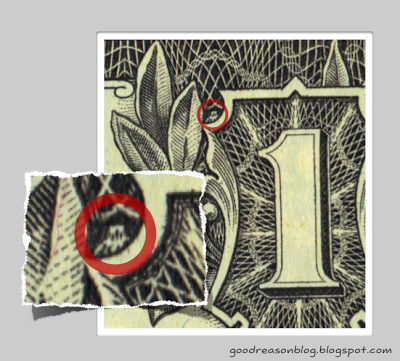
I noticed this item on Tom Ellard’s site, and I was intrigued. I happened to have a nice crisp US dollar bill in my possession, so I set my scanner to ‘insane’ setting (19200 dpi), and here’s the scan. Click to enlarge.


So… is it an owl? I don’t know. To me it looks like a place where a bunch of curlicues intersect. The ‘head’ has three holes in it, which to our human brains might look like two eyes and a nose (or beak). And maybe a couple of bumps for ears. Too bad the corresponding pattern on the other side of the bill is covered up.

What’s more interesting to me is why most people who have a web page on this topic are either loopy about Masons, Jesus, or the Illuminati. I suppose if you’re spending your nights looking for sinister symbolism in money, you’re heading for one of two options: John Birch meetings, or muttering to yourself in bus stations. Not much difference, really.

English gets its infinitieth word, right now.

Language Log has done a much more thorough beatdown of this story than I could, but it’s still worth mentioning.

English contains more words than any other other language on the planet and will add its millionth word early Wednesday, according to the Global Language Monitor, a Web site that uses a math formula to estimate how often words are created.

It is a silly claim, especially when you realise that English already has an infinite number of words right this instant. You can paint a fence, and then you can re-paint the fence, and then if you have any paint left, you can re-re-paint the fence. In fact, you can keep adding re- as many times as you like, on to infinity, and each one of those will be a separate word.

Or you can have a great-grandmother, and a great-great-grandmother, and a great-great-great-grandmother, on and on to infinity.

That’s one of the things about English morphology: it allows some prefixes to be used recursively. Recursion is why English (or any other language, pace Everett) can have an infinite number of sentences. You can walk and walk, or you can walk and and walk and walk, making the sentence longer and longer and longer, on to infinity.

Quibble about hyphens, if you like. I could argue that a hyphen, not being whitespace, does not constitute a word boundary, and thus words containing them are kosher. If you wanted to push it, you could even consider multi-word expressions as words themselves. After all, ‘ice cream’ contains a space, but it represents just one thing. It can be found variously with a space, a hyphen, or all smashed together. Your definition of ‘word’ will influence your count.

People discover things, religions don’t.

I’m going through President Obama’s Cairo speech. I’m very encouraged by his commitment to undo the misdeeds of the past administration.

As an atheist, though, I’d be remiss if I didn’t correct one point that the president brought up about Islam.

As a student of history, I also know civilization’s debt to Islam. It was Islam – at places like Al-Azhar University – that carried the light of learning through so many centuries, paving the way for Europe’s Renaissance and Enlightenment. It was innovation in Muslim communities that developed the order of algebra; our magnetic compass and tools of navigation; our mastery of pens and printing; our understanding of how disease spreads and how it can be healed.

This focus is misguided. Islam did not give the world algebra, the compass, printing, the ballpoint pen with erasable ink, or anything like them. Individuals can and do discover and invent such things; religions do not. Religions qua religions are not capable of advancing human knowledge because they are non-empirical belief systems. They get their data not from the physical world, but from supposed revelations. As such, they are no more likely to be right than random chance.

Religions may on occasion offer interesting hypotheses about the world or human behaviour, which someone might test. But then that’s science, not religion.

Religions have acted as a repressive force on human progress more often than a promoting force. The library at Alexandria was a repository of the great learning amassed up to that time. Its destruction over centuries is one of the great crimes against humanity. The responsible parties are the ravages of time, public indifference, conquering kings, and people acting under the influence of religion.

As Christians gained dominance in the region, they felt uncomfortable with pagan temples full of pagan documents. In 391 AD, Theophilus, the patriarch of Alexandria, urged a mob to destroy the temple at Serapis, presumably at the same time destroying whatever books were left in the daughter library. This was hailed as a great victory of the Christians over the pagans.

The final fire was in 645 AD, when the Moslem caliph Omar conquered Egypt. The story is that Omar was asked what to do about the books in the library, and gave the reply: “If the books agree with the Koran, they are not necessary. If they disagree, they are not desired. Therefore, destroy them.” According to tradition, the scrolls were used as fuel to provide hot water for the soldiers’ baths for six months.

The story may be bunk, but the sentiments are real. In the days of Galileo, churches tried to suppress knowledge. It didn’t work. Now they attempt to wall off their theology from scientific scrutiny (perhaps by saying that their god is ‘outside of science’), or they offer up ersatz science with fake facts to misinform.

I see human progress as the triumph of empiricism and reason over superstition. The credit belongs to the people who invented and discovered, not to the religions that for too long have stood in the way.
Problem solved!


The mice aren’t talking.

FOXP2 has (perhaps a little over-enthusiastically) been called the “speech and language gene”. It exists in non-human animals, and without it, people don’t speak well, zebra finches don’t learn or sing songs well, and mice don’t squeak very well.

FOXP2 is now in the news. A team of researchers has given a human FOXP2 gene to a mouse. (Apparently chimps were a no-go.)

Researchers at the Max Planck Institute for Evolutionary Anthropology in Leipzig, Germany, have now genetically engineered a strain of mice whose FOXP2 gene has been swapped out for the human version. Svante Paabo, in whose laboratory the mouse was engineered, promised several years ago that when the project was completed, “We will speak to the mouse.”

He did not promise that the mouse would say anything in reply, doubtless because a great many genes must have undergone evolutionary change to endow people with the faculty of language, and the new mouse was gaining only one of them.

Yep, you’re not going to get talking mice just like that. Human speech has been built up over the years from at least two important factors:

  • Cognitive horsepower. Before you can talk, you have to have something to say. Miss Perfect’s dog doesn’t need speech; it can already communicate everything in its tiny dog brain by the usual means: whimpering, plaintive dog-looks, and above all the constant and ceaseless barking barking barking. If the dog were under some selectional evolutionary pressure to communicate, it might do it some good to upgrade its hardware to include the capability for abstract symbol manipulation, which is one way to regard language. Language and brainpower have probably contributed to each other. Michael Arbib, among others, argues that the stages on the way to human language (recognition of others’ actions, gesture, and so forth) helped to increase our brainpower, which in turn helped to improve our capacity for language, and on and on until here we are.
  • Vocal tract. The human vocal tract can make a lot of distinct sounds, which is what you’d want. A good range of sounds makes it easy to have words that sound distinct from each other, which brings down the cognitive brainpower necessary to use a spoken language. The human vocal tract isn’t a straight pipe; it’s bent into an L-shape, possibly because of our bipedalism. This shape contributes to our ability to make a range of sounds.

So, to get a mouse to speak, you’re going to need to do more than add a gene here and there. There’s a lot of infrastructure to add.

But the addition of human POXP2 does some interesting things to the mice:

In a region of the brain called the basal ganglia, known in people to be involved in language, the humanized mice grew nerve cells that had a more complex structure and produced less dopamine, a chemical that transmits signals from one neuron to another. Baby mice utter ultrasonic whistles when removed from their mothers. The humanized baby mice, when isolated, made whistles that had a slightly lower pitch, among other differences, Dr. Enard says.

Dr. Gary Marcus, who studies language acquisition at New York University, said the mouse study showed lots of small effects from the human FOXP2, which fit with the view that FOXP2 plays a vital role in language, probably along with many other genes that remain to be discovered.

“People shouldn’t think of this as the one language gene but as part of broader cascade of genes,” he said. “It would have been truly spectacular if they had wound up with a talking mouse.”

Prodigious texters, those kids.

A factoid about youth and texting from this article.

American teenagers sent and received an average of 2,272 text messages per month in the fourth quarter of 2008, according to the Nielsen Company — almost 80 messages a day, more than double the average of a year earlier.

I’m ignoring the hand-wringing tone of the article — kids will be fine, and I’m glad they’re communicating to each other in writing. But is anyone else rather surprised by that rate of messages? I know I’m an old fart, but even when I was a young fart, I never communicated with friends at that rate. That’s a message every twenty minutes, day and night.

A brief typographic tour of Collins St, Melbourne.


Daylight Savings does not fail; it is failed.

I have always measured the social backwardness of an area by their acceptance or rejection of Daylight Savings (e.g. Arizona, Saskatchewan, Mali, Queensland). It was disappointing, then, that WA rejected Daylight Savings last weekend. The issue will likely stay dead for 20 years, much like the gun control debate in the USA, though with less serious consequences.

The ‘no’ vote was helped along by some of the more unsavoury and obnoxious elements of society:

Morning people. What do they care if it’s blazing light by 5 am? They’re already out for a swim!

Farmers. Eschewing the company of other humans, these folk prefer to live among plants and animals. Evidently their chief concern was that cows would feel confused.

The elderly. Almost unanimously resistant, but honestly, how long are they going to be around to live with the results of their decision? On this issue, voting should have been weighted by age.

The technically inept. Also known as ’12 O’Clock Flashers’ for their inability to set the time on their VCR’s. They just got the microwave back to normal from the last time. A large section of the population, though there is high overlap with the aforementioned groups.

How long must the daylight remain unsaved? We, the 45 percent, will soldier on.

Shopping for religions

When I left my religion of origin, it was because it didn’t live up to its hype. It claimed to be the one and only way that God had chosen to reveal his truth to humans. Then it turned out that not only was it not the Only True System, it wasn’t even a true system. Once that became clear, the choice was simple. I got out.

If you’ve left a religion, my hat’s off to you. I don’t really mind which reason was the one that got you out. And yet it seems to me that if you do the right thing for the wrong reason, there’s a very good chance you’ll end up reverting to an earlier wrong opinion.

I’m thinking about this because I’ve noticed this result from the latest Pew survey.

More than half of all Americans have switched religions at least once, according to an in-depth survey released this week.

And that may still be “a conservative estimate,” says Luis Lugo, director of the Pew Forum on Religion & Public Life.

First off, religious mobility is a good thing. If people are becoming disaffected with their current religion, at least some of the movers will give up on religion altogether, and that will boost the numbers of ‘nones’. But to me at least, the reasons people give for leaving seem a bit weak.

The reasons people give for changing their religion – or leaving religion altogether – differ widely depending on the origin and destination of the convert: 71 percent of Catholics and nearly 60 percent of Protestants who switched to another religion didn’t think their spiritual needs were being met or they just liked another faith more, or they changed their views on religious or moral beliefs.

I know religion is a commodity, but it still seems weird to me to approach religion like a shopper. Maybe that’s because Mormons are used to putting up with their faith even if they don’t like it very much or disagree with it sometimes. After all, it claims to be the Only True Et Cetera, so what are you going to do?

This could be the scientist in me talking, but it seems to me that the only valid criteria for determining your belief system is: is it true? If it’s true, you accept it, even if it’s unpalatable. But look at these folks wandering around. They escape one religion only to bounce into another one. And how will they know if it’s the right one? Because of how they feel. Or they’ll like it more. Both poor reasons to accept an idea. They’d be better off it they’d realise that ideas are true to the extent that they match up with available data from the real world. And if they did that, they’d abandon the baseless doctrines that form the basis of all religions.

Ex-Catholics seem to have the right idea though.

Catholicism has suffered the greatest net loss in the process of religious change: Those who have quit the church, 10 percent of U.S. adults, vastly outnumber incoming Catholics, 2.6 percent of adults. Two in three of Catholics who became unaffiliated and half of those who became Protestant say they left the church because they “stopped believing its teachings.”

Well done.

Capsicun: The plot thickems

I first became aware of the word ‘capsicum’ when I moved to Australia. It’s what American English speakers call a ‘green pepper’. But I recently became aware that some speakers of AusEng call it a ‘capsicun‘, with an [n] sound.

I first heard it from the young lady at the pizza place when she read my order back to me. “So you’re getting the pizza with capsicun, onions…”

I was surprised, but I pretended not to hear her, just to make sure it wasn’t a fluke. “What was that?” I asked.

“I said ‘capsican, onions…'” and so on. So it was dinkum.

Then the next week I ordered the same pizza again, and this time it was a young man who said ‘capsicun’. This kind of thing always sets the linguistic sense a-tingle. Is this happening with lots of people? Is it an age thing? Economic level? Education level? And what’s driving it?

Since then, I have found that many of my students say ‘capsicun’. Sometimes they’re surprised to discover that they say it.

As a linguist, I don’t care whether people say ‘capsicum’ with an [m] or an [n]. The two sounds are pretty similar, and speech communities sometimes swap. Miss Perfect herself says the word ‘something’ with an [n] in the middle. You probably say ‘input’ with an [m] without realising. But that’s because of a process known as assimilation, where a sound changes because of its proximity to a similar sound nearby. It’s strange for ‘capsicum’ to be changing to an [n] seemingly independent of context.

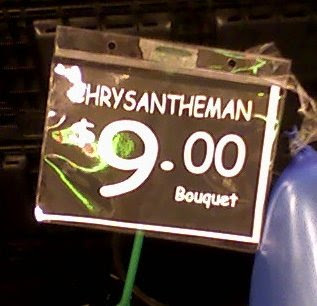
Well, yesterday, I found a tantalising clue that this might be part of a larger pattern. The flowers I got for Mothers’ Day were clearly marked ‘chrysantheman’, as seen in the photo below.

The chase continues. Further updates as warranted. In the meantime, do you say ‘capsicun’ or ‘chrysanthemun’? And where are you from? Become a data point in comments.

Older posts Newer posts

© 2026 Good Reason

Theme by Anders NorenUp ↑