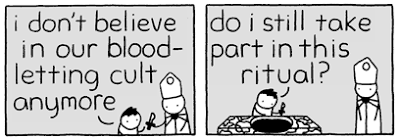
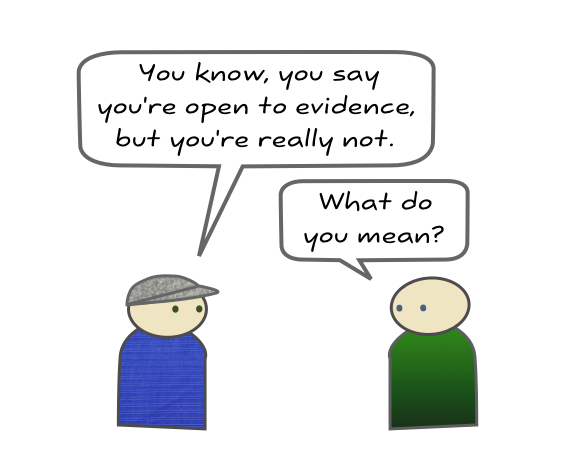
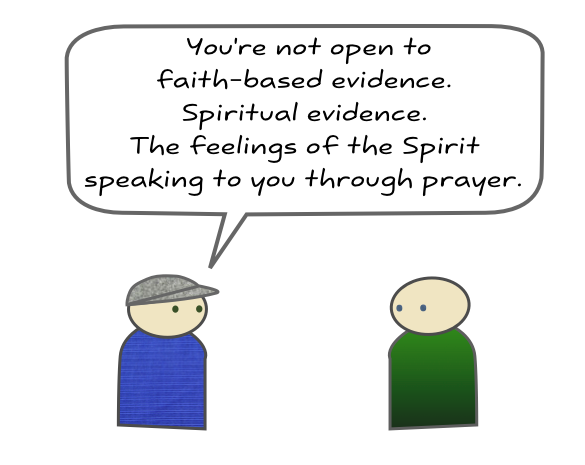
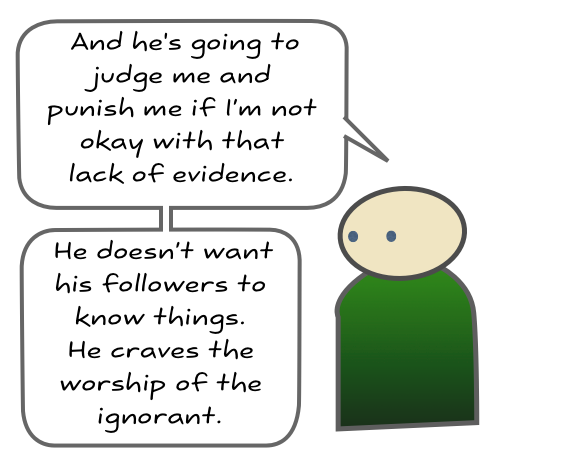
Today’s Pictures for Sad Children asks: what do you do when you no longer believe in your family’s religious tradition?
Oh, go on. You know what they say: It doesn’t matter what you believe, as long as you believe in something.
Today’s Pictures for Sad Children asks: what do you do when you no longer believe in your family’s religious tradition?
Oh, go on. You know what they say: It doesn’t matter what you believe, as long as you believe in something.
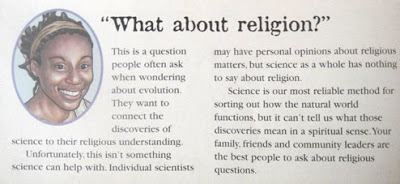
I’m reading through this book with Youngest Boy. It’s “Evolution: How We and All Living Things Came to Be” by Daniel Loxton. It’s really good. It has a good overview of evolutionary theory, with the evidence.
But there is one misstep, and it’s toward the end of the book.

If you can’t read that scan, here’s the text.
This is a question people often ask when wondering about evolution. They want to connect the discoveries of science to their religious understanding.
Unfortunately, this isn’t something science can help with. Individual scientists may have personal opinions about religious matters, but science as a whole has nothing to say about religion.
Science is our most reliable method for sorting out how the natural world functions, but it can’t tell what those discoveries mean in a spiritual sense. Your family, friends and community leaders are the best people to ask about religious questions.
I think this answer was trying to do two things: tell why science is good, and allow for the validity of religion. Those are probably good goals for a book like this, since they’re aiming for a broad audience, and the book wasn’t intended to be an atheist polemic. I can even see the benefit in not antagonising religious readers.
But I also think it’s important for scientists to tell the truth, and this answer sidesteps that responsibility. Here’s what’s wrong.
I think the book should have said something like this:
Some religious people claim that evolution didn’t happen, or that it’s impossible. But according to the evidence we have, evolution is real, and it’s happening all around us.
Many religious people do accept evolution. They don’t see a conflict between evolution and their religion, or they see evolution as part of creation.
Whether you believe in a religion or not, you can use science to figure out how our amazing world operates.
This answer re-asserts the reality of evolution and the primacy of science, but it takes it easy on the conflict between religion and science. It allows that people have their own opinions, and is written not to be offensive.
I still think the book is really good. It’s interesting, has beautiful illustrations, and lays out the basics of evolutionary theory in a way young people can grasp. Even the religion question can lead to an interesting discussion.
The author responds to the criticism here.
Has a month gone by already? I’ve got a backlog on Talk the Talk, so here’s a load of links for your enjoyment and edification.
For the first three links, I’m on about 5/6ths of the way through the stream. Watch out; it starts playing as soon as the page loads.
– – – – – – – – – – – – – – – – – – – –
23 March 2010: American English
For this episode, I report live from the USA, and fittingly I’m talking about that special dialect known as American English.

– – – – – – – – – – – – – – – – – – – –
30 March 2010: Guys
Would you call someone a ‘guy’, even if they’re a ‘gal’? What about in mixed-gender groups? A recent article in the Boston Globe is raising issues about what to call people. Is there any better way of handling this in English? And what about other languages?
This time on ‘Talk the Talk’, we return to language and gender, with a look at this most peevish of language peeves.
– – – – – – – – – – – – – – – – – – – –
6 April 2010: The Munduruku
This week on Talk the Talk, we talk about numbers. In English, we have lots of names for numbers, but the Munduruku people of the Amazon have no words for anything higher than five. Experiments show that they’re good at estimating large numbers like English speakers are, but not so good at working equations using numbers they have no words for. Is it a case of language constraining thought? Or are both being constrained by culture?
– – – – – – – – – – – – – – – – – – – –
13 April 2010: Homer-nyms
We have the Simpsons to thank for such words as “D’oh” and “embiggen”. But what else do the Simpsons have to tell us about language? On this week’s ‘Talk the Talk’, we look at neologisms and derivational morphology. But don’t worry, I do explain what all that is. I’m also pleased to say that I managed to restrain my urge to overdo the Homer impersonation.
This link seems to be different. They’ve made Talk the Talk downloadable, so now you can take it on your listening device of choice.
– – – – – – – – – – – – – – – – – – – –
That’s a lot of Talk the Talk to listen to, so don’t overdo it.
For next week’s show, we’re taking your questions, so be sure to email your language questions to talks@rtrfm.com.au, and I might pick it for next time.
Michael R. Ash is an LDS apologist, which is kind of like being a scholar, except that instead of making knowledge, you make excuses. His latest article at the Mormon Times tackles the DNA issue.
The DNA issue is a problem. The Book of Mormon purports to be the story of people of Hebrew ancestry (sometimes called ‘Lehites’) who traveled to the Americas. We should expect a healthy percentage of their descendants to have DNA that corresponds to that of a Hebrew population. But DNA studies have shown fairly conclusively that people in this region test up Asian. At this point, it would be reasonable to conclude that the Book of Mormon represents a failed hypothesis. But this is very difficult for True Believers to do without saying ‘yes, but’ and ‘what if’. Many would rather listen to LDS apologists like Ash, who sing the faithful back to sleep, and delay the advance of knowledge. Let’s see what he’s come up with this time.
As noted in an earlier column, I believe the scientific world is part of God’s truth. Therefore, I not only accept the current DNA studies as accurate, I also don’t believe God simply changed Nephite and Lamanite DNA to Asiatic DNA in order to fool scientists. While God certainly has power over all things, I can’t accept that he intentionally deceives us.
I’d like to give Ash props on this, but I can’t. True, he gets the little things right, but his actual commitment to science is paper-thin, ready to be discarded in favour of far-fetched scenarios when it comes down to it. I could say he has a form of science-ness, but he denies the power thereof. I would rather he were hot or cold.
Ash (along with other apologists) argues that it’s not possible to find Lehite DNA because…
We don’t know what “Israelite” DNA from Lehi’s time looks like. We have a general idea of what the DNA of modern Middle-Eastern populations looks like, and we know that as of today it has not been detected among Native Americans, but because we don’t know anything about the DNA of Lehi’s party, we can’t exclude that it could fit among the multiple Asiatic markers we find in modern Native Americans.
I’m not a geneticist. (Although, neither is Ash.) But from my reading, this claim seems untrue. This work has been done, and Native Americans and Hebrews appear to have very little mtDNA in common.
If it’s so difficult to track DNA, then why are geneticists able to do it for other groups? I ran across this description of the Lemba, an African group that claims to have split off from the main body of Israelites, and who in fact do carry the Cohen modal haplotype, a marker of Hebrew origin. If it’s possible to track this group after so long (and on the Y-chromosome, no less), why not the descendants of the Lehites?
Ash again.
DNA markers can disappear. According to virtually all scientists who specialize in DNA as it pertains to population genetics, when small populations mix with large populations there is a significant possibility of losing the DNA signatures of the smaller population.
Genetic bottlenecks, for instance, occur when a significant portion of a population does not reproduce or doesn’t pass mtDNA on to its progeny. If the original Nephites and Lamanites had mostly sons rather than daughters, for example, those sons would have married native women and the mother’s DNA — not Lehi’s wife Sariah’s DNA — would have passed on to the children.
This is a big leap. In order for Ash’s argument to hold, the Lehite women would have to have had no babies. Or babies, but no girls. Usually, the proportion of boys to girls will be about 50:50 for good-sized populations. How come no girls in this case? Were the Lehites into female infanticide? Or were the Lehite girls just not very popular? Are we to assume that none of the maternal Lehite line got through?
Ash’s scenario is incredibly improbable, but it gets worse. For Ash to be right, the same bottleneck would have to have happened twice, once with the much-earlier Mulekites, and again with the Lehites.
So once again, it’s the Incredible Vanishing Hebrews Who Leave No Artifacts. At some point you have to ask yourself: What’s more likely – that an incredibly improbable genetic bottleneck happened twice (and it conveniently coincides with the framework of speculations that Ash promotes elsewhere) — or that someone wrote a fake book?
Wait: I’ve just had a revelation. I’ve just figured out why Lehites left no DNA.
Lehi and Sariah were actually Native Americans. They traveled by boat to get to the Middle East, like Thor Heyerdahl in reverse. That could explain how they were able to navigate the trip back to the Americas so easily. In fact, since so many people from the Book of Mormon were cruising over to the New World, it must have been a piece of cake in either direction. I’m sure that when we finally get those large plates of Nephi, Lehi’s genealogy will turn out just like I say. After all, my evidence is just as solid as anything Ash has written.
Normal people don’t like playing Scrabble with me.
I have all the two-letter words memorised, I’m not bad with my three-letter hooks, and I always have a copy of the OSPD handy during a game. I also have a habit of laying tiles next to other tiles in a tight little bolus, which has the unfortunate effect of locking down the board so tightly that it can’t breathe. But I admit it’s a really unpleasant habit.
The other unpleasant habit I have is making up new words and placing them with confidence. I sometimes have to add, “It’s a word. I am a linguist, you know.”
Sometimes an opponent will complain about the words I use.
“Za? What’s za?” is how it typically begins.
“It’s short for ‘pizza’,” I explain.
“That’s stupid. ‘Za’ isn’t a word, and neither is ‘aa’, which you said was a kind of lava. I’m not going to play if you’re going to use dumb words.”
At this point I calmly remind my friend that we agreed on the OSPD.
“That’s dumb. Who said that those words should be in the OSPD?” says he or she, but usually she.
At this point I give the Every Lexicographer Has to Make Some Tough Choices speech, in my patient linguist voice. It usually doesn’t help, and there is much grumbling.
I tend to resist changes to Scrabble. I was against adding ‘qi’ to the Fourth Edition. I thought it made it too easy to unload the Q. Eventually I got used to it.
But now Mattel has gone too far.
The rules of word game Scrabble are being changed for the first time in its history to allow the use of proper nouns, games company Mattel has said.
Place names, people’s names and company names or brands will now count.
Mattel, which brings out a new version of the game containing amended rules in July, hopes the change will encourage younger people to play.
What, any proper noun? Xerox? Zovirax? Qwyjibo?
This doesn’t seem well-thought out. How can you check if a proper noun is unacceptable?
Mattel said there would be no hard and fast rule over whether a proper noun was correct or not.
I think I’m going to be kicking it Old School on this one. No proper nouns at my place. Or foreign words, abbreviations, or usu. cap.






I love how Catholic leaders are being forced to deal with the so-called New Atheism in public nowadays. But they’re going overboard. Usually we’re just accused of being mean to people. Now Archbishop Anthony Fisher is saddling us with the collective baggage of the 20th century. It’s not a new tactic, but one would think a Catholic archbishop would be a mite careful about criticising another philosophy for rotten things done in its name. Sadly, irony doesn’t seem to be his strong point.
GODLESSNESS and secularism led to Nazism, Stalinism, mass murder and abortion, according to Anthony Fisher, the new Archbishop of Parramatta, who has used his inaugural Easter message to launch a scathing attack on atheism, while ignoring the sex abuse scandals besieging the Catholic Church worldwide.
It’s a bit rich for a Catholic archbishop to be claiming Nazism is a consequence of atheism. Hitler was a Catholic, and was never excommunicated. The failure of Pope Pius XII to act during the Holocaust is a modern tragedy, and it’s telling that the current pope has venerated him, a step on the road to sainthood.

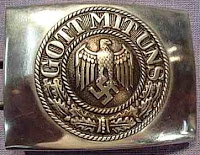
How anyone can claim Hitler was an atheist is beyond me. He said in speeches that he felt he was doing God’s work. Maybe Hitler didn’t believe it. Maybe he was hypocritically mouthing religious platitudes to get people to agree with him. All the more reason to be suspicious of politicians who claim to be religious. But Hitler did claim to be on the side of the Big Guy. Check out the belt buckle for one example. If your German is as rusty as mine, here’s a hint: “Gott Mit Uns” does not mean “We have gloves on”.
That’s Hitler. But what about Stalin and Pol Pot, and the terrible things they did in the name of atheism? Oh, that’s right, they didn’t do those things in the name of atheism. They did them in the name of Communism and the Khmer Rouge. Though they were atheists, the atrocities they committed were done to further their political goals, not to promote atheism.
I’m not trying to say that atheists can’t do rotten things. Anyone can when they’re in the grip of an absolutist philosophy, whether religious or political. But name me anyone who’s killed people or started a war to promote secular rationalism. No one does. It just isn’t in our line.
For the record, I don’t blame Catholicism or Christianity for mass murder either (except in those cases where an ideological link can be made). People seem to pick up these ideologies and use them for their own ends, and it’s a shame. Someday maybe someone will shoot up a high school and claim it was for atheism. It never seems to happen — violent ideologies seem to be religion-based more often than not — but it might someday. If it does, I’ll say the same thing I’m saying today: inflexible ideologies in the hands of unbalanced people are a problem. But that doesn’t describe your average New Atheist, who usually just wants to talk about secular issues (often at a pub), and who doesn’t believe in supernatural beings without adequate evidence.
At least Fisher didn’t accuse atheists of systematic child sex abuse. That would have been a giveaway.
UPDATE: Atheists hit back.
The Atheist Foundation of Australia said on Friday Dr Jensen’s claims were “preposterous” and condemned Christianity for a spate of child sex abuse scandals.
“He seeks out a scapegoat and attacks atheism without any understanding of what he is saying,” foundation president David Nicholls said.
“To state we hate his god or are attacking his god is nonsense.
“How does one hate or attack that which does not exist?”
Eight hundred posts. How do I come up with so many things to write about?
Practice.
I practice by glowering angrily in the mirror, denouncing random objects while hanging laundry, a few push-ups, and then typing random characters to see if they spell anything interesting.
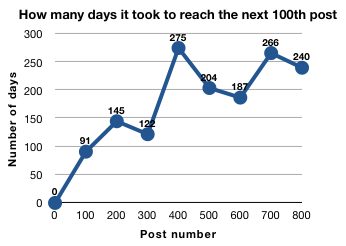
Here are some stats regarding my posting.
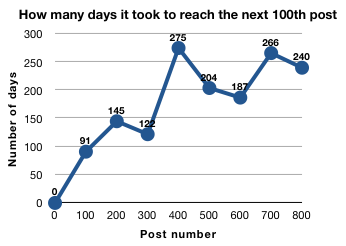
Anyway, feel free to say anything you’d like in comments. That’s what we do around here for every hundredth post.
© 2026 Good Reason
Theme by Anders Noren — Up ↑










Recent Comments