


Certain pragmatic jobs in language seem so human that we feel like computers could never begin to approach them. Recognising sarcasm is one of these. How could you get a computer to recognise that a speaker is intending the opposite of what their words are saying, particularly if it’s very subtle?
Well, a paper presented at AAAI last week gives details of a project in sarcasm detection. And they didn’t even use tone of voice as a feature — they just used the text from reviews at Amazon.com.
Of course, words aren’t enough when you’re recognising sarcasm. We also need real-world knowledge, and an idea of what words to expect in a situation. Let’s say the dentist tells Fred he needs a root canal, and Fred says, “Great.” We know it’s sarcasm because we know that root canals aren’t very fun, and Fred isn’t likely to look forward to it.
We can’t tell that to computers (although some have tried), but we can use other information. For this project, they used the number of stars in the Amazon review. If it was a poor review (one to three stars), the appearance of words like ‘great’ are likely to be used sarcastically, especially if the word “can’t” appears first.
This is what I love about Computational Linguistics. We can get a start on even the hardest problems with a well-crafted experiment. The meaning is already there in the words we use. All we need is that little bit of extra information to tell the system that something extra is happening.
Via Pharyngula and Podblack:
The State Library is hosting an anti-vaccination event tonight, 1 June 2010 with Meryl Dorey of the so-called ‘Australian Vaccination Network’. They’ll be promoting their noxious brand of pseudoscience. Alt-Med is always a problem, but in this case, the stakes are higher. They tell worried parents that they’ll be harming their children by vaccinating them, when in fact the risk of death and disability from disease is much higher without vaccination than with. So more WA kids are going to die as herd immunity diminishes.
Your orders: meet Kylie (along with me and the Perth Skeptics) at the coffee shop at the State Library at 6:00 tonight. Let’s spread some good information.
A good source for info is the Immunise Australia Program.
A quick TED talk by Graham Hill, founder of Treehugger.com. He has an innovative solution for people who want to go veg, but maybe aren’t ready to make the jump.
Text, for the non-video-watchers.
I realised that what I was being pitched was a binary solution. It was either: you’re a meat eater, or you’re a vegetarian. And I guess I just wasn’t quite ready. Imagine your last hamburger.
So my common sense, my good intentions were in conflict with my tastebuds. And I’d commit to doing it “later”. And not surprisingly, later never came. Sound familiar?
So I wondered: might there be a third solution? I thought about it, and I came up with one, and I’ve been doing it for the last year, and it’s great. It’s called Weekday Veg.
The name says it all. Nothing with a face, Monday to Friday. On the weekend, your choice. Simple!
Sounds like a good idea.
You know, I’ve been doing this for years, but with punching people. On weekdays, I refrain from punching people. Nothing with a face. Or in the face. On the weekends, my choice. (I confess I do go a bit nuts on the weekend.)
I’ve always known that it’s better for people’s faces and gonads if I didn’t punch anyone at all. I always told myself I’d stop leaving random strangers languishing in a pool of blood or leaving a trail of broken noses — ‘later’. But I figure: being a weekday non-puncher is something I can do. Surely cutting down on the pummeling is better than nothing.
Next week’s Talk the Talk topic comes to us from the pages of New Scientist.
Many linguists are interested in the similarities between languages. Noam Chomsky once claimed that if a Martian visited Earth and looked at all the human languages, they’d be impressed not by the diversity, but by how similar all human languages are. (Falsify that claim.)
Linguists in the Chomskyan mold have postulated the existence of a Universal Grammar — a set of structural principles that undergird human language. It’s an appealing idea — not least because it could explain how children learn language so quickly, from nada to full sentences in about two or three years. Why so fast? The UG is already in there at birth, and kids will pick up the individual quirks of their native language as they go.
The New Scientist article (PDF) highlights the work of linguists who take a different view. For example, Chomsky felt that recursion was one of the fundamental properties of human language. You can repeat elements of English syntax in certain ways: “My mother’s doctor’s boyfriend’s cat.” No non-human animal communication system has this, and every human language has it.
Except Pirahã. Dan Everett, who’s worked among these Amazonian people for years, says there’s no recursion in Pirahã. You can’t say “My brother’s house”. You have to say “I have a brother. My brother has a house.” And so it goes; the more languages we know about, the more we find that violate these seemingly inviolable constraints.
Is the theory of Universal Grammar falling apart? If language isn’t innate in our human brains, then how do we do it? On the next Talk the Talk.
Last week saw the passing of Martin Gardner, a mathematician, skeptic, and puzzle master.
I first became aware of his work when I was just a wee lad, probably about nine. I ran across an article he wrote about ‘Hexapawn’, a game he invented. Hexapawn uses only six pawns, on a 3 x 3 board, like so.
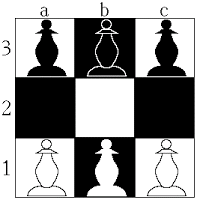
You can move like a pawn in chess: straight ahead, or diagonal to capture. You win either by getting to the last rank, by capturing all the other player’s pieces, or blocking the other player so they can’t move.
The article showed diagrams of all the possible moves in the game, in the form of pictures like this one.
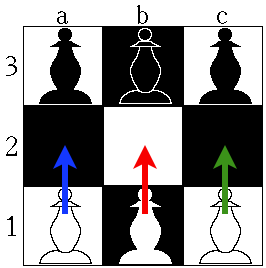
You were meant to print these out, paste the pictures onto matchboxes, and put coloured beads in the matchboxes. When you’d done this, what you had was a kind of computer. You’d make your move, look at the board, choose the matchbox that matched the current state of the board, shake up the matchbox, and the colour bead you pulled out was the move the computer would make. If that move made the computer lose, you would remove that bead so the computer couldn’t make that move anymore.
Eventually, once all the losing moves were pruned out of the system, you’d have an unbeatable Hexapawn machine. This was my introduction to machine learning and AI. What an eye-opener! I realised that unthinking boxes (or computer chips, or what have you) could learn things without people explicitly teaching them.
(Here’s an implementation of Hexapawn as a PDF.)
Later, I found a book called “Mathematical Puzzles of Sam Loyd“, which Gardner edited. I spent hours poring over Loyd’s puzzles, and Gardner’s explanations. Later I picked up Gardner’s “My Best Mathematical and Logic Puzzles“.
Gardner was a skeptic, but he believed in a god. Here’s a bit from an interview with Michael Shermer in 1997.
Skeptic: Inevitably skepticism leads to asking the God question. You call yourself a fideist.
Gardner: I call myself a philosophical theist, or sometimes a fideist, who believes something on the basis of emotional reasons rather than intellectual reasons.
Skeptic: This will surely strike readers as something of a paradox for a man who is so skeptical about so many things.
Gardner: People think that if you don’t believe Uri Geller can bend spoons then you must be an atheist. But I think these are two different things. I call myself a philosophical theist in the tradition of Kant, Charles Peirce, William James, and especially Miguel Unamuno, one of my favorite philosophers. As a fideist I don’t think there are any arguments that prove the existence of God or the immortality of the soul. Even more than that, I agree with Unamuno that the atheists have the better arguments. So it is a case of quixotic emotional belief that is really against the evidence and against the odds. The classic essay in defense of fideism is William James’ The Will to Believe. James’ argument, in essence, is that if you have strong emotional reasons for a metaphysical belief, and it is not strongly contradicted by science or logical reasons, then you have a right to make a leap of faith if it provides sufficient satisfaction.
It makes the atheists furious when you take this position because they can no more argue with you than they can argue over whether you like the taste of beer or not. To me it is entirely an emotional thing.
This is strange to me, but it’s not the first time I’ve seen a good reasoner suspend critical thinking in favour of supernaturalism. And emotional reasoning is a terrible rationale — it’s like saying ‘I’m going to believe it if it makes me feel satisfied.’ Oh, well, good for you. This is epistemological hedonism.
And it gets the reasoning backward. Gardner argued that you could believe what you liked if it wasn’t strongly contradicted by evidence, but we’ve already seen that when someone’s in the grip of a belief, no evidence is ever strong enough. Science works the opposite way: you believe something when there’s evidence to support it.
On the other hand, Gardner sounds like someone who’s done the reading (unlike me) and knows his way around the philosophy. He’s aware that his position is reaching out into the unknown, and even though he chooses to believe, he knows that he doesn’t know.
Martin Gardner must have been a fascinating guy, exerting an influence on mathematics, skepticism, and philosophy. I’m glad I’ve had the chance to benefit from his work.
Ran across this quote as a Facebook status update.
Without God, life would end at the grave and our mortal experiences would have no purpose. Growth and progress would be temporary, accomplishment without value, challenges without meaning.
In other words: There must be a god. If there weren’t, it would be depressing, and depressing things just can’t be true!
Not much of an argument, is it? But you can see the self-congratulatory appeal. It tells the believer: ‘You’re not wasting your time believing. Your belief gives your life a purpose.’ Well, I suppose the author’s church gives him a purpose. Maybe he actually means that his life would be meaningless without the god that he’s based all his hopes and aspirations on.
It also lets him pity atheists — oh, how empty their lives must seem!
Well, he can save his pity. Life without gods is still full of value and meaning, even if it doesn’t last forever. In fact, I find life more precious because of its brief duration.
I’m thinking of Babette’s Feast, a wondrous film that I first saw at BYU. (I wonder if it’s still a favourite on the International Films list.) Babette, a French chef, is a long-time resident of a village full of dour Lutherans. When she announces that she’s making a feast for her friends, it sends them into turmoil — how can they enjoy the feast while renouncing the pleasures of the flesh? Maybe it’s the age I am now, but as a BYU student with false assurances of a future eternity, I thought, “What a neat film.” Now when I think of it, and of our brief time to feast, I am moved to tears. I feel that coming to accept mortality and non-existence has deepened my emotions in way that was impossible when I thought life would go forever.
Is growth and progress temporary — and therefore meaningless — if we die and cease to exist? For the individual, perhaps, but there’s more than just us, you know. There’s also humanity. The great things that people have made and left behind continue to benefit all of us. How short-sighted to claim it’s all pointless if he’s not around to have it forever. How self-centered. How this view devalues life. What paucity of imagination. What meanness of spirit.
There’s more. The author continues:
There would be no ultimate right and wrong and no moral responsibility to care for one another as fellow children of God.
Ultimate right and wrong? Says someone whose barbaric holy books need constant reinterpretation and explanation to bear any resemblance to the morality held by normal people today.
And as far as moral responsibility, if he needs to believe in an invisible man to care about other humans, then I hope he never stops believing. Luckily, we atheists can take care of people we love and contribute to the good of humanity without all the supernatural baggage.
I wonder if the author of this quote would be disappointed to find that atheists aren’t all miserable and depressed. We have the temerity to be happy in this life. And how confusing it must be to see us taking care of other people without an ‘absolute morality’. I think I’ll confuse him even more by dropping a few coins into ‘Non-Believers Giving Aid‘. Figure that one out, God-Boy.
I’m going to start a new tradition for Good Reason readers. As I find the topic for next week’s ‘Talk the Talk’, I’ll post it here, and you can listen for it later on the RTRFM page, if you want to. You’ll probably know something I don’t about this or that topic, so comment away.
For next week, I’m curious about ‘cougars’. Sex & The City star Kim Cattrall just turned down a magazine cover because she would have been asked to pose with a real live cougar.
The actress insists she had nothing against the big cat but doesn’t like the term ‘cougar’ when it’s used to describe an older woman who likes dating much younger men.
She tells U.S. news show Extra, “I was asked recently by a significant magazine for women over 40 to pose with a cougar and I refused to do it because I felt it was insulting and they took away the cover.
“I think that ‘cougar’ has a negative connotation and I don’t see anything negative about… sexuality.”
Do you think ‘cougar’ has a negative connotation? When I hear it, I think ‘aggressively sexy’, two appealing qualities to my view. But I’m not the one being referred to. Anyone else care to comment?
I’ll also be talking about other animal names used to describe people’s sexual categories. If you’re over 40, you’ll remember the days when an attractive girl was a ‘fox’. And we all know about ‘bears‘ — big furry gay guys — but what do you call slightly smaller furry gay guys? Otters, apparently. What other animal terms am I missing?
You can like ‘Talk the Talk’ on Facebook, you know. Just hit the fan page.
God is at it again.
Man tells cops God told him to stroll in the nude
THIBODAUX, La. — A man who told police that God told him to walk the streets naked to save his soul has been arrested. Thibodaux police responded to an obscenity complaint around 2 a.m. Thursday and found Shafiq Mohamed walking nude down the street. When approached, Mohamed reportedly told officers that “America raped him” and added God told him to walk the streets naked to save his soul.
Obscenity complaint? They should have written him into the Old Testament. Haven’t they heard of Isaiah? God told him to walk around naked for three years.
20:2 At the same time spake the LORD by Isaiah the son of Amoz, saying, Go and loose the sackcloth from off thy loins, and put off thy shoe from thy foot. And he did so, walking naked and barefoot.
20:3 And the LORD said, Like as my servant Isaiah hath walked naked and barefoot three years for a sign and wonder upon Egypt and upon Ethiopia;
20:4 So shall the king of Assyria lead away the Egyptians prisoners, and the Ethiopians captives, young and old, naked and barefoot, even with their buttocks uncovered, to the shame of Egypt.
The cops don’t recognise a literary allusion when they see it. Only one thing to do: teach the bible in schools.
UPDATE: More on Mohammed.
Here’s the pictorial Mohammed archive: Mohammed as depicted by Muslims
And an interesting article by Marlon Mohammed: Why I Will Draw Mohammed.
In the UK, each capitulation has been followed by another demand for yet another capitulation. By giving in to Muslim “sensitivity” demands, even at the expense of their own ancient culture, the Brits (and the other European nations) have only encouraged more demands.
At fault here is not Islamic extremism per se. It’s human nature. It is a basic element of our species to take when we see the opportunity to take, to demand more if we think we can get more. As children, we learn to test our parents and relatives. “Who lets me have the most cake? Daddy or mommy? Grandma or grandpa? Who will give in if I ask for one more piece?”
That’s why all good parents know the value of saying “no.”
Today I said “no”.
© 2026 Good Reason
Theme by Anders Noren — Up ↑
Recent Comments