Good Reason

It's okay to be wrong. It's not okay to stay wrong.

Category: post (page 37 of 125)

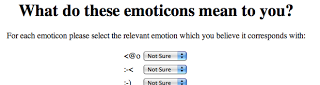
Emoticon test

Here’s a survey about emoticons that you can take. I recognised some, but others I had to guess.

I like to see what other linguists are doing, and it’s fun to guess what the work is intended for. I’d say this work is part of sentiment analysis: working out automatically how a writer is feeling about what they’re writing. Or tweeting.

So help a fellow linguist out and take the test. It’s quick, and sort of fun.

What’s it going to take?

Boyd K. Packer takes another opportunity to deride gay relationships as ‘Satanic’, ‘wrong’, ‘wicked’, ‘impure’, ‘unnatural’, ‘not worthy’, ‘immoral’, ‘basically wrong’, and ‘evil’.

In part:

We teach a standard of moral conduct that will protect us from Satan’s many substitutes and counterfeits for marriage. We must understand that any persuasion to enter into any relationship that is not in harmony with the principles of the Gospel must be wrong. In the Book of Mormon we learn that “wickedness never was happiness.” Some suppose that they were “pre-set” and cannot overcome what they feel are inborn tendencies toward the impure and the unnatural. Not so. Why would our Heavenly Father do that to anyone? Remember, He is our Father.

O what an objectionable old man. Too bad he isn’t just someone’s embarrassing elderly uncle. There are millions of LDS faithful who believe him reflexively, and will help him to legislate for his private prejudices.

This isn’t a one-off, by the way. Boyd Packer was saying this stuff back in the 90s.

There are three areas where members of the Church, influenced by social and political unrest, are being caught up and led away. I chose these three because they have made major invasions into the membership of the Church. In each, the temptation is for us to turn about and face the wrong way, and it is hard to resist, for doing it seems so reasonable and right.

The dangers I speak of come from the gay-lesbian movement, the feminist movement (both of which are relatively new), and the ever-present challenge from the so-called scholars or intellectuals.

I knew he was saying these things back then, and I disagreed with it. But I didn’t see it for what it was. I thought it was an inspired leader giving his own misguided opinion. I figured that in a few years, this kind of rhetoric would work its way out of the system, and give way to a more enlightened mindset. A more liberal, tolerant mindset. A mindset more like the one held by… wonderful enlightened me! (More than once, I threw out a shoulder patting myself on the back during those times.)

What I didn’t realise was that I was a very slim minority in a very conservative church. I felt like I was holding down the liberal fort, but the rest of the church was continually working on goals I didn’t like. The leaders were actively working to undermine values I prized. They were fighting against the validity of gay relationships in Hawaii. They’d fought against equal rights for men and women. Before that, they’d fought against equality for people of African descent (but I was rather younger then). Each time, I and the other liberal Mormons I knew were bothered by it, to be sure. But then we all hit the spiritual snooze button and refused to wake up. I stayed in a church that despised members like me. I didn’t leave. And this haunts me now.

Why wasn’t overt institutional prejudice enough for me to quit? What would it have taken for me to realise that this church was committed at its core to inequality? Well, I believed in the church, had a testimony, and I thought these policy stances, though objectionable, were temporary, and would change in course of time. I think it might be the same dynamic that keeps people in abusive relationships. You keep getting hurt, but you make excuses, tell yourself it’s not that bad. And you stay for the next round.

If you’re a committed Mormon, and you have no trouble with prejudice, then you’ll do fine in the church. Keep it up. I’m not writing this for you.

But if you’re a Mormon who’s feeling a bit alienated and unsure about this latest Packerism, consider that this is just another piece of evidence for the LDS Church’s all-too-human origins. Its policies and practices reflect the thoughts and prejudices of its leadership and its membership at the time. And even if you don’t share these prejudices, remember that as long as you’re a member, they do what they do in your name. You are donating your time, money, and numbers to an organisation that is actively working to undermine your values.

If you decide to stay in, like I did all those years, I understand. But I can also tell you that it’s good to wake up and live a life that’s more free of internal conflict. The LDS Church has their issues that they’re dealing with. You don’t need them to drag you down. Your values are better.

Get off Emma Thompson’s lawn!

So I notice this article about actor Emma Thompson:

Emma Thompson says youngsters’ poor language drive her ‘insane’

And I think: Uh-oh. We may have found the precise moment at which Emma Thompson turned ‘old’. Because there’s no better marker of advanced age than when you start complaining about the language use of younger people.

“We have to reinvest, I think, in the idea of articulacy as a form of personal human freedom and power. I went to give a talk at my old school and the girls were all doing their ‘likes’ and ‘innits?’ and ‘it ain’ts’, which drives me insane. I told them, just don’t do it. Because it makes you sound stupid and you’re not stupid,” the Telegraph quoted her as telling Radio Times.

Sounds like another prescriptivist rant.

But then, because she’s a smart person, she says something smart.

“There is the necessity to have two languages – one that you use with your mates and the other that you need in any official capacity. Or you’re going to sound like a knob,” she added.

Ah, now that puts things in a different light. We can command different styles of talking, and we can switch depending on who we’re talking to. And I myself worry when a young person either doesn’t know how to use a higher register or doesn’t know when to switch into one. So that’s quite on.

But Emma Thompson is still being an old fart because
1) she’s annoyed, so everyone else has to change?
2) complaining about language is something old farts do.

Atheists know more about religion

Try your hand at the latest Pew Forum poll. This was designed to test religious knowledge, and most Americans flunked.

On average, people who took the survey answered half the questions incorrectly, and many flubbed even questions about their own faith.

Those who scored the highest were atheists and agnostics, as well as two religious minorities: Jews and Mormons. The results were the same even after the researchers controlled for factors like age and racial differences.

So Mormons did almost as well as atheists? That makes sense. I knew a bit about religion as a Mormon. Then when I learned a little bit more, I became an atheist.

Oh, and in fairness, I did score 15 out of 15 on the poll, but the last question was a 50/50 lucky guess.

The Medium Challenge

Many thanks to everyone who has responded to the news of my mother’s death. I’ve appreciated everyone’s comments, and I was especially intrigued by this one from a long-time commenter.

I would love you to meet my good friend, I’ve spoken of her before, the clairvoyant one.

I would like you to test her objectively, with your atheistic views intact. Ask her to get in touch with your mother.

I should add (for the religious minded amongst your readers) she is a pure Catholic – purest of pure hearts. And I should also add I am almost an expert on the biblical views on visionaries, prophets, and the like. So no-one can argue badly against her without my intervention!

She is likely to get some wisdom and advice from your mother – you can test it for yourself.

I’m challenging you to a duel of sorts, on belief.

Now, I don’t think spirits exist, since no one’s yet presented evidence for them. And the idea of having a medium contact dead relatives is silly. If my Mom’s going to go to the trouble of crossing boundaries of time, space, and matter to give me a message, then I think she’d come to me, and not someone who has to fish around for information, saying “I’m getting the colour red; what does that mean to you?”

I don’t like what psychics and mediums do. I think they’re either fooling themselves into thinking they can communicate with spirits, or they’re vultures, preying on the grief and desperation of the bereaved. Their techniques are well-known — cold reading is something that you can learn to do. You throw out a lot of suggestions, wait for the subject to feed you information, take credit for the hits, and hope they forget all the misses.

In short, I’m with this guy.

It’s the whole problem of rigour. Going to a medium wouldn’t be a good test for me, since I’m as capable of fooling myself as anyone else. (And maudlin emotionalism, too. After Dad died, I cried watching Blades of Glory, for Pete’s sake. On a plane! It doesn’t take much when you’re in a state.)

With all that in mind, I think the Medium Challenge is a great idea. Even though I don’t believe in spirits and psychic phenomena, I could be wrong, and if we don’t do the experiment, we won’t learn anything new. So I’d like to run the experiment. But it’s going to be a controlled experiment. I want to get not one, but three clairvoyants, psychics, mediums, what have you. As a control, I’ll also need three non-mediums — people who don’t believe in psychic power or readings — doing their best at their own readings.

To make sure I’m not feeding the mediums information, some tight controls will have to be in place. I will be obscured from view by a screen, so the readers won’t be able to read my actions. (It should be all the same to the spirits.) I will only respond to direct questions, and I will only say “yes” and “no”. Other than that, I’ll be very helpful, truthful, and accommodating. The test will be whether the mediums are able to get hits with any greater frequency than the non-mediums, or random chance.

I’d like to video this and turn it into a programme — YouTube at the least, possibly more. Full recordings of all the sessions will be made available via the Internet. And — this is important to me — I’ll be publishing the results no matter what they are, even if they run counter to my current belief. (Or those of the psychics.)

The test needs to be blind, so I won’t know who the mediums or non-mediums are. For this reason, Maureen has kindly agreed to assist in lining up the readings for various nights in November or thereabouts. So if you would like to volunteer as a medium or a non-medium (you-know-who, your friend has priority), please contact her at mediumchallenge@gmail.com.

I still need to work out the particulars of the experiment, so watch this space for the full list of rules and conditions here in comments.

Ketchup and tomato sauce: Australians fret over lexical shift

Is there a difference between ‘tomato sauce’ and ‘ketchup’?

When I first arrived in Australia 70 years ago, all you could get was tomato sauce. Ketchup wasn’t available. Never mind, I thought, it’s the same stuff, that’s just what they call it here.

Then I noticed that my local supermarket began to carry both ketchup and tomato sauce. Obeying some primal American instinct, I always buy ketchup. But I feel rather silly, since there’s no difference. Or is there? Tomato sauce: thinner, less spicy? Ketchup: more vinegar?

For some people, it matters.

The term “tomato sauce” could be lost to future Aussies with Heinz, for the first time, advertising ketchup on TV.

In a move Dick Smith labelled “disrespectful” to the Australian culture, Heinz has unveiled a new national ad for Tomato Ketchup, which they say is thicker and has spices and more tomatoes than tomato sauce. “They don’t give a stuff about Australian culture or our way of life,” Mr Smith said.

Who knew the Australian way of life was less spicy, with fewer tomatoes?

Channel 9 star Scott Camm said the term tomato sauce would be lost to future generations.

“What, are we gonna start walking down the sidewalk?” he said.

“They’re infiltrating us – it’s not our way of life.”

It isn’t really about sauce. It’s about language attitudes. Australians like the way they talk, and they don’t like the thought of losing expressions like ‘footpath’, ‘giving a stuff’, or saying ‘zed’ for ‘zee’. Mind you, this is a pretty strange place to draw the line. Other far more iconic expressions have dwindled with nary a peep. (When was the last time you called someone a ‘cobber‘, honestly?) But maybe this item is extra sensitive because it’s being framed as a foreign corporation dictating language change by fiat.

So even if there’s no difference in the actual sauce, there’s a difference in the words. ‘Tomato sauce’ is fair dinkum Aussie, while ‘ketchup’ is an American intrusion to be resisted. Will this become a selling point? We’ll just have to see which way the chips fall.

– – – – – – – – – – – – – –

UPDATE: The ad.

Stephen Hawking on the afterlife

“I regard the afterlife as a fairy story for people that are afraid of the dark.”

I used to be afraid of the dark, too. Then I grew up. Now, having grown up, I don’t find this fear admirable in others, or worthy of respect.

Talking to Americans

Shared parenting is optimal

Nice to see this article about a successful co-parenting situation.

SEAN BROGAN is ”enormously proud” of what he and his ex-wife, Ayela Thilo, have achieved for their family.

Divorced for nine years, they share custody of their three children, Arielle, 17, Sienna, 13, and Oliver, 11, in a ”week on week off” arrangement.

Mr Brogan agreed with the findings of the Shared Care Parenting Arrangements study that shared custody is positive for both parental satisfaction and children’s wellbeing.

”In a funny kind of way it has given the kids a sense of stability,” he said. ”They know where they’ll be at any given time, if they’ve got something coming up they see whether they’ll be with mum or dad and talk to that person about it.”

The arrangement has also improved his relationship with Ms Thilo by increasing co-operation and joint decision-making.

”We were determined to make it work for the children,” he said. ”It has certainly healed any rift we might have had. We talk regularly, we talk about school things. Another upside is that it allows the non-custodial parent time out in their week off and time to do all the things they want to pursue.”

It’s in the news because of a recent report evaluating shared care arrangements since 2006 (PDF). At that time, a new emphasis was placed on shared parenting arrangements, rather than custody.

Among the findings of the study:

This research confirms that children‘s wellbeing is optimised under certain circumstances:

  • Parents are able to cooperate about the arrangements for the children
  • Parents have a say in making decisions about the child
  • There is relatively little conflict between the parents
  • Parents believe that each parent is paying their fair share of the costs associated with raising children.


Overall, this research paints a relatively positive picture of shared care in terms both of parental satisfaction and children‘s wellbeing. However, it remains only a relatively small minority of parents who can share the care of the children and fewer still manage to sustain it for a substantial period of time.

I’m firmly of the opinion that a good divorce between people who are genuinely concerned about their kids and who are determined to share the parenting is far less damaging for kids than an intractable, conflict-filled marriage. I may be one of the lucky ones, but this kind of arrangement has worked well for me and my boys, who are so far thriving under the care of both their loving parents.

It’s a big ask. It requires parents to work together at a time when their will to do so may be at its weakest. But perhaps knowing that this setup is good for children would help parents to muster the ability to make shared parenting work when staying married doesn’t.

Still alive, more than ever.

This is a post about my Mom. It’s not intended to distress family members — I think I’ve written it with a modicum of sensitivity and tact — but it may. If you think you may be offended by my views on the implications of religious belief as they pertain to mortality, best to stop reading now, instead of making a scene at the funeral later. If, however, you’re willing to risk it, or you just want to know where I’m coming from, please read on.

Facebook friends will already know that my Mom passed away last week. It wasn’t unexpected — she hadn’t been well for a long time, and I’m glad she’s not in the pain and the frame of mind that she was in. I’d already done a lot of the emotional work and the ‘letting go’, but I was still surprised at how tender I felt that first day; I felt the fragility of my body, my heartbeat, the delicate chemistry of my consciousness. I walked and moved gingerly, as one does at the beginning of a cold. I’d always lived in a world where my mother existed, and now I didn’t.

It must have been a long time since we really talked, what with her being ill for such a long time. My memories of her come back in pieces. I’ll remember something she said, a conversation we had, something she taught me. If we went to McDonalds, we had a ritual where I’d wind up the straw, and she’d flick it with a loud crack! All with the most blasé expression on our faces. It’s much funnier if it’s your Mom. As I said on Facebook, “My mom was a great person. She always encouraged me to develop my mind and my talents. She loved me. And she taught me to shop.” She really was amazing, and I’m really going to miss her.

Subsequent days have been fine. I may feel different at the funeral (jet-lagged), but for now I feel like I’ve bounced back. In particular, I feel no desire to revert to the comforting myths of the religion of my youth. Quite to the contrary — when someone wrote that Mom was in a ‘better place’, I felt a quiver of very mild exasperation.

This has raised a question for me, though. I’ve often heard that stories of an afterlife serve to ‘comfort’ believers in times of death. So why are the religious members of my family so glum? Of course, we’re all sad because we’re going to miss her. But among all the condolences and the contacts I’ve heard and read, there has been precious little optimism (so far). Why are they expressing sadness at all?

They ought to be delighted! Right now, Mom’s wearing a robe, padding around in little white slippers, waiting to be taken to some kind of veil thing where she can give the handshakes and passwords. Whereupon she will be ushered into a bright white place with tasteful furniture, there to be with my father, her sisters, parents, Jesus, and everyone, for all eternity.

I believed in that story, and I talked with other believers for years, so I think I know the mindset pretty well. When you believe in the supernatural stuff, there’s always some vacillation between certainty and doubt. It comes in cycles. You can have a doubting period, but then you pump yourself up with faith until you’re ‘strong’ again. Maybe some people don’t let themselves doubt, but I’m sure many believers are familiar with what I’m describing.

For me, the conflict ended when I realised that the evidence for gods was poor. The concept of a ‘spirit’, or a little ghost inside of us, was equally unsubstantiated. The sensible explanation was that our brains were the things that produced the sensations of cognition and perception, and when the brain died, perception would simply stop and we would experience nothing. I wasn’t fond of this conclusion (and I’m still not), but I found it to be the explanation that best fit the facts. You could say I ‘took the hit’, and accepted its implications for my life.

As a result, I’ve accepted my Mom’s passing with an equanimity that I couldn’t have mustered in my believing days. I was taking all my time going between belief and doubt. Someone who believes in heaven and an afterlife is just dodging the inevitable conflict. They can’t do the work of accepting the finite nature of human existence because they think they’re going to live forever. Their religion keeps them from accomplishing this very important task of adulthood. They are prevented from growing up.

Me, I’m waking up today and feeling grateful. I’m enjoying all the sensations my body feels. I realise that my life is a tiny blip in an eternity that will go on without me, and I feel happy and amazed that I get to be here on this day that will never come again. I’m tasting food. I’m enjoying the touch of a sweetheart. I’m the guy you saw riding the bicycle too fast, shouting “I’M ALIIIVE!”

For so we are. All of us here today are alive. Let’s get out there and do it.
Older posts Newer posts

© 2026 Good Reason

Theme by Anders NorenUp ↑