Good Reason

It's okay to be wrong. It's not okay to stay wrong.

Category: post (page 123 of 125)

Does downloading harm the music industry?

I’m sitting here at my desk listening to “Turquoise Hexagon Sun” by Boards of Canada.

I first heard the Boards on RTRfm. They played “Sixtyniner,” and I thought it was pretty good, so when I got home, I downloaded it. And I downloaded two more songs by BoC. They were good too. So I bought everything I could find!

If I hadn’t downloaded the songs, I wouldn’t have known I liked BoC. I probably would have just listened to the thousands of discs I already have. But then I wouldn’t have bought all the Boards of Canada CDs. And that would be sad.

I’m buying music again. That’s got to be good for someone.

On intuition

I was talking to another parent at my kids’ school, and we were talking about science. You have to understand — it’s a Steiner School, so the people there are much more likely to be new-age types and homoeopathy believers (among other things) than at other schools, with all the anti-science baggage that goes with it. (One parent once told me, “I like that science can’t explain why homoeopathy works.” My answer: “It can — gullibility.”)

Anyhow, this parent said something like “Science is all very well, but there’s a higher form of knowledge, and that’s intuition.”

Is intuition any good?

We have amazing brains. We notice things without even noticing that we’re noticing. Our brains are great at taking mountains of data and coming up with patterns. Not that we do it optimally, of course, but very well in most normal cases. So we could see intuition as our brains trying to come up with conclusions, in such a subtle way that we aren’t able to articulate how we arrived at these conclusions.

And yet… one has to watch out for confirmation bias. When we find out that an intuition was correct, we take it as a ‘hit,’ but we seldom notice intuitions that turn out wrong or that go unfulfilled.

There’s another possibility. I remember when a prominent BYU professor came out and said he was gay. Afterward, I heard a few students say something like “Oh, yeah, I had a feeling about him,” after the fact. I never heard anyone say that beforehand! Did they really have an intuition? Or did they retroactively rewrite the story of what intuitions they had in order to fit what actually happened? I suspect the latter. It’s easy to do. It makes you feel more knowing.

So if intuitions are so malleable and interpretable, what good are they?

In my work in Natural Language Processing, I get intuitions all the time. After all, I’ve been speaking a language for quite a while, so I should be able to have some shadowy ideas about what kinds of features would work best on a certain task, or what kinds of patterns we should expect in dialogue. But I never trust my intuitions unreservedly. I make every attempt to verify them. They don’t always hold up, but if they do, I keep them.

It’s all about keeping everything in its place. Intuitions, though useful, are down there with hunches and guesses. They’re certainly not above facts, as that Steiner parent would argue. That’s just upside-down. You have to know how seriously you can take an idea.

Traction is a funny thing.

I’m watching the Cheney hunting accident story unfold with a bit of bemusement. It was an accident, though apparently a very careless one. (I don’t hunt, of course, so I’m not sure how easy it is to avoid blowing someone’s head off.) But it’s causing chaos — angry exchanges at the White House press briefings, miles of column space, accusations of cover-ups. It’s not stopping, it’s getting bigger, and I’m not sure why. There are tons of things you could be upset about with this Administration — wiretapping, body armour, Patriot Act, deficit — why is this event gaining traction when so many other more serious issues are being papered over?

Maybe this ties into George Lakoff‘s idea of the Idealised Cognitive Model, or ICM. In times past, I’ve tried to explain to family members and friends why invading Iraq (for example) was a Bad Thing. But they wouldn’t always accept the idea because it didn’t look like their idea of a Bad Thing. It didn’t fit their cognitive model (ICM) of someone doing something Bad. But a man shooting another man? That’s a very salient example of a Bad Thing. Trying to cover it up also looks Very Bad, in a way that anybody can see and understand. I think that may be why this thing is gaining traction and getting attention.

For another take, I defer to ReddHedd from firedoglake:

I think, as other have pointed out, that this is a microcosm of the whole administration:

1. Try to play tough, with a gun, or an army.

2. Fail to follow well-established rules, guidelines, and past experience (either out of ignorance or willful disregard, or both).

3. Get someone hurt or killed.

4. Try to keep the story under wraps for as long as possible.

5. When the story does come out, spin it so that there was no possible way the administration did anything wrong.

6. Blame someone else, where possible, blame the victim.

7. Make anyone who has a problem with it look like an un-American pussy.

Yes, all the attention over the accident is a bit silly, though it has revealed some larger patterns to a few people. And it’s not going to bring the Bush cabal down, I’m sure. But I’d just like to encourage Mr Cheney to take Mr Bush along on his next hunting trip. I’d also recommend that they use a slightly larger gauge, like the kind they use for deer or something.

Perhaps seances could help normalise the results.

I just found out about this survey showing that people in Western Australia are the nation’s unhappiest.

I’m not sure about the study. Seems to me they haven’t taken suicide into account. All the suicide victims from the other states have removed themselves from the sample. But here in WA, we’re unhappy, but not that unhappy. These respondents get included, though, and that’s going to hold down the WA results.

See, it’s very important to consider all the factors when you’re doing sampling.

Conversations with The Priest, part one: Faith

I had an interesting conversation yesterday with a church leader type person. I’ll call him The Priest. He’s a good guy. He thinks he’s fighting for my soul, which is very nice of him. He has some funny ideas, but they’re the same funny ideas that I had until recently. I think I understand his view better than he understands mine.

He was talking about the importance of having faith. I don’t like the idea of faith because if a theory is really valid, it works whether you believe in it or not. Nobody gets all funny about having to believe in gravity — it just works.

So he asked me, “What is faith?”

I thought it was perhaps a rhetorical question, until he repeated, “What is faith? I’m asking you.”

Well, he asked for it. So I told him what I’d written in my journal some weeks earlier:

“Faith is the willingness to suspend critical reasoning facilities in the service of a belief for which there is no adequate evidence.”

He was silent for quite a while after that. He didn’t seem happy, but he listened as I explained.

“What if I told you,” I said, “that there was a race of blue fairies that lived in the shrubbery outside? You’d expect some kind of evidence before you believed it, I hope. But what if, instead of providing you with some evidence, I merely told you to have faith?”

He’s not likely to believe in the fairies. It doesn’t do anything for him. Maybe if his mom and dad and everyone he knew believed… well, let’s just say that people can be induced to have faith in a good many things. And this has a lot to do with the way we reason.

We are bombarded by data all the time. Luckily, we have some pretty good cognitive tools that help us to group things and cut down the complexity. We can recognise that a group of shapes coming towards us is a bus, and we can get out of the way. We can categorise ideas (right- or left-wing, new-agey) or occurrences (coincidence, miracle, odd, mundane). Finding patterns in data helps us make sense of the world.

A problem comes when we used biased reasoning. Bias tends to confirm what we already believe, whether it’s valid or not. I view faith as a kind of bias, where the believer

  • accepts the patterns of a belief system
  • interprets essentially random data in a way that seems to confirm the belief system, and
  • uses this biased interpretation as evidence that the belief system is true.
  • Over time, as this cycle repeats, the certainty of the believer increases. It quickly reaches the point where, when confronted with facts that contradict the belief system, the believer dismisses the facts and keeps the system.

    One example of ‘exercising faith’ in my religion of origin is the practise of the ‘laying on of hands’ for the healing of the sick. It’s not unusual for someone to ask for a ‘blessing’ when ill. Sometimes they get better, and they have a great story to tell at church. Sometimes they don’t, but believers never seem to take this to mean the practice is ineffective. Some other explanation is invoked, such as the need to ‘understand God’s will’. I don’t know if anyone’s done the numbers to see if people with blessings get better more quickly or more often than people without. I suppose that having faith means not conducting such a test in the first place. And then explaining your way around it when it doesn’t seem to work.

    For me, learning about critical thinking broke the cycle of faith. I learned that I was engaging in many different kinds of bad reasoning in my religious practice, including selective sampling, wishful thinking, confirmation bias, and cognitive blackouts when a line of thinking became too threatening to a cherished belief. (I plan to treat each of these in future posts.)

    I could go back to ‘exercising faith’ after learning about all of this. But to do so, I’d have to be willing to suspend my critical reasoning skills, and instead just believe the beliefs. Accept the pattern. Start interpreting things according to the theory. In time, it’ll seem like it’s true.

    Of course it would. Any system is more believable if you’re willing to believe in it. But that’s not good evidence.

    This kind of talk upsets The Priest. His faith makes so much sense to him. As you might expect.

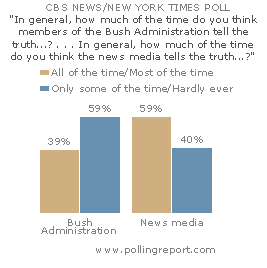
    It’s that 39% again

    How much do you have to lie before people think you’re just a big fat liar who lies and lies all the time?

    If you’re the President of the USA, quite a lot.

    I’ve never seen an administration like this one for the lying. It’s like their policy is to lie, and then when they get caught about it, lie about that. And yet, notice the left-hand side of the graphic. The trusty old 39% of the populace (the same 39% that approves of Bush’s performance) says, “Oh, yeah, he tells the truth most of the time.”

    If you like the guy, well, whatever. But to say he’s basically honest is, well, dishonest. Or ignorant. Take your pick.

    I mean really.

    When you spell-check your blog using Blogger’s spell-checker, the word ‘blog’ gets flagged because it’s not in the dictionary.

    Discuss.

    Ignorance is louder than reason.

    I’ve been reading about something called the availability heuristic. Sometimes events seem more likely or more common than they really are because they’re easier to recall. See here for a fun demo.

    Now we’ve all been seeing pictures of angry Muslims in the news lately, torching embassies and what not. It would be easy to conclude that a vast percentage of Muslims are the batshit crazy kind.

    I’ve seen pictures of batshit crazy Christians too. They’re the ones holding the “God Hates Fags” signs. Or shooting doctors and so on. Hell, I’ve met some real loopers, back in the Utah days. Yet because I have been a Christian, I know a lot more Christians that aren’t the crazy kind. For that reason, I’d say that the crazy kind represent… I’m guessing… maybe 5% or less of all Christians. Generously. A small minority.

    Can anyone who knows more about this than I do tell me what percentage of Muslims are the crazy kind? Just a guess? Go ahead and put your guess in comments, and (as per the name of the blog) tell what your Good Reason is for thinking so. I have a feeling that the availability heuristic is making it look bigger than it is. I hope I’m right.

    I tell you what though: if I were a moderate Muslim, I’d be screaming right now. The loonies are grabbing all the attention, and the moderates are getting tarred with the same brush. Whenever I do hear moderate Muslims speak out on the issue (which isn’t very often), they speak in measured tones, a voice of reason. But loud loonies are louder than measured moderates. That’s the way it always goes.

    The origins of morality

    A friend mentioned the “Mirror Hypothesis” to me yesterday, in a context I hadn’t considered.

    The Mirror Hypothesis is an explanation of how human language (among other things) may have originated. The hypothesis arose from an observation: If you show a primate (even a human one) a video of someone else grasping something, it activates neurons in the viewer’s brain related to grasping. You’re not grasping, but the brain scan will show activity in your grasping centres, if that’s even a term.

    Dr Michael Arbib is a leading proponent of the view that the capacity for language grew from this tendency; first, that primates could grasp, then they could understand that someone else was grasping, then to pantomime, and on and on to language. He’s here at UWA from time to time, so it’s interesting to talk to him about it.

    Anyway, my friend pointed out this article from TPM Cafe which suggests that the Mirror Hypothesis is a good explanation for how morality arose in human life. We have the ability to feel what other people are feeling, almost like it’s happening to us. (Unfortunately, we have to turn it off sometimes as a defense mechanism. Evolution has not yet equipped us for the nightly news.) This ability has given us the capacity for empathy and altruism. This has probably conferred some selectional advantages on humans because helping each other helps more people to survive, which leads to a diverse and healthy gene pool.

    I haven’t had anyone try and tell me that morality comes from God yet, but if they do, I’ll suggest there’s a simpler explanation.

    Since the USA usually cares so much about, you know, what Muslim folks think and all.

    In a move that cost them nothing, the US State Department blasted the real cause of tension between the West and Islam: cartoons!

    “We all fully recognize and respect freedom of the press and expression but it must be coupled with press responsibility,” [spokesman Justin] Higgins told AFP.

    And ‘press responsibility’ means the responsibility to print what we tell ’em!

    No wonder the US came out on this one. They can’t stand it when the media won’t follow message discipline. Whip them into shape!

    Older posts Newer posts

    © 2026 Good Reason

    Theme by Anders NorenUp ↑