Good Reason

It's okay to be wrong. It's not okay to stay wrong.

Category: post (page 109 of 125)

Friday Random Five: A smidgen of class

Pink Panther Theme by Henry Mancini Album: The Collection
Where’d this one come from? My parents’ collection? Oh, yeah, it did. I remember it on the old Maganvox, way back when. It could have been worse. The Refresh button could have picked ‘Baby Elephant Walk’, and then where would we be? So, the Pink Panther it is. Try not to let it make you think of the damn cartoons for just a minute, will ya? Use beginner mind.

That familiar saxophone/flute line suggests feline grace, but there are also some hot drum moves and outrageous horn stings. The way the strings hover over the middle saxophone solo just oozes sophistication.

I think this ranks as Mancini’s finest composition, with the possible exception of Moon River and the theme from ‘Newhart’. The 80’s one, not the 70’s one. Although that was pretty sassy too.

Cul De Sac by Lush Album: Topolino
Check it out; now even Lush has gotten into a jazzy mood. Must be that Pink Panther influence.

I didn’t understand Lush at first. Sure, I bought Gala and Spooky, and I thought ‘nice ethereal vocals’ like everyone else did. But then I saw them live, and there was Miki with the bright red hair, and I thought, ‘Hello, what’s this’?. Then they tore the place apart with ‘Deluxe’, and I reached enlightenment. I still remember standing right in front of Phil on bass, with his incredibly interesting shoes — at least they must have been. The shoes that named a genre.

This track was written by said bass player Phil, and it shows. It’s got a walking bass line, but also vibraphones and sax. I dedicate it to Mancini, who would have been proud.

The Polonaise by Frédéric Chopin Album: Shine (Soundtrack)
A snippet from the ‘Shine’ soundtrack. Chopin was a legend. He died at my age. They all died early. Do you ever wish you could give some of your life to these composers? Because you’re not really doing anything with it, and they could use some extra time. I’d personally give a month out of my life so Mozart could finish his Requiem, even though everyone likes it fine just as it is.

Better to listen to the full version of this song; this version is so short that it’s time to move on to…

Like Dust (Extended) by Passion Puppets Album: Like Dust (Single)
You want to talk 80s. Here’s a band you probably missed. Their debut effort was Beyond the Pale, and the track that got all the airplay on college stations was ‘Like Dust’. The opening bars have a guitar rhythm that sounds like a gallop, and makes the song faintly western. The whole album was a really fine effort, so passionate and heartfelt, and it’s too bad they only ever had the one album. If you see it in some old record store and you still sort of like Modern English or The Icicle Works, give it a spin.

Carol Masters by Alphaville Album: Afternoons in Utopia
Okay, now it’s going to seem like I only have a few albums and they keep repeating. I do have more than just the eight CDs. And yet I’m not complaining that this one’s come up. Again we see Alphaville in a rather complex song with science fantasy overtones. A gorgeous line: “We shall meet tomorrow night, and I’ll kiss you just as tenderly as Cygnus kissed the deserts.” Is it mythology? Or just magical?

Genetic algorithms and the Traveling Salesman Problem

Cool Little Toy of the Day: An applet that solves the Traveling Salesman Problem.

The TSP is a classic in AI. You’re a salesman that has to find the shortest path to visit each city in an area. (Apparently you’re allowed to cut across fields in this implementation.)

This approach uses a genetic algorithm, where ‘agents’ try finding a path, and the most successful agents spawn ‘children’ that do the same job but just a little different from the parent.

Give them 300 cities and watch as generation after generation struggles to optimise!

Genetic algorithms are a great model of evolution in action. When I programmed an evolutionary system for a dialogue agent, the most interesting part was evolutionary convergence: how the successful organisms in a population converged on an optimal answer, and thus resembled each other.

Compare it to this description:

There is a certain species of aquatic snail that has to put up with a parasite that bores into its shell and can kill it. So should the snail grow a thicker shell, to reduce the risk of being parasitised? Not necessarily, because being heavier means it’s more difficult to escape predators. So should the snail grow a thinner shell? Maybe, but that means it’s more exposed to the risk of being smashed against a rock and killed by a wave. So a thicker shell is in order? Well yes, unless this reduces its fertility by diverting calcium from its reproductive organs. If we sat down and tried to work out the optimum shell thickness, we would find it nightmarishly difficult. However, natural selection just does it all automatically: a snail with a shell of thickness X will be exposed to certain dangers during its lifetime, and will run a certain risk of dying. No matter how complicated the risks, there will likely be a single optimum shell thickness, and natural selection will home the snail in on this.

That’s it. Just pump out a population of individuals and let natural selection converge. Perhaps a tad wasteful, but very effective.

There are implications for belief systems as well. Many religions were created in the fertile 1800s, and most of them have broken up. Those that have survived are the ones that have made all the right moves. And successful religions resemble each other; that’s why all religions say things like ‘Be good to people’ and ‘Don’t kill or steal.’ These belief systems, by appearing in a population and being modified gradually, have converged upon a moral system that is more or less optimal for humans in a world such as ours. They represent thousands of years of human experience. If there’s a reason to respect religious beliefs, this is it.

This genetic algorithm thing can really change the way you see your life and other people. We’re all evolutionary agents in the world. How are you doing?

Latin is the new Klingon

I think it’s a little odd that Finland is publishing news bulletins in Latin on its EU presidency website. Finnish isn’t even an Indo-European language, like Latin is — it’s Uralic (or Finno-Ugrian, if you’d prefer).

Whose idea was this?

Classicists can catch up with the news in Latin every Wednesday thanks to two energetic Finnish Latin academics.

Tuomo Pekkanen and Reijo Pitkaranta already have a cult following among Finnish classicists who tune in every Sunday night to Nuntii Latini, a five-minute Latin news bulletin broadcast on YLE, Finland’s public broadcaster.

Pitkaranta said: “Latin is not dead: it is still very much in use in different forms across the world today. Italians, French and Spaniards all speak a new form of Latin. I hope that EU documents are soon translated into Latin which is such a clear language.”

He’s right — you wouldn’t really say that Latin is ‘dead’. Modern English is just as much English as Old English was in its day. Latin just gradually morphed into unrecognisability.

But why translate EU documents into Latin? Perfectly good languages that people currently speak already exist. Clarity? I don’t speak Latin, so it’s not clear to me. Or does Pitkaranta mean that using Latin will help avoid ambiguity? You’d have a tough time making that case. No language can really claim not to be ambiguous, since all people have essentially the same cognitive wiring, and they’ll put up with roughly the same amount of ambiguity in their language before ‘evolving’ it.

No, this is a nerd factor thing. Some people just like Latin, as some people just like Elvish. And that’s okay.

Chessboard illusion

I’ve always enjoyed optical illusions. That and magic — maybe I secretly like being tricked.

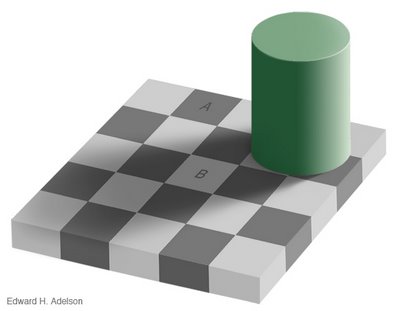
Here’s my favourite optical illusion at the moment.

You see before you a chessboard, with a cylinder casting a shadow upon it.

There is a square marked ‘A’ and a square marked ‘B’. Believe it or not, squares A and B are the exact same shade of grey. Don’t believe it? Fine, be that way. Proof is offered at the artist’s page, along with some other great illusions in Flash.

Don’t blame your brain for leading you astray. It’s doing a fine job. Our brains aren’t designed to show us things as they are. They’re pattern extractors. They combine the data we get into meaningful patterns that help us group those nearby random shapes into the image of an oncoming truck — thereby ensuring our survival.

In language, that means a child can extract the syntatcic patterns from grown-up speech and ingore all the ‘ums’ and ‘uhs’ that aren’t all that important. It also allowed you to read right through those two spelling mistakes I made in the last sentence. You knew what I meant.

Unfortunately, these little funny bits in our reasoning mean that it’s hard for us to learn things like statistics and logic — it’s not intuitive. We also get swayed by fallacies. Fortunately we can learn these things with a bit of effort.

Happy Birthday USA

I’d just like to wave a sparkler in the air for the dear old USA on this July 4th. They won’t let me in Australia because of fire danger. The whole place is a constant blaze.

I am still amazed that this experiment of democracy caught on and has lasted so long — long enough to trick people into thinking that stability is natural and that it will always be there.

America (and democracy) is built on the notion that most people, most of the time, will choose the right thing. We have yet to see if this is actually true; I see people making horrible choices a lot, I see photos of warfare and torture, I see people’s emotions manipulated by a fear-mongering president in the most un-American way possible. But I have also seen some good-heartedness in just about everybody, so maybe that’s enough to help people make the good choices when it matters. I hope that such a radical notion as faith in human goodness can last.

Happy Independence Day, America. Hate your prez; love you.

Right now

I was walking down the street with Oldest Boy on Saturday. I wanted to tell him about a book.

“I’m reading this book right now…” I started.

He looked at me, and said “No, you’re not.”

Pesty boy.

One well-deserved noogie later, I said, “Well, no, not right now. But about now.”

Temporal expressions have an interesting way of spreading out if we’re not careful. I grabbed some samples from the BNC, and found that ‘right now’ could mean a number of things including:

  • this precise moment in time
    • I want an answer, right now!
    • You have to decide, right now, do you want to go to the hospital or stay…
  • at this general time, including now, but perhaps a bit on either side of now
    • …right now large multi-national companies are clearing vast areas of that forest…
    • There’s a lot of organized suffering in England right now.” Petulancy is Morrissey’s forte:
  • and even narrated past (!)
    • The only thing he wanted right now was to go back to Jubilee Wood.
    • …but she was too shattered right now…
    • Tony and I shared the navigation seat, and right now I was in the back…

So there’s some slop if we need it. It sure makes a problem for computational linguists though. You have to have some idea of what’s intended if you want to pin down exactly when ‘right now’ is.

Time expressions have other interesting features. You can use them in place of other things like distance:

“How far it is to town?”
“About 10 minutes that-a-way.”

but not the converse:

“How long was that movie?”
“A mile.”

But I don’t think I’ll elaborate on that right now.

Hoo-boy! This time we’ve really found the Ark!

Even their own promotional site admits this schtick is getting old.

How many times have you yawned at the claim “Noah’s Ark Has Been Discovered”? Right, you say, and Elvis has been sighted again, too. People who hoped to find the famous vessel and the legendary voice have been pretty much in the same boat (so to speak)—No proof. Until today.

How many arks does this make now?

There are photos, too. It’s that black thing. Oh yeah, that’s gopher wood all right.

I’m sure they’ll be working on submitting their evidence for scientific review. Instead of, perhaps, focusing on doing talk shows.

Is there a conflict between science and religion?

I browse Polling Report from time to time. Opinions are fine, but seeing them in the aggregate can be especially revealing. Take this one:

“Do you feel like Christianity is under attack in the United States today?”
11/29-30/05

Yes No Unsure
% % %
59 37 4

Yep, a majority of Americans think Christianity is under attack. From? … a minority of the population. Martyrdom has always been a part of Christianity; nice to see they’re keeping it up.

Now here’s a serious one, same page:

“Which comes closer to your view about the relationship between science and religion? They generally agree with each other. They generally conflict with each other. OR, They are not related to each other in any meaningful way.”
9/8-11/05

Generally Agree Generally Conflict Not
Related
Unsure
% % % %
24 35 36 5

That first column is interesting. I think this response is a good-hearted one. It seems to come from religious people who nonetheless accept science, and don’t see anything contradictory about doing so. It’s a thread that runs through Mormonism as well, as in the phrase “All truth can be circumscribed into one great whole.” A liberal Mormon would probably say that we know some things about spirituality and we know some things about science, and when all truth is known, they’ll match. In the meantime, we should avoid drawing dogmatic conclusions about either one.

As a former liberal Mormon, I used to take this view myself (and I congratulated myself mightily on how broad-minded I was), until I realised just how badly religious views fail. I’ll pick on the Old Testament. It contains statements about the origin of the earth and history that are just plain counterfactual or, at best, unsupported by evidence. Creationism. Tower of Babel. Noah’s Ark. People living for 900 years. Every religion makes unsubstantiated claims about the origins of humankind or the afterlife. Good stories? Yep. Literal fact? Not according to the evidence we have.

The only way you could think science and religion generally agree if
a) you’re unaware of what religious views actually are, or
b) you somehow exclude “discredited religious notions” from the category of “religious notions” because they’re not what the religion “really believes”, or
c) you decide to work it out later.

The second and third options in the poll — science and religion are incompatible, or unrelated — are the only really honest and well-informed ones there. (Besides ‘unsure’, of course.)

You could take the third option and say that religion and science are talking about completely different areas and both could be equally valid and they don’t relate. It’s a tempting position. Try something like:
“Science deals with observable facts, religion is about unobservable (but nonetheless true) facts.”
Or “Science generates testable and falsifiable hypotheses, religion doesn’t.”

See? They’re just different. And isn’t it true that many scientists believe in God? There you go.

But wait a minute. Let’s remember a key scientific principle: Science tests hypotheses against observable data. If the data doesn’t square with the hypothesis, you reject the hypothesis.

How does this relate to religion? A belief system is a theory. If a belief system posits the existence of a god, we examine the claim with regard to the observable evidence. Is the god selective about who he appears to and how? Then it’s not observable. Got a supernatural theory about how the world came to be? Well, if we can explain the world using a natural theory, then that’s a better theory. Got ideas about what happens after death? That’s interesting, but if it’s not testable, it stays in the storybooks.

For this reason, I say that if a scientist believes in an unseen creator, then something has gone terribly wrong with their scientific training. They are accepting a theory without adequate evidence, and in fact despite loads of disconfirming evidence. Whether they grew up with it, or they defer to popular belief, or for whatever reason, they are giving religion a huge pass that it hasn’t earned.

Science is (and scientists should be) eternally opposed to the acceptance of any belief that is unsupported by evidence. Here’s an example from my work. Let’s say I have a theory about dialogue — perhaps that the words in an utterance are a sufficient indicator of the speaker’s intention in making that utterance. I can test my theory using samples of real dialogue. If my theory is correct, I should be able to classify the text accurately using only words as data. It turns out that this isn’t so. If I run this kind of a test, I get only so-so scores. There’s not enough evidence to support the belief.

Now what do I do? If I’m honest, I’ll have to accept that I need to change my belief, and find a theory that works better. That way I can get better results and maybe find something that works. But if I’m too attached to my theory — if it’s too painful to give it up, or too much work, or I’m worried about what people will think — I may ignore or even fudge the data and keep the false belief, evidence or no evidence. I may insist that my science is the true science and complain that the language tech community isn’t accepting my work because they’re too biased. I’ll have to get good at argumentation and marketing to get anyone to believe me. It’ll help if there’s a political element that believes basically the same thing I do. Then I can ingratiate myself with them and maybe score some funding.

If I do these things, I am showing that I value my belief above the truth. I am not doing science. And yet this is exactly what purveyors of religion do when

Why do people think that accepting some false ideas along with the well-supported ones is okay? This isn’t like having a snack once you’ve had your vegetables. Unwillingness to dump counterfactual or unsubstantiated theories is not good science. It’s par for the course in religion, though. They’re incompatible opposites.

Objective Ministries

I’m aware of Poe’s Law which says:

Without the use of a winking smiley or other blatant display of humor, it is impossible to make a parody of Creationism that someone won’t mistake for the real thing.

So will someone please tell me if Objective Ministries is a real creationist/Christian site or if it’s just a really straight-faced parody?

I go back and forth. I see no smileys, so I think it’s real. Then I run across this:

Fellowship Baptist Creation Science Fair 2001
2nd Place: “Women Were Designed For Homemaking”
Jonathan Goode (grade 7) applied findings from many fields of science to support his conclusion that God designed women for homemaking: physics shows that women have a lower center of gravity than men, making them more suited to carrying groceries and laundry baskets; biology shows that women were designed to carry un-born babies in their wombs and to feed born babies milk, making them the natural choice for child rearing; social sciences show that the wages for women workers are lower than for normal workers, meaning that they are unable to work as well and thus earn equal pay; and exegetics shows that God created Eve as a companion for Adam, not as a co-worker.

And I feel like I’m reading the Onion.

And this page on ‘Reclaiming Hallowe’en‘:

Just as the winter solstice – which was created by God, not demons – was reclaimed from the villanous grip of the Pagans in the name of our Lord Jesus Christ, we as Christians must reclaim Halloween. We must proclaim that Halloween is now Christ’s holiday. From now on it shall be used to witness to the wicked and ignorant. What was once used by Satan as a recruitment program, shall now be used against him. Satan’s tricks shall be turned into the Lord’s treats!

But people could be serious about this. They link to real sites (I think). That Roy Moore banner is just what you’d expect. If this is a fake, they’re not giving anything away. I’m stumped. What do you think?

Friday Random Five: Nifty tunes!

Tonight the ‘Refresh’ button brings you the swellest songs you’re likely to get.

Windy by The Association
Here’s a delightful little tune from the year I was born, and it’s still getting airplay on AM radios all over the country. Sing along! You know the words!

Here are some interesting facts about the name ‘Windy’.

  • It is apparently a real name that some people have.
  • ‘Windy’ was the 1473rd most common first name for women in the 1990 U.S. Census, not as popular as Clementine or Dorcas, but more popular than Bambi or Latrina
  • About 4 women in 100,000 are named Windy. This means that in the USA, there are about 11,829 women walking around with the name ‘Windy’.
  • An important stage in the psychological life of a ‘Windy’ is learning to be at peace with the song.
  • They also probably have to explain a lot that their name is not ‘Wendy’.
  • The name ‘Wendy’ is much more popular than ‘Windy’. It ranks at number 115, somewhere between Gladys and Ethel.
  • When I was six, my teenage sister brought home a friend named Wendy, and I annoyed her by constantly calling her ‘Windy’ after the song. “But everyone knows it’s Windy,” I explained.
  • She never came over again. I was a pesty kid.

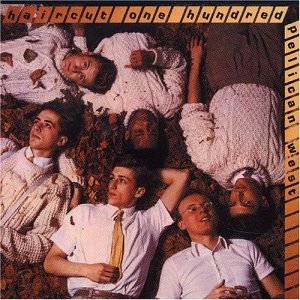
Kingsize (You’re My Little Steam Whistle) by Haircut 100 Album: Pelican West
Oh, no, you say. Not Haircut 100. And what an embarrassing title. But that’s because you’re not listening. If you were, you’d hear the sunniest, jazziest album of 1982. Don’t say anything bad about Nick Heyward, by the way, because he still has a lot of fans that monitor the Net and they may come to your house and bop you over the head with a wet plimsoll.

I will say, however that this is an album that you have to be in the mood for. Albums are like that when they’re really heavily marked by a certain musical style. Full marks for musicianship, though.

In Between Days by The Cure Album: The Head on the Door
Now we’re talking. The Cure was just coming out of a dark patch, what with Faith and Pornography, and they were getting on a happy track that would eventually lead them on to “Friday I’m in Love” and so on. I got into the Cure about the time this album came out, and though it’s not my favourite (that would be Seventeen Seconds), but lots of good songs, and this one causes my ears to perk up whenever I hear it in supermarkets, which I sometimes do.

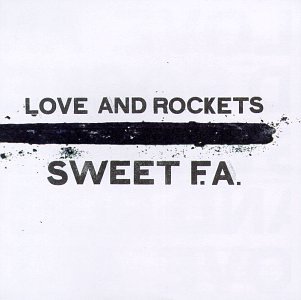
Fever by Love & Rockets Album: Sweet F.A.
Bringing it down a bit. The charred guitar on the cover belonged to Daniel Ash; it was ruined in the fire that destroyed producer Rick Rubin’s house. I wasn’t sure about this album at first because I wasn’t in a L&R mood when I got it. I wisely put it away until I could approach it with the right mindframe. And now I think it’s right up there with their best. The dance thing cuts through the hippy thing, and there’s lots of drug things going on, which is probably how the fire started.

Song’s got a good groove. All the Bauhaus guys have been behind a lot of great music.

(Dawning of a) New Era by The Specials Album: The Specials
This is absolutely the coolest album that I know of. You can always pull this out and it always works. Forget what I said about albums being marked. This one’s as ska as they come, but it pulls you along even if you’re not in the mood. I don’t think I even know what this song’s about. I’m singing the chorus anyway.

Older posts Newer posts

© 2026 Good Reason

Theme by Anders NorenUp ↑