Good Reason

It's okay to be wrong. It's not okay to stay wrong.

Month: September 2011 (page 3 of 3)

Prayer

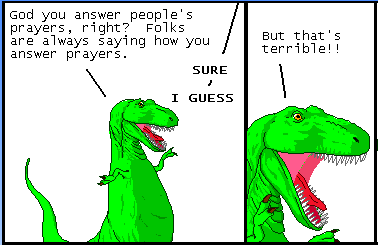
Sandra points me to this episode of Dinosaur Comics.

Click on the image to go to the whole cartoon.

It reminds me of something George Carlin said about prayer:

If you insist on praying, what you need is a Magical Wishing Ferret. You can ask him for anything you want. He works by the power of confirmation bias, so if you don’t get what you want, you’ll never notice.

Monson fondly remembers 9/11

Religions are in the business of providing emotional comfort (among other things), and after 11/9/1, Americans’ sense of stability was rocked. I think this played out in a predictable way for Mormons.

I visited my US home ward in late 2001, and it was the strangest thing: I’d never heard so many references to Satan before. Naturally, when people feel like events are out of their hands (what’s known as an ‘external locus of control’), they develop superstitions, and here it was unseen malevolent agents. I saw something else on that visit that I’d never seen before: In Priesthood Meeting, they’d developed the habit of reciting their ‘group values’ in unison, chanting a sort of ‘we believe’ mantra. Even as a believer, it struck me that here was a group of people too frightened to think.

From a look at this WaPo column, Mormon president Thomas Monson sure misses that time.

There was, as many have noted, a remarkable surge of faith following the tragedy. People across the United States rediscovered the need for God and turned to Him for solace and understanding. Comfortable times were shattered. We felt the great unsteadiness of life and reached for the great steadiness of our Father in Heaven. And, as ever, we found it. Americans of all faiths came together in a remarkable way.

And the bottom line couldn’t have been better.

Side note: what’s with the capital H on ‘Him’? I haven’t seen that in Church publications since the 1920s.

Sadly, it seems that much of that renewal of faith has waned in the years that have followed. Healing has come with time, but so has indifference.

Isn’t it too bad that we don’t have more horrible tragedies to turn our hearts to god? Darned if Monson doesn’t feel some nostalgia for that time of national agony. What a ghoul.

Whether it is the best of times or the worst, He is with us. He has promised us that this will never change.

But we are less faithful than He is. By nature we are vain, frail, and foolish. We sometimes neglect God.

Then we’re even, because God was more than a little neglectful on that day. He failed to save the lives of 3,000 people, but left instead a steel cross. You know, just to let us know he’s there, thinking about us.

If you object to this, saying that ‘super-hero’ isn’t part of god’s job description, consider: What would you have done if you’d had the knowledge of what was about to happen that day, and the ability to do anything? Well, god had all that, and still failed to do what you — a normal human, with all your goods and bads — would have done. Why do people say that god is good?

Mormons talk interminably about what they call the ‘pride cycle’: People get prosperous and prideful, they forget god, then god (that sicko) burns them up in fires, buries their cities in earthquakes, or sinks them into the sea (and that was gentle Jesus, BTW). Then the people remember to grovel sufficiently before him, and he prospers them. Because it’s all about him.

One could rewrite the narrative thus: Tragedies happen, and the feeling of vulnerability drives people into authoritarian religions. But life goes on, and people stop feeling frightened, at which point they abandon superstition, becoming secular or at least joining liberal churches. Until the next tragedy. Rinse, repeat.

Small wonder, then, that Monson is banging the drum for a more godly society. The vacuum cleaner salesman wants everyone to buy vacuum cleaners, and the god salesman… you get the picture. It’s just business.
Reasonably Good Performances

The Mormons had Gordon Jump and Mike Farrell doing their films in the 70s and 80s (remember Gordon as the Apostle Peter? probably not), but the Seventh-Day Adventists had a young Russell Crowe plugging their ministry programme at Avondale College in New South Wales.

I have to say, young Russell brings a certain believability to the role, with his grudging yet growing acceptance of ‘the call’.

Two by two

Wow — I didn’t know you could get these.

What’s that Elder on the left doing? Ah, he’s expounding.

I think the other one is dusting off his feet. Watch out — that’s like a level 3 Harm spell when they do that. I think you can only recover from that if you’re a Mage.

Denser is slower

A linguistic tidbit from the ‘Obvious in Retrospect’ file:

A recent study of the speech information rate of seven languages concludes that there is considerable variation in the speed at which languages are spoken, but much less variation in how efficiently languages communicate the same information.

Dr. Pellegrino outlined the major findings of the team’s research: “Languages do need more or less time to tell the same story – for instance in our study, the texts spoken in English are much shorter than their Japanese counterparts. Despite those variations, there is a tendency to regulate the information rate, as shown by a strong negative correlation between the syllabic rate and the information density.” In other words, languages that are spoken faster (i.e., that have a higher syllabic rate) tend to pack less information into each individual syllable (i.e. have a lower information density).

In other other words, the more information packed into each syllable, the slower those syllables have to be delivered. Across languages, those two factors balance each other.

It makes sense because human brains have a cognitive limit, and they’ll only put up with so much throughput. Still, nice to see this result in black and white.

Without a trace

I recently learned of L’Anse aux Meadows. It’s a place in Newfoundland, Canada where Vikings settled about 1,000 years ago. It’s the oldest European settlement in the Americas. The Vikings didn’t live there very long — only about 10 years — and it seems that there weren’t that many of them. It’s only a small site — no stables, no burials.

Yet for that small a group in so short a time, they left enough artifacts to fill a small museum.

Long-time readers will see where I’m going with this. The Book of Mormon claims to be the history of a group of people who lived in the Americas for about a thousand years, numbering in the millions. The book discusses their metalwork, their swords, their coins, their money, and much more — no evidence of which occurs in the archaeological record. And they didn’t dwindle down slowly — they were supposedly killed off quickly in wars of extinction. You’d think that something would have survived, but no.

Maybe the Nephites and Lamanites just didn’t build stuff as well as the Vikings. Or else fictional people don’t leave archaeological traces.

Three Card Monte

Everybody knows not to play Three Card Monte, right? It’s an old scam that relies on a little sleight of hand and a lot of psychology.


It’s not just one operator, but a whole team, including confederates who make winning look easy, and blockers who separate you from your more sensible friends. And if you do manage to pick the Ace, a shill will bet more on the wrong card so the dealer will take their fake bet instead. There will even be some ‘muscle’ on hand to give you a few broken ribs if you make trouble.

It’s fascinating to watch, but it’s a dangerous game, and you always lose. Don’t play.

Does it matter what a candidate believes?

People are talking about this article by Bill Keller in the NYT about religion in politics.

Asking Candidates Tougher Questions About Faith

If a candidate for president said he believed that space aliens dwell among us, would that affect your willingness to vote for him? Personally, I might not disqualify him out of hand; one out of three Americans believe we have had Visitors and, hey, who knows? But I would certainly want to ask a few questions. Like, where does he get his information? Does he talk to the aliens? Do they have an economic plan?

Hal Boyd of the Deseret News gives a roundup of writers who are shocked — shocked! — at the impertinence of asking candidates about their religious beliefs. After all, isn’t that personal? Well, it could be, if the candidate makes it private. Colbert I. King thinks faith is no big deal, but he makes an exception for candidates who make a big deal out of it. Sounds fair, but it doesn’t go far enough for me.

I’d say that a candidate’s faith is fair game for a much more pragmatic reason. Let me start with evolution. If someone doesn’t accept evolution as true (as all but a few Republican candidates don’t), I won’t vote for them. That’s because this person is going to be making decisions on my behalf, and by rejecting evolution, they’re showing me that they don’t know how to tell if something’s true. They’re not good at making decisions based on evidence. And there’s a high probability that their thinking is compromised by undue influence from the religious sector. Those are all very worrying tendencies in a leader.

And that’s just evolution. I’d say the same goes for Mitt Romney’s underwear, Michele Bachmann’s superstition about a god controlling the weather, Rick Perry’s belief in ritual starving to attract the attention of his god, or anyone else’s beliefs in magical nonsense. Delusion is delusion.

Of course, even if someone is an atheist, they can still be a disappointing leader; check Australian PM Julia Gillard, an atheist who shows a bewildering opposition to gay marriage, and an unaccountable fondness for distributing federal dollars to Christian chaplains in high schools. Nor are religious beliefs the only ones to watch out for. There are also irrational and dangerous secular beliefs involving climate change denialism or free-market fundamentalism. For me, the key is: does this person know how to use science and evidence to find out what’s true? If not, keep them away from the levers of power. Ignorant people should be represented in government, but not by ignorant people.

Markov Everything!

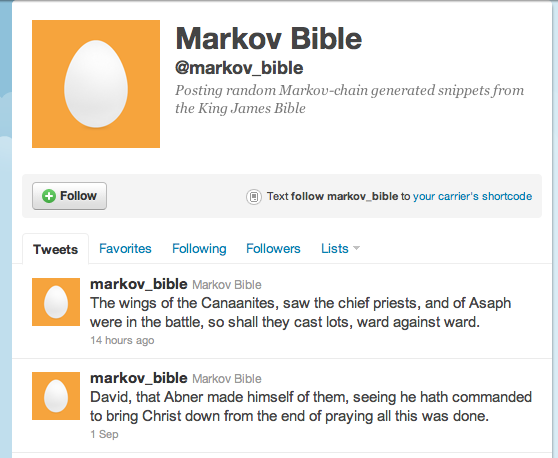
Someone on Twitter has created Markov Bible.

We’ve had fun with Markov chains on the blog before. They’re really quite simple: just take a big file full of text, and pick any two adjacent words at random (let’s say it’s ‘in the’). Then, find every occurrence of the words ‘in the’, and make a list of every word that occurs right after them. Pick one of those at random, and that’s word number 3. Now repeat with your word number 2 and 3 to get a word 4, and so on for as long as you want.

It’s fun to mess around with the Bible, but my favourite thing is to do mashups. Here’s the Bible combined with George Orwell’s 1984.

They say unto you, Ye shall worship at his saying, and nipped off to Canada like cattle. They could do nothing against the children of the same: but the one end of three years old when he would have cast upon a pole, and it was too late–no such thought occurred to me, and on the north corner, he made windows of agates, and thy master’s son? And Ziba said unto Onan, Go in this book.

That last part is funnier if you know who Onan is.

And here’s some of Alice’s Adventures in Wonderland, mixed in with Franz Kafka’s The Penal Colony.

CHAPTER XI Who Stole the Tarts? The King laid his head and, feeling behind him with his face to the Bed. First, I’ll describe the apparatus to you.” The Traveller acted as if a dish or kettle had been asked to attend the execution of a bottle. They all came different!’ the Mock Turtle replied; ‘and then the execution is a very grave voice, ‘until all the players, except the King, who had been sleeping on duty. For his task is to give the prizes?’ quite a chorus of ‘There goes Bill!’ then the other, and making quite a long time together.’ ‘Which is just the case might be, if he had neglected to look down and appeared peaceful. The Soldier showed the Traveller and laid his head sadly. ‘Do I look like one, but it is.’

The longer the sentence, the less likely it is to be coherent, since Markov chaining doesn’t preserve the long-range structure of a sentence. But still, it’s surprising when it works.

Would it be a bad thing to live forever?

‎”Blindly we dream of overcoming death through immortality, when all the time immortality is the most horrific of possible fates.” -Jean Baudrillard

One of the worst things about my deconversion was realising that there probably wasn’t going to be an afterlife. I’d been counting on that all my life, and as a result, I had to do some serious rethinking on my timescale. A universe without me? I’m not an eternal being? My religion had flattered me, made me feel so important, and appealed to my sense of vanity. I hated thinking that I probably wasn’t going to live forever.

I was surprised, then, to find that some people aren’t concerned about it, and don’t particularly want to live forever.

In the Hitchhiker’s Guide to the Galaxy series, one character is immortal, and it’s a curse.

To begin with it was fun; he had a ball, living dangerously, taking risks, cleaning up on high-yield long-term investments, and just generally outliving the hell out of everybody.

In the end, it was the Sunday afternoons he couldn’t cope with, and that terrible listlessness that starts to set in at about 2:55, when you know you’ve taken all the baths you can usefully take that day, that however hard you stare at any given paragraph in the newspaper you will never actually read it, or use the revolutionary new pruning technique it describes, and that as you stare at the clock the hands will move relentlessly on to four o’clock, and you will enter the long dark teatime of the soul.

So things began to pall for him. The merry smiles he used to wear at other people’s funerals began to fade. He began to despise the Universe in general, and everybody in it in particular.

“I think I’ll take a nap,” he said, and then added, “What network areas are we going to be passing through in the next few hours?”

The computer beeped.

“Cosmovid, Thinkpix and Home Brain Box,” it said, and beeped. 

“Any movies I haven’t seen thirty thousand times already?” 

“No.” 

“Uh.” 

“There’s Angst in Space. You’ve only seen that thirty-three thousand five hundred and seventeen times.” 

“Wake me for the second reel.”

Immortality might be horrible. Really: how long can you enjoy the vitality of life? How many more times can you listen to Vivaldi’s ‘Four Seasons’? How many times can you watch your favourite movie? Eventually you’ll have found all the things that do it for you. And habituation’s a bitch. What if I became so accustomed to the sunset, or the touch of my sweetheart through repeated exposure that I could no longer enjoy it? I’d be dead then, but still walking around.

Okay, so I can see that eternity would be a long long time, but I don’t envision a check-out date. There’s too much to learn! There’s enough for fifty lifetimes. I’m doing linguistics now. I think in the next lifetime, I’ll do maths and get really good at that. Then what? A lifetime of typography! What kind of computers will people invent? What will English be like in 500 years? And so on. Seventy years seems so short.

Even so, it’s probably a good thing that people die. Max Planck has been paraphrased to say “Science advances one funeral at a time.” And Steve Jobs has his take on it:

 
Transcript for people who don’t like watching videos.

No one wants to die. Even people who want to go to heaven don’t want to die to get there. And yet death is the destination we all share. No one has ever escaped it. And that is as it should be, because Death is very likely the single best invention of Life. It is Life’s change agent. It clears out the old to make way for the new. Right now the new is you, but someday not too long from now, you will gradually become the old and be cleared away. Sorry to be so dramatic, but it is quite true.

It’s true, but that doesn’t mean I have to like it.

So what do I do about it? Steve continues.

Your time is limited, so don’t waste it living someone else’s life. Don’t be trapped by dogma — which is living with the results of other people’s thinking. Don’t let the noise of others’ opinions drown out your own inner voice. And most important, have the courage to follow your heart and intuition. They somehow already know what you truly want to become. Everything else is secondary.

Have you made peace with mortality? Or do you rage against the dying of the light? I haven’t decided which approach I like best. I guess at this stage I’m just glad to have escaped the liars who make big, empty promises about forever.

Newer posts

© 2026 Good Reason

Theme by Anders NorenUp ↑