Good Reason

It's okay to be wrong. It's not okay to stay wrong.

Month: January 2010 (page 1 of 2)

10^23: Homeopathy Overdose in Perth

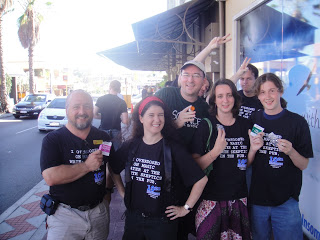
I’m happy to report that I survived the Homeopathy Overdose. Imagine, if you will, about twenty Perth Skeptics standing outside a chemist’s on Beaufort Street, snarfing down tiny white pillules. It was all to highlight the point that homeopathy is bunk, and unsupported by any scientific evidence. Other skeptic groups around the world held similar events.

Many of the Perth skeptics chose sleeping pills (and subsequently failed to fall asleep). But I went for the hard stuff. Arsenicum album is a homeopathic nostrum that is supposedly derived from arsenic. You’d think that if you ate a lot of them, you’d experience some form of arsenic poisoning, but I ate half a bottle of those horribly sweet crunchy things (Oldest Boy ate the other half), and we experienced no ill effects at all. Actually, I’m lucky I didn’t die — who knows what crap they use as filler.

But wait: there’s a reason that I didn’t die of arsenic poisoning. Homeopathics are deluded — sorry, diluted — so that no trace of the original stuff remains. The pills I took had a dilution of 30C. A dilution of 1C is a 1:100 ratio, so 30C would be 10^60 molecules of water — a one with sixty zeros. 10^60 molecules of water is a lot. It’s about 27 billion earth volumes. (Back of the envelope calculations here.) That’s how much you’d have to drink before being certain of getting one molecule of arsenicum album with a 30C dilution. And some dilutions go a lot higher than that. There is no chance any of the original stuff is still there.

Homeopaths admit this, but still claim that the water retains some ‘memory’ of the remedy. Baloney and hogwash. If the water ‘remembers’ the arsenic, then it should also remember the urinary tract of every person it’s passed through, as well as all the effluent carried through it over the years.

Why do people believe this stuff? Probably because homeopaths, with no need to do real research, can spend all their time making up far-fetched explanations for their silly bullshit.

The 2010 Overdose was great fun, and a good way to make the point that homeopathy is a scam. And I shall never forget the look on that motorist’s face as she passed us, gleefully chomping away.

Obligatory YouTube clip.

Hey, where’d he go?

Religious vultures in Haiti: Not helping.

As if the people of Haiti didn’t have it bad enough. After the earthquake, the residents now find themselves beset by a plague of opportunistic religionists, eager to tell Haitians that they themselves are the reason for their suffering.

These days, preachers are wandering through public squares, carrying Bibles and delivering sermons to the homeless residents of makeshift tents pieced together after the earthquake.

Mio Janvier is among the estimated one million who became homeless on Jan. 12.

The middle-aged woman spends her days sitting in front of her new home made of bedsheets, in the shadow of the smashed remnants of Haiti’s presidential palace.

She says she hasn’t been going to church; the preachers are coming to her.

And the messages she’s been hearing haven’t been all that stern.

“No,” she says. “They just tell us, ‘Jesus is coming back’.”

One of her tent-city neighbours disagrees.

He says that, yes, there have been plenty of preachers promising the imminent return of Jesus, but they’ve also had harsh words for their fellow Haitians.

He says the tent-dwellers are being told that the end is nigh, and that they’d better change their ways in time for Judgment Day.

Nickerson Gay says they’re being told they might wind up suffering the same calamitous fate periodically visited upon the infamous sinners of the Old Testament.

“They’ve been talking a lot about that,” said Nickerson Gay, a high-school teacher.

“They’re talking about Sodom and Gomorrah. They’re even talking about the floods in Noah’s time.”

“They’re saying God hit Haiti because there’s a lot of evil and sin going on in the country, which is why God hit us this way.

Absolutely infuriating, and completely in line with Christian doctrine. Richard Dawkins‘ has already blasted the hypocrisy of Christian doctrine with far more erudition than I could muster, but let me just say this.

If you take the Christian view, you must accept that your god caused or allowed the disaster to happen. And why wouldn’t he? It’s the same god that drowned everything on earth except Noah and his family, leveled Sodom and Gomorrah, and killed millions more because they were insufficiently faithful to him, or because he didn’t like what people were doing with their private bits. In which case, any Christian should recognise the hand of justice when they see it, and any thinking person should recognise a fishy story when they hear it.

Everyone tries to understand why bad things happen (in Haiti or anywhere else), and it’s human nature to accept a superstitious answer when things are out of your control. But it’s horribly ironic that people who have the least consistent explanation are having so much influence on an understandably jittery population. And they’ll keep loading these worried people into their churches, and pass the plate.

These people are still reeling from the tragedy that’s befallen them. Either help them to feel better, or leave them the fuck alone.

UPDATE: Just one more quote from the article.

Gracia Ganer Lemercier, also rendered homeless by the quake, is wandering in front of the shattered cathedral.

He’s active in his church and has had a decent career in the federal public service. Even though he now wears a scraggly beard and frayed clothing, he’s feeling grateful.

“The great Lord, who is the architect of the universe, I thank him for having saved my life – and for having saved the life of many of my brothers and sisters,” Lemercier says.

“I ask him to continue blessing us.”

But what is he hearing from religious leaders? Why would such a terrible string of tragedies befall Haiti?

“These are our sins,” he replies. “They are the sins of each Haitian on this Earth, which God has given us as our heritage.”

Tell me this doesn’t fit the profile of battered-spouse syndrome.

In lay terms, this is a reference to any person who, because of constant and severe domestic violence usually involving physical abuse by a partner, becomes depressed and unable to take any independent action that would allow him or her to escape the abuse. The condition explains why abused people often do not seek assistance from others, fight their abuser, or leave the abusive situation. Sufferers have low self-esteem, and often believe that the abuse is their fault. Such persons usually refuse to press criminal charges against their abuser, and refuse all offers of help, often becoming aggressive or abusive to others who attempt to offer assistance. Often sufferers will even seek out their very abuser for comfort shortly after an incident of abuse.

Teenagers getting by on 800 words a day?

I’m used to hearing people complain about the language of Them Dern Kids, but this rationale is a new one.

Here’s the claim:

800 words won’t get job done

LONDON: A generation of teenagers risks making itself unemployable because its members are using a vocabulary of only about 800 words a day, according to the British government’s first children’s communication tsar.

Communication tsar? Are they sure she’s not a czar?

I wonder what’s causing the supposed paucity of vocabulary? Could it be the Internet and mobile phones?

The teenagers are avoiding using a broad vocabulary and complex words in favour of the abbreviated “teenspeak” of text messages, social networking sites and internet chat rooms.

Thought so.

Jean Gross, the government’s adviser on childhood language development, is planning a national campaign to prevent children failing in the classroom and the workplace because they cannot express themselves.

“Teenagers are spending more time communicating through electronic media and text messaging, which is short and brief,” she said. “We need to help today’s teenagers understand the difference between their textspeak and the language they need to succeed — 800 words will not get you a job.

Gee, 800 words doesn’t sound like a lot. Or is it? How many words do most people say? Let’s check.

First, keep in mind that the 800 words claim is about daily vocabulary, not total vocabulary. That is, young people are using the same 800 words over and over again in a typical day. I’m not sure if that’s true, but let’s accept it for now. The question is: how many different words do adults employ in a day?

We’re going to use a dialogue corpus to find out. I’m pulling words from Verbmobil-2, a corpus of appointment scheduling dialogues. But we don’t know many words to use until we know how many words someone speaks in a day. This is a scary prospect, laden with assumptions.

I had a read through the corpus and found that I can read about 250 words out loud in a minute. Of course, in a dialogue you’d only be speaking about half the time unless you’re rude, or a lecturer. (Or, like me, both.) So let’s say I’d rip through 7,500 words in an hour. Most of us spend some time alone or watching TV, so I doubt we’d spend the equivalent of 4 full hours of every day talking. But let’s say 30,000 words as an upper boundary. (I admit this is highly speculative. Stay with me.)

Here I’ve listed the number of word types (different words) for various numbers of word tokens (each separate word we say) in the Verbmobil-2 corpus. If you think you’re more laconic or loquacious, you can adjust your expectations accordingly.

Word tokens Word types
10,000 words 814 types
20,000 words 1,080 types
30,000 words 1,342 types
40,000 words 1,510 types

So if you’re an adult on the lower end of the talking scale, you’re going to use about 800 different words, over and over. And even if you quadruple the number of words you say, that still won’t quite double the daily vocabulary. Keep in mind that 40,000 words represents hours and hours of transcripts. The fact is, 800 words is quite a lot. Even if teens only use the same 800 words over and over, that’s certainly not a sign that their vocab is sub-standard. That’s just the way word frequencies fall.

———————-
UPDATE: I’ve just discovered this article in USA Today about a study that saw people wearing tape recorders all day long.

Both sexes say about 16,000 words a day, a study in Science magazine says.

He and colleagues analyzed conversations recorded from 1998 to 2004 of 396 students in the USA and Mexico, 210 women and 186 men, ages 18-29. The study examined word count, not vocabulary or word use. Pennebaker says two-thirds of participants spoke 11,000 to 25,000 words a day; the average for both sexes was about 16,000.

So there it is. Sixteen thousand words of dialogue would probably be comprised of under 1,000 word types a day, not too far from 800.
———————-

Let’s take a look at another claim in the article.

Ms Gross said her concerns were supported by research by Tony McEnery, a professor of linguistics at Lancaster University, who found in a study that the top 20 words used by teenagers, including “yeah”, “no” and “but”, account for about one-third of the words used.

Twenty words is not a lot. Is it possible that it could account for a third of the total?

Fortunately, we have frequency statistics for many corpora. If we take a look at the top 1000 words from COLT, the Bergen Corpus of London Teenage Language, we can see that the top 20 words account for 35.6 percent, or about a third. (Some words are excluded from this count, but that just means that the real proportion will be a good deal smaller, which makes the teens seem even more erudite.)

Now we head over to this data from the BNC, or the British National Corpus, a large and wide-ranging collection of spoken and written language. Here, the top 20 words account for around 32 percent of the total, or… about a third.

I decided to run a counter over some works of literature. I tried George Orwell’s 1984. Nobody’s going to accuse Orwell of having a tiny vocabulary. But here the top 20 words account for only 33.7 percent of the total. And for Alice’s Adventures in Wonderland by Lewis Carroll, the top 20 words make up, again, 33.1 percent of the total. Somebody better tell Pseudonym Boys that they’ll never get jobs with that kind of vocabulary.

Gross’s claims sound impressive until you break them down. Most people don’t do this because it’s easier to just accept claims that you already believe. But it’s just another way to complain about young people in a way that’s socially acceptable. It’s a shame people try to enlist linguistic data to confirm their prejudices.
———————-
If you want to hear me say about the same thing on the radio, you can listen to last week’s RTRFM interview. For some reason, I was talking pretty fast. I bet I could have clocked 60,000 words per day at that rate.

I’m on about 5/6ths of the way through the stream. Watch out; it starts playing as soon as the page loads.
Religious logic: Baseball edition

When you ask for evidence, do you get it? Or do you get a lot of tap-dancing to explain why you shouldn’t need evidence?

If the latter, then this cartoon is for you.

But that’s only one ending. There are lots of others.

  • Thinking that he has a baseball gives him a sense of peace. Who are you to upset his equalibrium?
  • What if you think he doesn’t have a baseball, and you’re wrong? Eternal consequences, that’s what!
  • It’s not meant to be taken literally. It’s a metaphorical baseball.
  • He has an amazing perfect baseball, so perfect that it doesn’t manifest itself in this physical plane. But it’s real, all right. Also, it transcends science.
  • All your family thinks he has a baseball, and what will they think of you if you don’t believe in it?
  • I knows that he has a baseball. I don’t just believes it; I knows it. With every fiber of my beings.
  • He really does has a baseball, so give him ten percent of all your money.

Thanks to snowqueen.

Helping Haiti the secular way

Those who are still wondering how to help people in Haiti may want to check out some secular ways of alleviating the suffering. Here are two.

Médecins Sans Frontières (Australia|other countries) is secular, and is making a real difference in Haiti. The server is busy right now — I hope that’s because they’re getting hammered with donations.

The Richard Dawkins Foundation for Reason and Science has an effort going to send money to MSF and the International Red Cross. I love seeing this kind of thing happening from the RDFRS, and I hope they keep it up. As the man says:

The myth that it is only the religious who truly care is sustained largely by the fact that they tend to donate not as individuals, but through their churches. Non-believers, by contrast, give as individuals: we have no church through which to give collectively, no church to rack up statistics of competitive generosity. Non-Believers Giving Aid is not a church (that’s putting it mildly) but it does provide an easy conduit for the non-religious to help those in desperate need, whilst simultaneously giving the lie to the canard that you need God to be good.

Here’s a chance to show what non-believers can do, even without an invisible fairy to reward us after we die. All right, so appealing to a sense of competition isn’t the worthiest of motivators, but when it gets money to people who need it, who’s going to complain?

Phrase Detectives: Try it out

One of my research interests is getting Internet volunteers to contribute to linguistic resources. And here’s one such effort, courtesy of Massimo Poesio: it’s Phrase Detectives.

It’s sort of a fun game where you get points for figuring out how pronouns (and other things) refer back to other entities in a text. Of course, the benefit to linguists is that it all goes toward the creation of a 1.2-million-word anaphor resolution corpus. A very worthwhile project.

LDS lessons: now even less content

I suspect that if I were still a believing Mormon in church classes, I’d have to go insane just as a coping mechanism. The lesson manual they’re now using for Priesthood and Relief Society is ‘Gospel Principles‘, a manual originally intended for new converts. As I remember, the chapters were, shall we say, spartan. How are long-time members coping with this? Will they go mad from repetition? Then again, don’t underestimate the Mormon capacity for boredom absorption.

Now how would I have approached teaching this kind of a lesson as a Priesthood teacher? I might have thought, sure it’s a little sparse, but nothing we can’t fix by bringing in some interesting outside sources. But even there I’d have been stymied; you’re not supposed to use them. Let’s peek in at a fictional Relief Society teacher, and see what the Brethren have in mind for its flock.

A woman sat at her dining room table, buried in dozens of books and magazines. She looked discouraged. Her daughter asked if she could help.

The woman said she was preparing a Relief Society lesson. She told her daughter she didn’t know how she could possibly “boil down all the information” she had collected for the lesson. The process, the woman acknowledged, was both time consuming and frustrating.

The daughter looked surprised.

“Why,” she asked, “are you trying to boil down information? An inspired Church-writing committee has already done that for you.

[L]eaders and teachers in the Church do themselves and the people they serve a disservice when they turn to unofficial — not correlated — materials in the planning of lessons and activities.

Oh, dear. Seems people have been using the Internet to get information, and finding out things that the folks in Salt Lake don’t want you to know. Those who want to control minds need foremost to control information, and this is part of an attempt to do exactly that.

The tone of this article needs to be read to be believed, but the last paragraph is a good indicator.

The Church — through its inspired correlation program — has given us official sources of information to help us prepare lessons and plan activities. Instead of turning to unofficial books and Web sites, let’s use those sources.

Something I realised after teaching Sunday School for many years was that the whole process was essentially stagnant. It was frustrating: I believed in eternal progression, but it was not to be found in church meetings. When I was younger, I thought that eventually I could graduate to — what? moving mountains? At uni, I could delve more deeply into topics of interest and there was always more to study. But at church? Delving into early Mormon history was just asking for apostasy, and who cared enough to delve into the Old Testament? Eventually I realised that there was no higher level. The quest for spiritual knowledge had plateaued, as far as earth goes, and it seemed to me the fault of the religious system. There was just no ‘there’ there.

In hindsight, it makes sense that going over the same books over and over would leave one with that cyclical feeling. The religion couldn’t really offer any answers past ‘goddidit’, and that doesn’t take long to explain. This was a source of profound disappointment for me at the time, but now I’m glad to have escaped that useless hole that I kept digging myself into.

Please don’t let them quote me.

Let’s say I gave a very sensible talk about linguistics. And in this very sensible talk, I said that there was a possibility that the spelling of some English words might change as a result of the Internet. And just for fun, let’s say I’m David Crystal. (Oh, come on. Flatter me.)

Anyhow, here’s how the article would pan out once it hit the Sydney Morning Herald.

Internet spells death of English

Traditional spellings could be killed off by the internet within a few decades, a language expert has claimed.

Aaaaugh! Not the spellings!

The advent of blogs and chatrooms meant that for the first time in centuries printed words were widely distributed without having been edited or proofread, said David Crystal, of the University of Wales in Bangor.

As a result, writers could spell words differently and their versions could enter common usage and become accepted by children.

Aaaaugh! Not the children! Won’t someone please, et cetera!

But notice that writers put the most calamitous material at the top of the article. And then by the end of the article, they’ve backed off of all the scary claims, and the whole thing becomes almost sensible.

Professor Crystal told the conference of the International English Language Testing System the internet would not lead to a complete breakdown in spelling rules.

”All that will happen is that one set of conventions will replace another set of conventions,” he said.

But by then, it’s too late because everyone has already fled the house screaming, or are writing angry letters to editors about Kids These Days.

If this article had been about continental drift, the headline would have been ‘Doomed Continents to Collide’.

My advice: When it comes to news articles about language, don’t read headlines if you can help it. They’re written by amphetmine-addled caffeine junkies. Instead, start reading about halfway down.

Surely he could have thought of even one.

Older posts

© 2026 Good Reason

Theme by Anders NorenUp ↑