Good Reason

It's okay to be wrong. It's not okay to stay wrong.

Month: September 2011 (page 1 of 3)

JW apostates “mentally diseased”

No question, Jehovah’s Witnesses play hardball with their ex-members. Ostracism of unbelievers (even if they’re family members) is not just a common practice; it’s official.

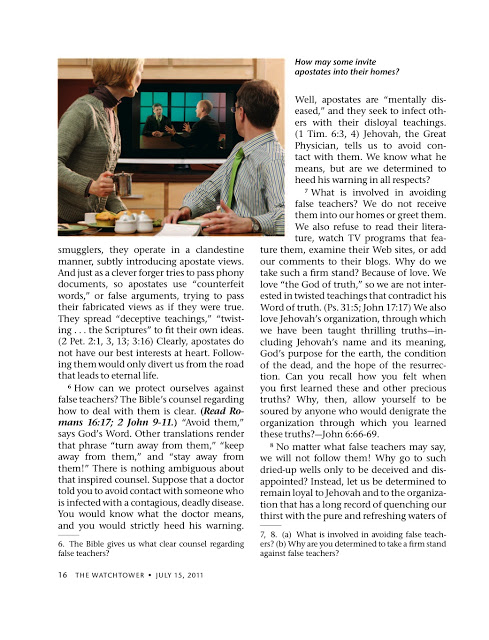
As if that weren’t enough, now there’s more. The July 2011 issue of the Watchtower (PDF) describes apostates as “mentally diseased”.

Suppose that a doctor told you to avoid contact with someone who is infected with a contagious, deadly disease. You would know what the doctor means, and you would strictly heed his warning. Well, apostates are “mentally diseased,” and they seek to infect others with their disloyal teachings. (1 Tim. 6:3, 4) Jehovah, the Great Physician, tells us to avoid contact with them. We know what he means, but are we determined to heed his warning in all respects?

Not everyone is happy with this assessment.

“Many like me remain associated with the Witnesses out of fear of being uncovered as an ‘apostate’ and ousted, not just from the organisation, but from their own friends and families,” said the man, who would only give the name John. “I find I am now branded as ‘mentally diseased’ – giving any who discover my true beliefs free licence to treat me with disdain.”

Yep, that shit’s hardcore. But what’s that little Bible verse tucked away in there? Could it be that the Witnesses are simply quoting the Bible, and that’s what describes people as “mentally diseased”?

Off to check 1 Timothy 6:3–4 (KJV).

6:3 If any man teach otherwise, and consent not to wholesome words, even the words of our Lord Jesus Christ, and to the doctrine which is according to godliness;

6:4 He is proud, knowing nothing, but doting about questions and strifes of words, whereof cometh envy, strife, railings, evil surmisings,

The key word here is “doting”, which now means “to be fond of”, but which in King James’ time meant “to be feeble-minded from age“, which is why we speak of an elderly person being “in their dotage”.

But of course, the Witnesses use their own New World Translation. What does it say?

3 If any man teaches other doctrine and does not assent to healthful words, those of our Lord Jesus Christ, nor to the teaching that accords with godly devotion, 4 he is puffed up [with pride], not understanding anything, but being mentally diseased over questionings and debates about words. From these things spring envy, strife, abusive speeches, wicked suspicions,

There it is. It still seems a bit harsh, but at least it’s not just the Witnesses being shitty to people — it’s the Bible being shitty to people. So now the question becomes: Is the JW translation of that verse a good one, or not? We’re going to have to take it to the Greek.

I don’t speak Greek, but fortunately people have made some good resources for Bible nerds. Here’s the relevant verse (PDF).

The key word is ‘νοσέω’ (here ‘νοσων’, or ‘noson’ in Roman letters). It only occurs once in the New Testament. So what’s it mean? Off to Strong’s.

1) to be sick
2) metaph. of any ailment of the mind
a) to be taken with such an interest in a thing as amounts to a disease, to have a morbid fondness for

Well, that’s kind of ambiguous. And herein lies the problem. If you wanted to go for the “mentally diseased” view, you’d certainly have a case. If, however, you wanted to soft-pedal it, you could try a more metaphorical translation like “unhealthily obsessed with questionings” or “morbidly interested in questionings”. Both readings are possible, depending on how much you like apostates, which if you’re Paul, isn’t much.

Still: Wasn’t Paul a shit? Imagine describing an ex-member of your church as someone with a mental illness. That’s just piling on. And even the “nice” version isn’t that nice. How accurate is that, describing someone who’s left the church as unhealthily obsessed with the church, or having a morbid interest in it, not able to stop talking about it, writing… erm.

Well.

It’s a relationship.

Occasionally I talk to people who identify as Christians, and they’re into God and Jesus and all that, but they somewhat paradoxically claim that they’re not “in a religion”. What’s with that?

Somehow, it doesn’t clear things up when I explain that God and Jesus are religious beliefs, so they’re in a religion, sure enough. No, they say, it’s a relationship.

Can you have a “relationship” with someone who isn’t a real person? Then I remembered objectophiles. Some people fall in love with objects, as did Erika Eiffel, who fell in love with (and married) the Eiffel Tower. Before that, she was in love with a crossbow. Other objectophiles have formed attachments to rollercoasters, videogame characters, and public buildings. Their attachment seems visceral and very real. You kind of have to stand in awe of the variability of human sexuality.

And yet, the object of affection is not a sentient being. The relationship is all in the lover’s head. And:

Interestingly, Objectum Sexuals – they call themselves OS people – believe their love with the objects are reciprocal and that they can telepathically communicate with them.

Sound familiar? Some women think they’re marrying public landmarks. Some think they’re marrying Jesus. Similar delusion.

An ex-missionary in the ‘Book of Mormon’

I always wondered if perhaps one of the cast members of the Broadway hit The Book of Mormon might be an ex-LDS-missionary in real life. And one is. Ain’t it funny how life works out? You must admit, it would give an actor a special kind of qualification for the part.

Enter me (from stage right): an ex-missionary, now ex-Mormon and a gay to boot (A triple threat?). But for me, being a Latter-Day Saint meant a lot more than donning a white shirt, dark pants, a tie, and a slick black name tag bearing the title of Elder—it was my life. My entire life.

He describes his mission experience as quite positive — good for him — but he loses me at the end.

But beyond being a preparatory experience, my mission and my time as a Mormon overall were very rich and special to me. I used to think that this was because of the system of beliefs themselves: that without the church I would feel sad, lost and broken. Since leaving the church I have realized that what was so beneficial and sacred about the religion in my life was not what I had faith in specifically, but rather the having of the faith.

As The Book of Mormon’s Elder Cunningham accidentally discovers, it doesn’t matter what people believe in if what they believe has the ability to unite them and inspire them to serve one another and love each other freely. Their beliefs can be silly—absurd, even—but that doesn’t matter. It’s the believing that counts.

This is, perhaps not coincidentally, the central conceit of The Book of Mormon; that belief in something, even if it’s entirely made-up, can still be good because of its power to create social unity. The problem here is that, while religion does a lot to build unity within the group, it builds walls and creates intractable conflict between people of different faiths. I bet anyone could think of about 4 or 5 examples without trying too hard.

There’s the epistemological side, too: Believing in something (which is likely to be wrong) is worse than believing in nothing. When you believe in nothing, you may at least be open to learning something. But when you believe in something wrong, you think you’re right, and it’s very difficult to shift. Bad information is worse than no information. Faith actually blocks understanding.

I still love the show. Well, I haven’t actually seen the show, so I’m basing this only on the soundtrack and things I’ve read. I’d like to return to this idea when I manage to get to the USA and actually see it, which I am currently planning to do.

Arabic not materialising on airplanes

Is there any language scarier than Arabic? (Unless you understand it, of course.) It doesn’t go in the right direction, and it looks so… foreign! No wonder it’s caused havoc before.

And when Arabic script unexpectedly appears on airplanes, well, it’s enough to make people involuntarily micturate.

Mysterious messages that appeared to be scrawled in Arabic writing on the underbellies of several Southwest Airlines jets were being investigated Wednesday by the airline and the FBI, Los Angeles radio station KNX-1070 reported.
The graffiti, which began appearing in February on 737-model planes, has been found more often in recent weeks, according to the report.
The writing appears to have been etched using a chemical process and is visible only after an auxiliary power unit is turned on.

So how do they know it’s Arabic? Gawker comes to the rescue with photos.

Where’s the Arabic? You mean those cross-looking things that look like someone wiped some dust off the plane? That’s the Arabic? Hey, wait — it looks kind of like a sword! Yeah! That’s Arabic, right? I think they have a sword on their flags.

Well, the markings are so not Arabic that even the Daily Mail has had to admit it.

The airline had suggested the symbols, which only show up with heat and are believed to be vandalism, looked like Arabic writing.

However the Department of Arabic and Islamic Studies at Georgetown University in Washington D.C. looked at the photos for MailOnline and a spokesman concluded they are ‘not Arabic script’.

It’s kind of sad: Muslims are now the most-feared group in society, just as Jews, Freemasons, and Catholics were in times past. As such, nervous people project their fears onto them. Strange markings on airplanes? Concerns over immigration? Mosque down the road? Obviously all part of a takeover attempt by Muslims.

But now, hopefully now people who work in aviation can stop being worried about Arabic script, and worry about something else, like lesbians kissing.

The Dr Fox Effect

As a lecturer, I used to worry that students would figure out how little I knew. After a while, I realised that I didn’t have to know everything, and more importantly, I probably knew ‘enough’ to be capable at my level. Now I’m quite relaxed about knowing hardly anything, as long as I keep reading and discussing things with people who know more than I do.

But this clip terrified me all over again. It’s about the ‘Dr Fox Effect‘, and it describes how an engaging lecturer can give students the impression that they’ve learned something, even when the presentation was content-free. In this clip, professors think they’re getting a lecture on game theory from an expert, when they’re really listening to complete gibberish from an actor.

Now I wonder: In a lecture, do I give students something real and useful? Or are students happy with my lectures because I’m ‘entertaining’, while getting nothing of real value?

This is really a little bit scary.

h/t/ weird experiments

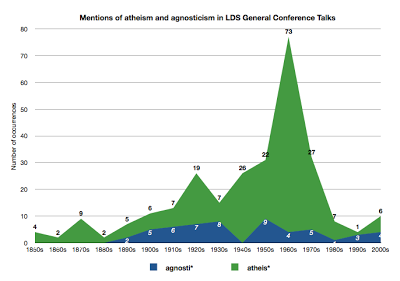
Atheism and agnosticism in LDS General Conference talks

Here’s a great tool that you can use to plow through General Conference talks.

I looked for references to words relating to atheism and agnosticism. I used the wild card, so my search terms were atheis* and agnosti*.

And here is the data, converted into a handy chart. (This chart is additive, so the data for atheis* is stacked on top of agnosti*.)

Click to enlarge.

Wow! Look at that spike in the 1960s! Most of this bump is due to talks by Ezra Taft Benson and Mark E. Petersen, who both liked to warn people against ‘godless communism’. Petersen even invoked what he thought was Lincoln’s prophetic warning against atheism:

Masquerading under the cloak of anthropology with great emphasis upon evolution, atheism is weakening the religious faith of the nation, and thus it also becomes an ally of the adversary. Is it any wonder that Lincoln, almost prophetically, looked into our future and foretold the perils that would confront us?

without realising that Lincoln was basically an atheist himself. Oops.

I suppose part of the 1960s bump could also be because more young Latter-day Saints were attending universities at that time, becoming acquainted with secular education, and horrifying their parents on visits home.

I don’t know why, but I’m rather surprised that Orson and Parley Pratt mentioned atheism, back in the 1850s.

As for recent times, notice the lull in a*ism from the 1980s onward. I guess atheism wasn’t on the radar until, say, The God Delusion came out. (All the mentions from the 2000s are post-2006.) That’s quite a drop-off. And it’s not coming up this decade. So far in the 2010s, nothing. (There’s one reference to ‘atheist’, in a footnote.)

So why the tail-off for a*ism in recent years? Here are some possibilities.

It’s not a concern. The numbers might have to climb a bit more before the alarm bells go off.

They dare not speak its name. Perhaps they’re keeping it positive and avoiding the mention of competitors by name. The term ‘catholi*’ has undergone a similar drop-off.

Give it time. The decade is young. If someone decides to make atheism the focus of a GC talk, it may include eight or nine mentions — a whole 80s worth in one go. Double that if it gets two speakers in the next decade, which seems likely.

I find this last scenario to be the most probable.

Advance Australia what?

I’ve read that Christians in Roman times were mistrusted for having allegiance to a king other than Caesar. And now it seems that modern Christians are doing little to dispel such suspicion.

Some private Christian schools are singing an alternative version of the national anthem which promotes religious values and talks of Christ.

Instead of the official second verse of Advance Australia Fair, which starts “Beneath our radiant Southern Cross”, the alternative verse says “With Christ our head and cornerstone, we’ll build our nation’s might”.

The version of the anthem is sung every fortnight at Thornlie Christian College and Christian Schools Australia WA executive officer Ray Dallin confirmed that it was regularly sung at other school assemblies and churches.

Original verses from 1879 in the National Library of Australia music collection do not include the Christian verse.

A spokeswoman from the office of Prime Minister Julia Gillard said that under national protocols, the anthem should not be modified and alternative words should not be used. The two authorised verses were proclaimed in 1984.

This story has been front-page news in Perth, but I’m actually having trouble getting worked up over it. For one thing, I’ve never been big on national fervour, anthems, or the like, so I don’t feel personally affronted that someone has altered it. It’s more annoying than sacrilegious. For another, this is happening in private religious schools, which is bad, but at least I’m not paying (as much) for it.

About the worst thing is that, just like in America, Christians are trying to re-write history, claiming that the original version was intended to be more Jesus-y. This kind of revisionism is SOP for that mob.

h/t to Calico in comments

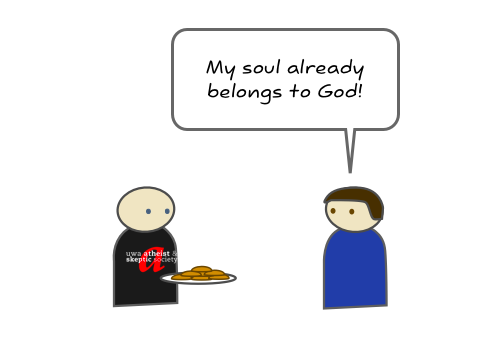
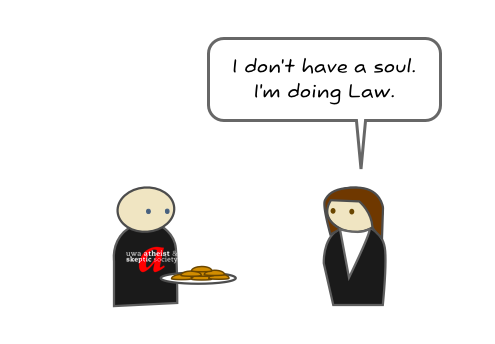
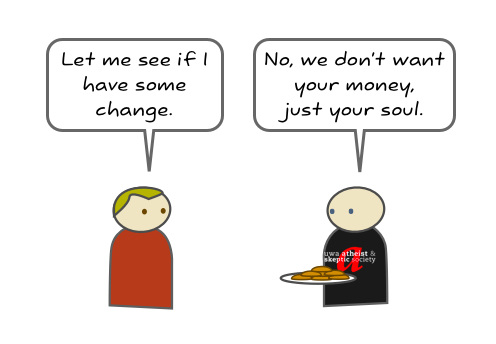
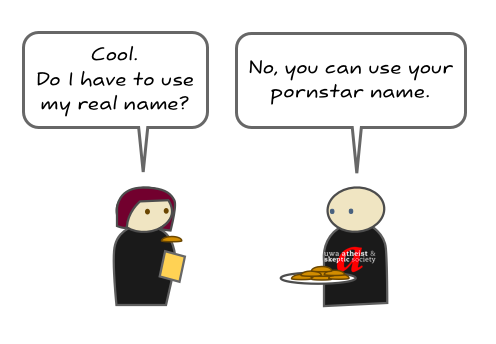
Atheist Bake Sale 2

If you like these cartoons, I have others.

Action Item: Support school secularism

There’s a primary school in Perth called Edgewater Primary. For 25 years, they forced students to say the “Lord’s Prayer” at school assemblies. Now, they’ve dropped it.

A WEST Australian government school has banned students from reciting the Lord’s Prayer before assembly in response to complaints from parents.

Edgewater Primary School, in Perth’s north, ended the 25-year practice after some parents said it contravened the WA Education Act, which stipulates schools cannot favour one religion over another.

“We acknowledge that of the parents who did respond to the survey, many wanted to retain the Lord’s Prayer and it is right that we continue to recite it at culturally appropriate times such as Christmas and Easter, as part of our educational program,” [Edgewater principal Julie Tombs] said in a statement.

“However, at this school we have students from a range of backgrounds and it is important to consider all views and not promote one set of religious beliefs and practices over another.”

Good on them. They made the right call.

But some people of faith are foaming about it.

A state primary school in Perth has been inundated with hate mail after deciding to drop the recital of the Lord’s Prayer at assemblies.

The Education Department says the Edgewater Primary School has received letters, emails and abusive phone calls from people around Australia, venting their anger at the decision.

The President of the Western Australian Primary Principals’ Association Stephen Breen says the complaints have been vengeful.

“We are getting comments like I’ll meet you in the grave, you know real loony stuff,’ he said.

“I don’t want to go on to it too much, but the receptionist is receiving phone calls and then people are slamming down the phone. It’s just gone over the top.”

I can understand that they’re not happy about losing their cultural hegemony, but as Australia and the world become more secular, it’s something they’re going to have to come to terms with.

In the meantime, I’ve written the school an email.

I just wanted to offer my support and tell you that I think your school made the right call. People can practice what religion they like, but it’s not fair for a public school to promote one religion over another. Keeping religion out of schools means that everyone’s religion is on an equal footing, and that’s good for everyone, religious or not. Good work.

If you’d like to convey your support, their email is Edgewater.PS@det.wa.edu.au.

Atheist Bake Sale 1

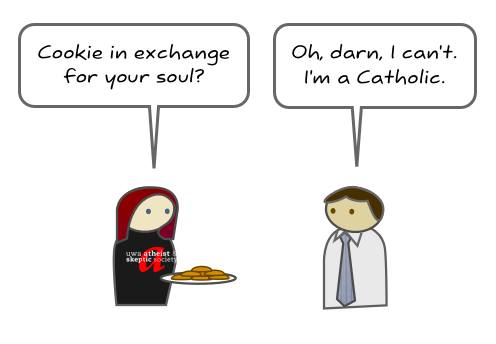
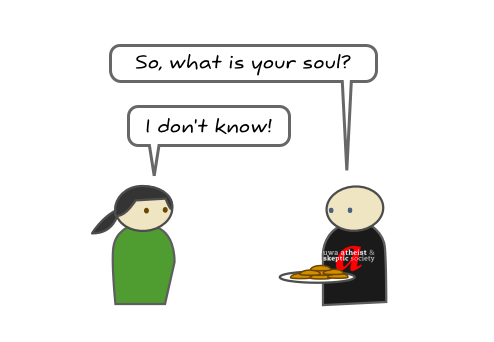
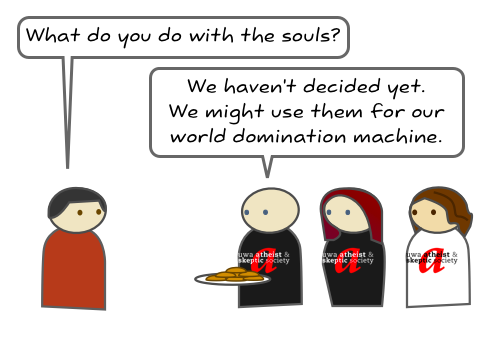
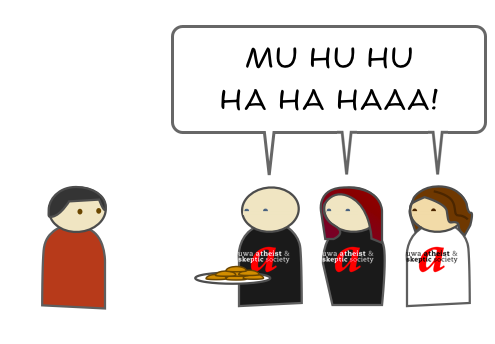
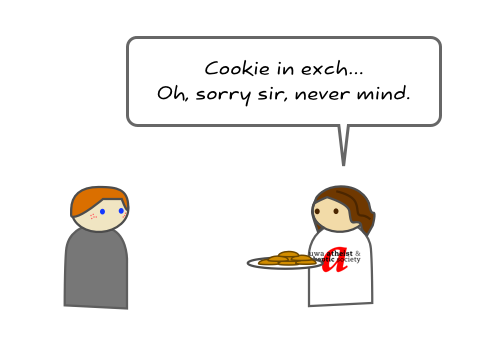
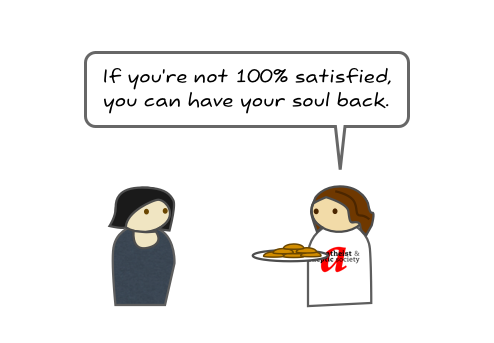
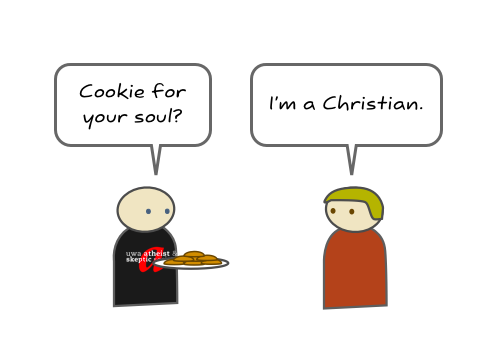
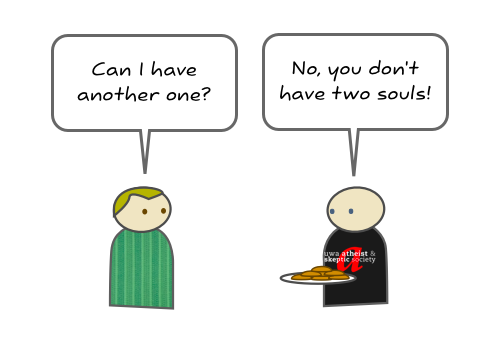
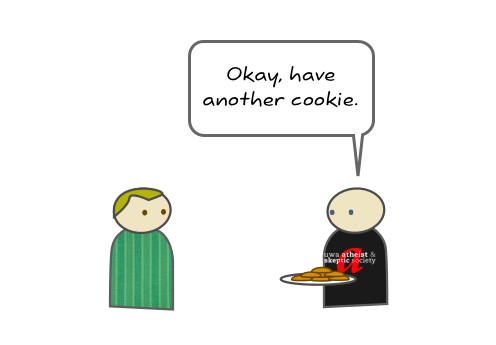
The UWA Atheist & Skeptic Society had a bake sale today. The cost of the baked goods: your soul.
We wanted to spark some discussion about souls; what it means to people, why we think we have one, and why people are so attached to the dubious notion that there’s a little ghost inside us making all our decisions. What I wasn’t prepared for was the reactions. Even though we were clearly ‘taking the piss’, many people showed a strange reticence. It looks like ‘selling your soul’ is a cultural taboo.
But we did give out lots of cookies.

Follow on to Atheist Bake Sale 2.

Older posts

© 2026 Good Reason

Theme by Anders NorenUp ↑